

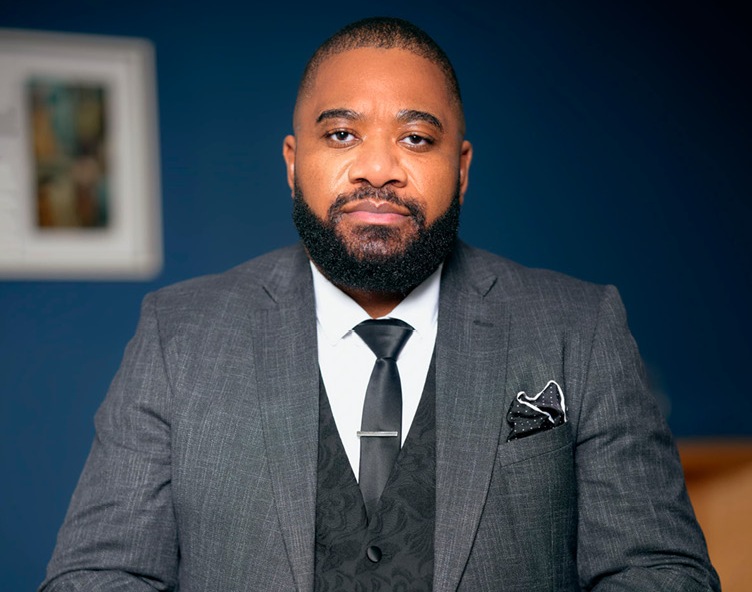
Dr. Nkhenso Sibuyi has turned his training as an optometrist into becoming a force for change in the world of libraries and AI at the University of Johannesburg
When Nkhenso Sibuyi set out to study for a degree in optometry, he had no idea that his vocation would see him evolve into a force for change in the world of AI by marrying the world of university research and support functions through his work in librarianship at the University of Johannesburg.
“Librarians overlap between the research and academic sides of the university, so we occupy a third space, partly because while academics do their work, there is also a huge support component. Librarians can’t be classed as completely supportive or completely academic – rather, they exist in that space. So we are working on ensuring that people understand the role of librarians and our passion for building the library of the future,” says Dr Sibuyi, whose attitude to AI integration is focused on human-AI collaboration, with a focus on the human always having the upper hand rather than replacing their skills with AI.
“We’re not a typical library. We’re doing something different and, after an intensive period of self-review, I am proud to confirm that we are ahead in terms of digital transformation. That comes from the culture of the university –we embrace technology and we embrace change.”
With his background as an optometrist, it’s no coincidence that equitable access to AI would become part of the library’s service offering.
“Through my passion as an optometrist, I’ve always been concerned about access to information for the blind and partially sighted,” adds Dr Sibuyi, who earned his MBA with a Digital Transformation Lens from the Johannesburg Business School, many years after graduating from the University of Limpopo with a BOptom. His passion for learning has also drawn him to undertake a PGDip in Higher Education for Academic Developers.
“We make sure that people with disabilities have specific software to use, and we ensure that they are able to access the resources that we have through alternative text, such as software that provides audio,” he adds.
On a macro level, the library has contributed to the academic growth of the University of Johannesburg through the creation of a research ecosystem. Their contribution stretches from data creation to the ethical use of that data.
“We support the integration of AI – ethical and responsible integration of AI – into research and learning, and we are very collaborative within the University. We don’t function just as a library, as we partner with our postgraduate school, as well as the research, development, and support teams.
“To make good financial decisions, it’s essential to have financial literacy, so in order to make good AI decisions, you need to have AI literacy. That’s one of the things that we also provide – AI literacy rather than advocacy. We make sure that people have AI literacy so that they can decide how to use it responsibly and know what to use and what not to use,” adds Dr Sibuyi, whose role as a father to a teenage daughter has offered him added motivation to understand–and shape–the future of AI.
“Once there’s a digital disruption, there’s no way back. Things will never return to normal. People who fight against it need to accept that it will happen with or without them, whether they like it or not. That’s why we advocate for responsible use and provide guidance in this day and age,” adds Dr Sibuyi.
The University focuses on enhanced discovery through the use of AI-powered search and recommendation tools that help users to navigate information, deliver efficient query language (QL), maintain transparency, and manage algorithmic data. He highlights that a major benefit of AI is its ability to personalise data based on search behaviour and generated recommendations. UJ also pilots’ different tools such as research assistants, writing assistants, data analysis, and training on the responsible use of AI. There is also a focus on capacity building through workshops for students and staff, as well as one-on-one consultations.
“We don’t just adopt the technology for its own sake; rather, every AI initiative is evaluated against our mandate. Is there a dip in learning? Does it accelerate rigorous research and advance the discipline? We ask ourselves those questions before we implement a pilot in AI.
“Our library is also one place where you can find students from different faculties all under one roof because of the spaces we provide. This encourages students from different disciplines to collaborate, and in that way, all the faculties can work together. That environment encourages collaboration between researchers and students,” adds Dr Sibuyi, whose department has a strong focus on reskilling, upskilling, mentorship, and creating a community of practice through peer-to-peer learning.
There is also a clear focus on transformation, underpinned by the understanding that a leading and ground-breaking education institution cannot rely on existing inequalities.
“We make sure that we advocate for institutional investment in connectivity through devices, accessible design, and ensuring that no student or researcher is left behind. To achieve this, my top three priorities for UJ’s library going forward are the skills of evolution, change management, and infrastructure equity,” says Dr Sibuyi, who initially joined the UJ library as a digital scholarship specialist to implement digital transformation.
“I identify as an informatician because this is like a human resource designer and is unlike traditional librarianship, which curates and provides access to knowledge, or information science, which focuses on retrieval and organisational information. Informatics is fundamentally concerned with how people, data, and technology interact in real-world contexts to improve outcomes.”
His background and training ensure that he can play his role in improving the library’s outcomes through the use of technology and digital transformation. This has been a significant enabler in implementing innovations throughout the library.
Instead of merely managing resources, Dr Sibuyi co-designed research systems to ensure that the library is not just a place to gather and read books, but rather a lab-like environment that contributes by creating and embedding information technologies, including AI.
“We are shifting from being fundamentally just a place that stores books to a platform of knowledge creation. This means that we embed digital scholarship and innovation services directly into research support, teaching, and learning, assisting researchers across their research cycle while offering various support systems, including open science practices.”
The library also places strong emphasis on curating African knowledge outputs to ensure that they are visible, citable, and globally impactful, helping to shape a distinctly African perspective.
“As much as global excellence is not about imitation, it is about contributing African scholarship to global conversations with confidence and vigour, and we also design digital literacy modules that respond to South African students’ realities and needs, for instance, the issue of digital divides. We ensure that everyone has access to these tools,” concludes Dr Sibuyi.
