

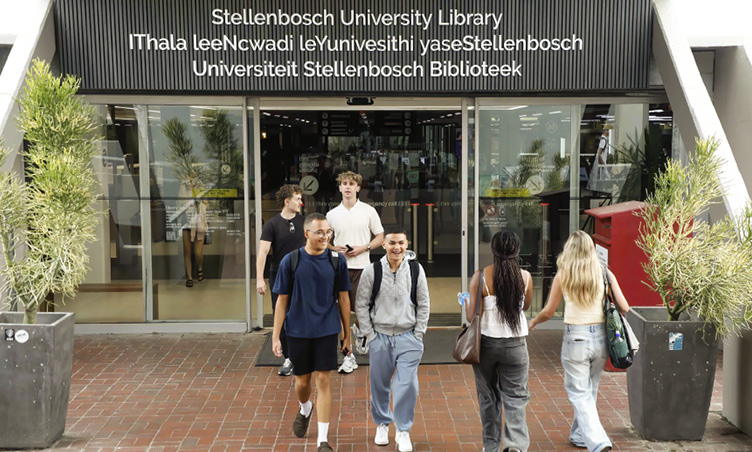
Stellenbosch University might be South Africa’s second-oldest institution of higher learning, but it is also leading the way when it comes to digital transformation of education and access to knowledge. Leadership sat down with Ellen Tise, Chief Director: Library and Information Services at Stellenbosch University to find out more.
Academic libraries are harnessing the power of digital transformation to position themselves at the intersection of scholarship and technology in order to cultivate inclusive learning environments and strengthen the research ecosystem.
“Libraries will increasingly function as platforms for knowledge creation, not just access,” says Tise.
“The focus and role of academic libraries will remain on deepening a digital-first approach, expanding leadership in open science and research support and developing inclusive, technology-enabled learning and innovation spaces further.”
How is the Stellenbosch library adapting to the changing expectations of digitally connected students, researchers and academics within an AI-driven and data-intensive research landscape?
User expectations have shifted toward immediacy, personalisation and seamless digital experiences, and Stellenbosch University’s Library & Information Service is responding by implementing AI-enabled discovery and research tools, offering digital literacy and AI literacy training, supporting data-intensive research workflows and providing virtual consultations and online services.
We are also embedding ourselves within users’ digital ecosystems, ensuring that library services are accessible within learning management systems and research platforms. Digital transformation is only meaningful if it broadens, rather than restricts, access to knowledge.
Academic libraries are evolving far beyond their traditional roles. How is Stellenbosch University transforming its Library & Information Services into a digitally enabled knowledge ecosystem that supports the future of higher education? At Stellenbosch University, the Library & Information Service has consciously evolved from a traditional repository into a digitally enabled knowledge ecosystem. This transformation integrates advanced digital infrastructure, curated digital content, research support services, and collaborative platforms.
The LIS had strategically invested heavily in staff development, technology, information and digital literacy, along with expanded access to scholarly resources to position the Library as a leader in digital scholarship, open access and research support. Milestones, of how the SULIS evolved far beyond its traditional role, included the development of world-class learning and research spaces, pioneering institutional repositories, early adoption of open access principles and sustained progress in digitisation and digital transformation.
We are embedding digital tools across the research lifecycle, from discovery and access to data management, publication and preservation. The Library now operates as a connector between people, data, technologies and global knowledge networks. This includes investment in digital collections, AI-assisted discovery tools, institutional repositories and research data services, all underpinned by a strong user-centred design philosophy.
Could you elaborate on the vision and purpose behind the University’s immersive and future-focused knowledge spaces, and how these are enhancing the student and researcher experience?
The Library’s technology direction is guided by targeted initiatives that leverage smart technologies to advance a digital-first service model and user experience. This approach is realised in physical library spaces by means of self-service solutions and innovation-driven environments, and the digital domain by means of deploying automated services and seamless client-facing systems.
Collectively, these initiatives are executed across the Library’s strategic objectives to ensure ongoing alignment with emerging technological developments in support of both clients and staff. Our physical spaces have been reimagined as immersive, technology-rich environments that support diverse modes of learning and research.
These include our Electronic Classrooms in the Stellenbosch University Library and Engineering & Forestry Library, Digital Commons in the Medicine & Health Sciences Library, Makerspace and Immersive Technology Lab in the SU Library.
Our Makerspace supports teaching, learning and research by providing access to advanced technologies such 3D Printing and Scanning support. In line with the library’s strategic objective of delivering responsive and transformative services across physical and digital environments, the Makerspace enables students and staff to engage with digital and immersive technologies in a supportive environment. It facilitates student creativity and research-oriented endeavours across all disciplines.
The Immersive Technology Lab at the SU Library is intended to extend the Library’s existing service catalogue of data visualisation services to meet the real-world requirements of SU’s student and staff communities to visualise data in virtual- and augmented-reality formats. The ITL is the first implementation of its kind at a South African university, and only the third technological implementation of this nature in South Africa across all industries.
With the ITL, the Library has taken a step closer to truly transforming user experience in interacting with data, whether big data or data specifically created for the purpose of enhancing students’ learning and training experiences through virtual-reality and meta-world formats. The ITL stands testimony to our commitment to furthering digital transformation as an institutional obligation, and to our intent to enhance students’ learning experience.
The vision is to create spaces that blend physical and digital experiences—where students and researchers can experiment, co-create knowledge, and engage with emerging technologies.
How does the Library contribute to advancing research excellence, innovation, and interdisciplinary collaboration across the University’s academic and research communities?
The Library contributes directly to research excellence by providing high-quality scholarly resources, bibliometric and research impact services and support for open science practices. It also actively enables interdisciplinary collaboration through research data management and curation services, digital scholarship support along with assistance in terms of digital humanities. In addition, it supports research analytics that inform institutional strategy and engages in partnerships with faculties and research units.
By positioning the Library as a research partner rather than a support unit, we help academics and postgraduate students innovate across disciplinary boundaries.
Open access, digital scholarships, and data-driven research are reshaping academia worldwide. How is the Library supporting these evolving research priorities?
One of the Library’s strategic objectives is to increase our leadership role in digital scholarship and research support at Stellenbosch University. The Library is thus at the forefront of these shifts by prioritising the visibility and accessibility of SU research output. This is achieved through managing and promoting open access publishing along with the University’s institutional repositories. It further supports research data management and FAIR data principles, enables digital scholarship initiatives (such as the digital humanities projects) and provides training in data literacy and research tools.
Our internationally quality-certified institutional data repository, SUNScholarData, is a critical open science platform, and we are also committed to helping researchers navigate an increasingly complex scholarly communication landscape.
As information ecosystems become increasingly digital, what are some of the key leadership challenges and opportunities involved in navigating this transformation within higher education?
In transforming its functions, the Library and Information Services have faced challenges in terms of rapid technological change and skills gaps, the need to balance innovation with sustainability, managing digital ethics, privacy and AI governance, along with ensuring equitable access to knowledge and information.
On the plus side, this has paved the way for us to redefine the Library’s strategic role in the institution, build new skill sets and professional identities and undertake institutional digital transformation initiatives. Effective leadership requires agility, collaboration and a clear long-term vision, and in a global knowledge economy, the Library’s digital capabilities directly influence the University’s reputation, rankings and ability to participate in international collaborations.
What broader impact do you hope the Library will have in shaping the future of knowledge-sharing, research innovation, and academic collaboration in South Africa and across the African continent?
The SU Library aims to play a transformative role beyond the institution by advancing open scholarship and equitable knowledge access across Africa, supporting capacity-building in digital and research skill, contributing to continental research collaboration networks and promoting African scholarship globally. Our vision is to help shape an inclusive, creative, digitally empowered and future-focussed knowledge ecosystem that strengthens higher education and research across the African continent.