

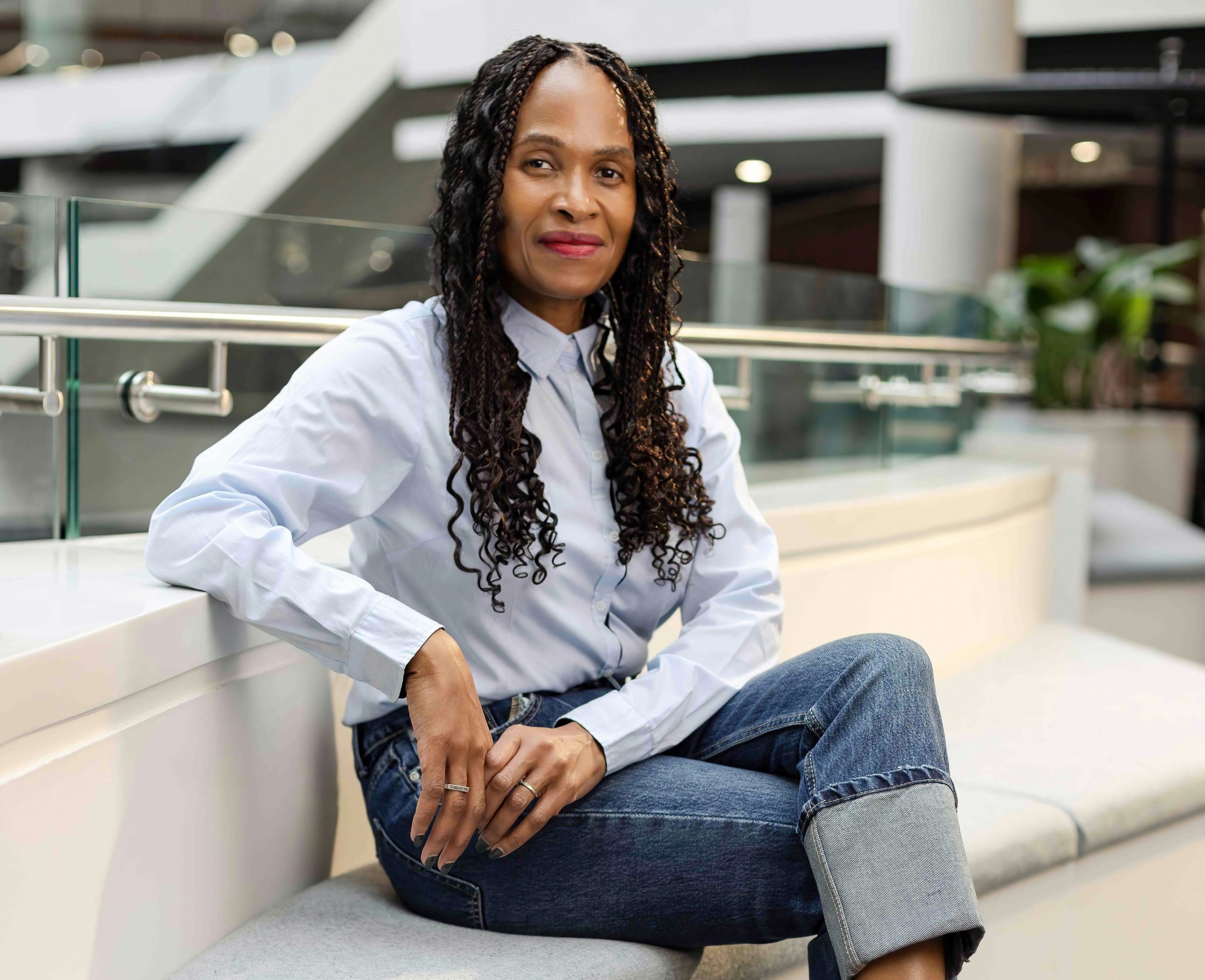
Discovery CSI Head, Andronica Mabuya, explains how integrated, measured partnerships can create lasting community impact, nationally
Andronica Mabuya says she has always been a social activist, committed to transforming socio-economic challenges into tangible results for emerging young leaders and communities. Mabuya joined Discovery in 2004, coming from one of the country’s biggest banks at the time, and worked her way through the ranks of leadership. In 2024, she was appointed Discovery’s CSI Head.
“I’m passionate about leading from the front as well as leading from the back. This allows me to both give active direction and feel the heartbeat of communities to identify how best to support them,” says Mabuya, who has an MBA and has completed the Advanced Leadership Programme at GIBS (Gordon Institute of Business Science).
Leading with purpose
For Mabuya, however, purpose remains the anchor. “At Discovery, we don’t just talk about business values—we live them. What we stand for isn’t just words on the wall; it is how we show up for society every single day.”
Discovery’s purpose—to make people healthier and to enhance and protect lives—also frames how she sees corporate social investment (CSI) changing. She is a firm believer in the credo that this purpose shapes not only the ‘what’ of social investment, but also the ‘how’.
“Everything starts with our core purpose, which is our lodestar: not just in terms of the projects we fund, but also of how we implement the projects within Discovery’s CSI strategy.”
In practice, that means backing initiatives and models that strengthen the systems that communities rely on, rather than chasing quick wins. For Mabuya, integrating CSI into strategy means taking accountability seriously, inside the business and across partners too.
Evolving CSI for measurable, scalable community impact
CSI has evolved over the years. The early era, Mabuya suggests, was largely based on philanthropy and aimed at short-term, reactive financial donations to specific causes.
“It was well-intentioned, but it didn’t fundamentally change anything because it wasn’t addressing issues in the underlying systems,” she says.
CSI then branched into becoming more strategic, as companies shifted from scattered donations to longer-term commitments.
“Instead of spreading small donations across many causes, companies focused on supporting programmes that leveraged their core competencies and business strengths to make a meaningful difference,” notes Mabuya.
She now believes a third phase is emerging, which she refers to as integrated or leveraged CSI, where CSI is built into the business’s model and is amplified through collaboration to extend social change.
“At Discovery, we view CSI and the programmes we support as part of our core strategy. This is not an add‑on or a box‑ticking exercise in corporate citizenship. It is a wholehearted investment in enhancing and protecting the lives of the communities we serve.”
CSI is systems work that is done with partners and backed by empirical data.
“It’s important to have outcomes that enable systemic change and have a broader influence.We aren’t only measuring activities,” she adds, noting that the work is harder, but the impact is deeper and more sustainable.
Discovery invests in communities where the need is greatest
Discovery delivers its CSI through long-term vehicles such as the Discovery Fund, the Discovery Foundation and its Force for Good platform, with the latter being the Group’s volunteer programme. Together, they focus heavily on supporting rural and under-served communities, where the need is greatest.
Those vehicles sit within four pillars. The first is health and wellbeing, which perfectly reflects Discovery’s own purpose. Then there’s roads and community safety, linked to Discovery Insure and behaviour change.
The third pillar is human capital and skills development, with education and training of healthcare professionals and specialists through the Discovery Foundation. The Discovery Foundation aims to help close the gap in human capital and skills by supporting the training of more medical specialists in public hospitals, so that high‑quality, specialised care becomes accessible to everyone—not only the few who can pay for it.
The fourth pillar is environmental restoration, which includes a pilot partnership with the City of Joburg to address the decaying of inner cities, and to scale the model in other regions.
Force for Good is crucial in deepening community capacity, with business units and employees sharing their time and skills with communities.
The logic behind this is shared value: CSI is embedded in how Discovery operates as a business, and when people get healthier, the business grows and society thrives.
“One of the biggest shifts that we focused on is moving faster, from our pilot projects to truly scaled programmes,” she says.
Driving meaningful change through smarter models
Another priority, as Mabuya mentioned, is outcomes measurement, as it is “no longer enough to just count tasks”. Discovery is committed to understanding real-life changes over time, using mixed methods of evaluation, and bringing in the community voice along with tracking longer-term impact.
Mabuya also argues for blended finance.
“Blended finance models are needed to unlock more capital behind what works. If we could realise that the CSI space is not a competitive one for corporates, we could actually pull resources together for more positive, far-reaching societal outcomes,” she says, adding that it is crucial to “start with the system, not the projects”. Key to this is mapping bottlenecks, identifying relevant players and choosing leverage points. Do fewer things for longer and co-create with communities so people have a voice and capacity is built for handover.
Mabuya believes that her CSI journey shaped her leadership more than any textbook could, adding that integrity of purpose matters, as communities know if you’re there for the long haul or just for appearances. Partnership is a discipline and, she believes, “magic only happens when you start listening as much as you lead”.
She also keeps returning to balance: “Data and empathy aren’t necessarily opposites. Data tells you what’s happening, while the lived experience tells you why it’s happening.”
Mabuya’s proudest moments remain the ones that will outlive her, such as when a community or NGO takes full ownership of a programme, when a specialist supported through a Discovery Foundation fellowship contributes research and trains the next generation, or when a clinic team achieves better outcomes because of tools put in place. She also cites being invited to New York as a Global Leader when the United Nations launched the 2026 International Volunteer Year.
Ultimately, the legacy she hopes to leave is one of lasting capacity, by empowering people and building systems that continue to thrive long after leaders have moved on, and that are grounded in equity, accountability and sustainable impact that endures on its own.
“While South Africa has no shortage of problems, there is also no shortage of people who can solve them. It’s about leadership and deciding what our role is in helping to shrink the gap between the two.
Our job in CSI is to connect those people, to bring the tools and to stay long enough to see the change through. We need to be the voice that speaks in the broader region, in Africa and globally. When purpose meets capability and persistence, that’s when you get an impact that lasts.”