

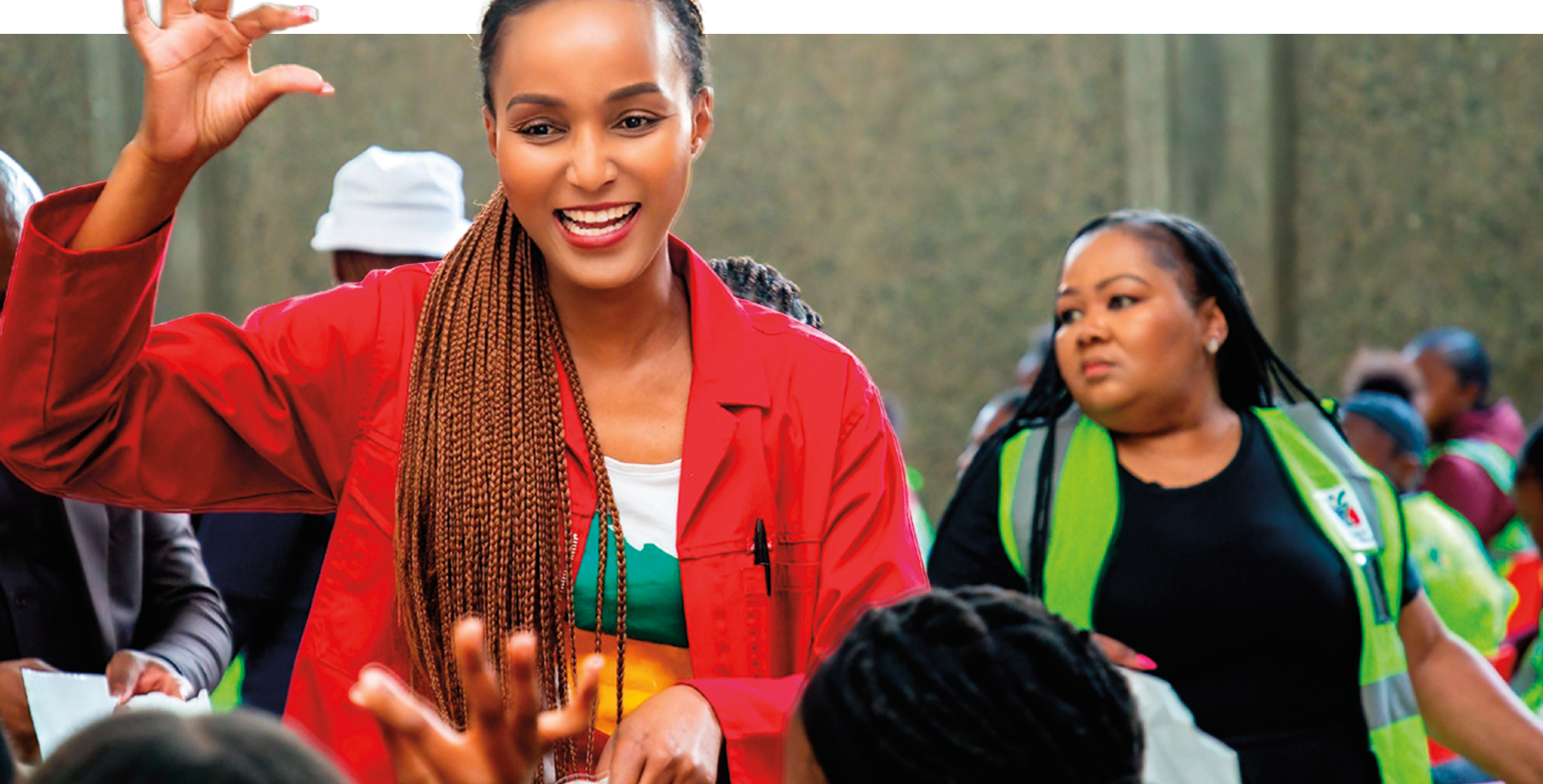
EFF spokesperson Thembi Msane reflects on economic justice, youth empowerment and why leadership must translate political freedom into meaningful opportunity for all South Africans
Politics is more than a contest of ideas for Economic Freedom Fighters (EFF) spokesperson Thembi Msane. It is about people, justice and creating a South Africa where every citizen has the opportunity to succeed.
While many political leaders find their calling later in life, Msane’s journey began in childhood. Her early experiences, strong family values and professional career shaped a leader who believes lasting change requires courage, conviction and a willingness to challenge systems that continue to exclude millions of South Africans.
Today, Msane has emerged as one of South Africa’s most recognisable young political voices. Calm under pressure and confident in public debate, she speaks openly about unemployment, poverty, inequality and the pace of economic transformation. Whether people agree with her political views or not, her willingness to engage difficult national conversations has established her as one of a new generation of leaders helping shape South Africa’s democracy.
Humble beginnings
Msane’s understanding of leadership was formed long before she entered politics. Growing up in Katlehong during the final years of apartheid exposed her to a community marked by political violence and uncertainty. She witnessed first-hand how political decisions affected ordinary families, shaping her belief that leadership is about standing alongside communities during difficult times rather than simply holding positions of authority.
Recognising the instability around them, her parents later moved the family to a quieter area. The move provided greater security, but it also sharpened her awareness of inequality as she saw the stark contrast between different communities and the opportunities available to them.
Raised within a large extended family, Msane spent much of her childhood with her grandmother while learning from parents, aunts, uncles and older cousins. The experience taught her patience, resilience and the importance of listening to different perspectives before making decisions. Those lessons continue to influence her leadership style today.
Education was central to family life. Her father believed it was one of the most powerful tools available to young black South Africans, but he encouraged his children to think beyond employment. His ambition was for them to become entrepreneurs and employers who could create opportunities for others.
Through his work in construction, farming, manufacturing and property development, Msane was introduced to business leadership from an early age. She came to understand that political freedom alone could not guarantee prosperity without meaningful economic participation, an idea that would later become central to her political philosophy.
Developing leadership
Like many young South Africans, Msane viewed education as both an opportunity and a responsibility. While studying, she became actively involved in student leadership and community initiatives, developing the confidence to lead and the conviction that young people have the power to influence positive change.
Even before entering politics, she saw leadership as an act of service rather than status. That philosophy remained with her as she qualified and worked as a civil engineering technician, a profession that provided another perspective on South Africa’s economic landscape.
Working in infrastructure exposed both the opportunities available within the sector and the barriers many young black professionals still encountered. Despite the gains of democracy, she saw unequal access to opportunity and economic participation remain a reality for many South Africans. Those experiences reinforced questions that had followed her since childhood. Why were talented young people still excluded from meaningful economic advancement? Why had political freedom not translated into widespread economic equality?
Political consciousness blooms
Seeking answers to those questions eventually led Msane into organised politics. For her, entering public life was never about personal ambition or recognition. It was about contributing to solutions for the structural challenges she believes continue to limit South Africa’s progress.
Her political journey transformed her from an engineer passionate about social justice into one of the country’s most recognised young political figures. Along the way, she also became a strong advocate for greater female representation in leadership.
Although South Africa has made significant progress in advancing women into positions of influence, Msane believes genuine equality remains a work in progress. Women, she argues, are still required to prove themselves more often than their male counterparts, particularly in politics, where public scrutiny is relentless.
A woman in leadership
Despite these challenges, Msane remains optimistic. She points to the growing number of young women making their mark in politics, business and civil society as evidence that leadership is becoming more representative.
She readily acknowledges the women who paved the way, particularly those who fought for equality during apartheid and South Africa’s democratic transition. Figures such as Winnie Madikizela-Mandela demonstrated extraordinary resilience under immense pressure, creating opportunities for future generations of women leaders.
For Msane, however, representation is only part of the solution. Women should not occupy leadership roles simply to satisfy quotas or symbolism. They should be trusted with meaningful responsibilities and recognised for their ability to influence important decisions.
Her own career reflects that principle. By tackling complex national issues and participating confidently in public debate, she hopes to demonstrate that leadership is open to anyone prepared to serve with commitment, integrity and purpose.
Breaking the digital divide
The rise of digital technology has transformed the relationship between political leaders and the public. According to Msane, social media has made politics more accessible, particularly for younger South Africans who can now engage with national issues without attending political meetings or relying solely on traditional media.
Digital platforms have expanded access to information, enabling citizens to follow government decisions, participate in public debate and hold leaders accountable in real time. Young people, in particular, are increasingly using these tools to educate themselves, organise campaigns and amplify their voices.
Msane also recognises the risks. Misinformation spreads rapidly online, while political discussions can easily become polarised and hostile. She believes political leaders have a responsibility to communicate honestly and responsibly, using digital platforms to inform rather than inflame. At the same time, citizens must develop the critical thinking skills needed to distinguish fact from opinion.
Despite embracing digital engagement, Msane does not believe technology can replace personal interaction. South Africa remains a country where many communities still have limited access to reliable internet and digital infrastructure. Effective leadership therefore requires more than an online presence. It demands time spent in communities, listening to people’s concerns, understanding local realities and maintaining genuine connections with the citizens leaders are elected to serve.
Honest reflection, 32 years after democracy
More than three decades into South Africa’s democratic journey, Msane believes the country stands at a defining moment. While constitutional freedoms, democratic institutions and improved access to education represent undeniable progress, millions of South Africans continue to face poverty, unemployment and inequality.
She believes these realities demand honest reflection rather than complacency. South Africans, she argues, must ask whether democracy has delivered equally for everyone and whether existing policies are doing enough to address the country’s most pressing challenges.
For Msane, leadership means confronting uncomfortable truths instead of avoiding them. Conversations about economic transformation, inequality and social justice should not divide the nation but encourage collaboration in building a more inclusive society. South Africa, she believes, has enormous potential, but unlocking it will require bold leadership, responsible governance and active citizen participation.
Ultimately, she argues, the country’s future will not be shaped by elected leaders alone. Ordinary South Africans also have a responsibility to strengthen their communities and contribute to meaningful change.
A legacy for future generations
For Msane, success is measured not by titles or political office but by the impact a leader leaves behind. Her ambition is to help build a South Africa where opportunity is determined by talent, hard work and determination rather than race, background or financial circumstances.
Central to that vision is education. She believes every child should have access to quality education and opportunities for personal development, regardless of where they are born or the financial position of their family. Education, however, should do more than prepare young people for employment. It should encourage innovation, entrepreneurship, creativity and critical thinking, equipping graduates to build businesses, create jobs and solve problems within their own communities.
Msane also believes stronger local economies are essential to reducing inequality. Communities thrive when entrepreneurship is supported, local businesses grow and employment opportunities are created. Achieving this, she says, requires collaboration between government, business and civil society.
Leadership, in her view, begins long before people enter politics or business. It starts in families, schools and communities where values such as honesty, discipline, compassion and responsibility are nurtured. Parents, teachers and community leaders all play a role in developing the ethical leaders South Africa will need in the future.
Although youth unemployment and limited economic opportunities remain significant challenges, Msane believes they can be overcome through responsible leadership, long-term planning and collective effort. Rather than allowing frustration to turn into hopelessness, she encourages young South Africans to become active participants in shaping the country’s future through education, entrepreneurship, community service and public leadership.
She understands the frustrations many young people feel because they reflect many of the experiences that shaped her own journey. Yet she remains convinced that lasting change is possible when citizens refuse to give up on South Africa’s future.
Looking ahead
Msane hopes to see a South Africa where justice and opportunity exist side by side, where economic growth benefits every citizen, women participate equally in leadership and young people can build successful futures without leaving their communities behind.
Whether one agrees with the policies of the Economic Freedom Fighters or not, she represents an important voice in South Africa’s democratic conversation. She challenges citizens to think critically about equality, justice and economic inclusion while asking difficult questions about the country’s future.
Leadership, she believes, is rarely about providing easy answers. It is about asking the questions others are reluctant to ask and inspiring people to imagine something better. Throughout her career, Msane has remained committed to those ideals, arguing that South Africa’s greatest strength lies not only in its institutions or natural resources but in the resilience, determination and potential of its people.
As part of a new generation of political leaders, she refuses to accept that inequality is inevitable or that meaningful progress must come slowly. Instead, she believes South Africa can move forward through bold ideas, accountable leadership and active citizen participation.
Her story is ultimately about more than politics. It is about purpose, perseverance and the belief that every generation has a responsibility to leave society stronger than it found it. Whether addressing Parliament, engaging with communities or speaking to young South Africans, Thembi Msane continues to advocate for a country where freedom is matched by opportunity, justice leads to prosperity and every citizen has the chance to contribute to a better future.
In a nation still navigating the complexities of democracy, voices such as hers will continue to shape important national conversations. For Msane, the vision remains clear: a South Africa that belongs equally to all who live in it, where leadership is measured not by power but by service, and where the promise of democracy is fulfilled through dignity, opportunity and hope.
Nasiphi Ndevu is Head of Research at Frank Dialogue Holdings.