

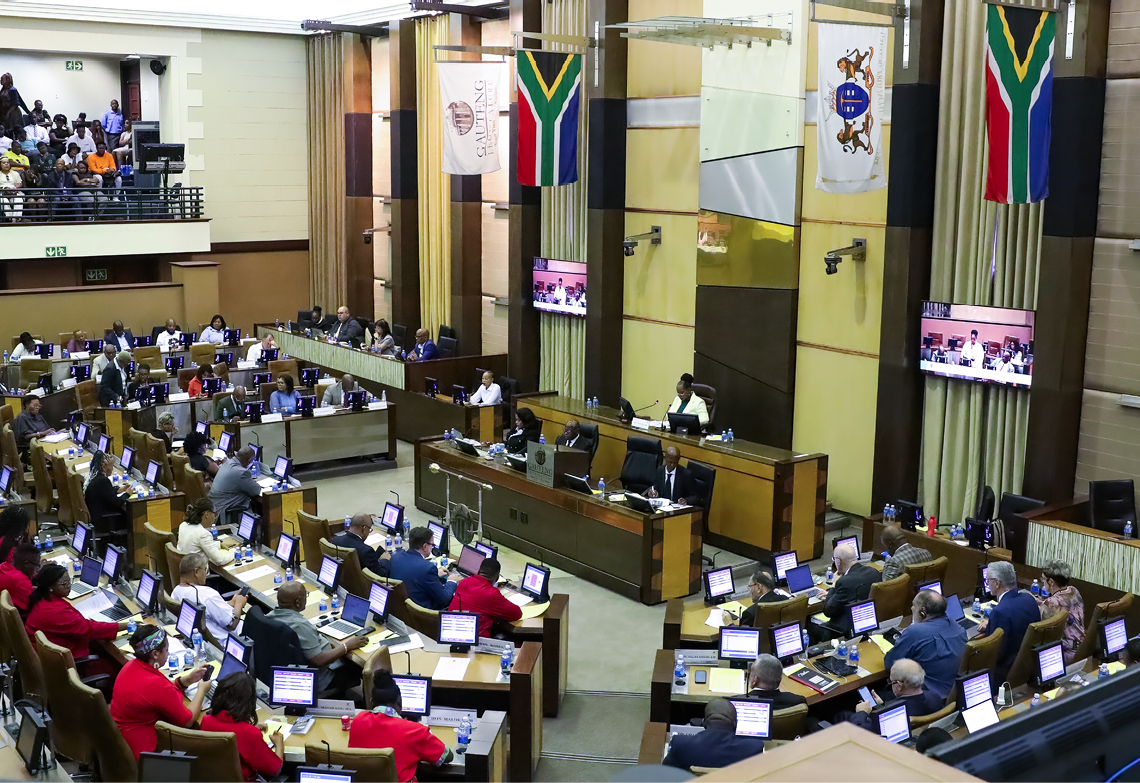
Is the continued existence of provincial legislatures—which are a drain to the fiscus—still justified in a country like South Africa, where there are numerous urgent pressing priorities like runaway unemployment, crime, and poverty? Max Matavire investigates…
This debate continues to rage on with compelling arguments from both sides—those for and against—being advanced. Those calling for the complete dissolution of provincial legislatures argue that these spheres of government are costly to run, are a duplication as national government can provide the services they are currently providing, and, among other reasons, that they lack administrative capacity.
For instance, during the 2024/25 financial year, South Africa’s nine provincial legislatures were allocated R2.3 trillion—money which could be directed to local government (municipalities), which is the sphere of government closest to communities, and where the rubber hits the tar in terms of service delivery. The money can be used to adequately and effectively capacitate municipalities by improving their infrastructure, developing their human capital to enhance the delivery of services to communities.
Some of the arguments advanced for the continued existence of provincial legislatures are that:
- They implement national policy by being responsible for the direct administration of critical social services such as education, health, and social development;
- Democratic accountability and oversight as they are an independent arm of the State, they provide a forum for public debate and scrutiny of the provincial executive;
- They provide a platform for public participation as they facilitate public access and involvement in lawmaking and governance at regional level, and that their existence is a Constitutional mandate enshrined in the country’s Constitution which outlines a system of three distinct and independent spheres of government.
On the other hand, arguments put forward against provincial legislatures continued existence are that:
- Poor performance and ineffectiveness: Due to a lack of their administrative capacity, their performance and effectiveness is suboptimal;
- Political will and party allegiance: The current electoral system based on proportional representation from party lists fosters allegiance to political parties rather than to citizens. This affects effective oversight;
- Blurred accountability lines: In instances where a single political party dominates, this leads to blurred accountability lines between party interests and State governance, leading to the erosion of democratic processes and oversight; and
- Cost duplication: It can be said that the provincial layer of government is expensive, there is unnecessary duplication of functions which could be effectively handled by national or local spheres thereby saving on public expenditure.
Interestingly, South African Local Government Association (Salga) president Bheki Stofile holds a totally different view on the matter from the organisation he leads. Although Salga as an institution has no policy calling for the dissolution of provincial legislatures, Stofile’s personal view is that it’s time these legislatures be done away with.
In an interview with Leadership Magazine, Stofile gives the analogy of the human body when asked if the continued existence of provincial legislatures is still justified.
“That’s a political question you are throwing. Look at this matter as the human body—the upper body and head as national government and the legs as local government. The head and upper body (national government) develops policies and maps up the developmental and economic route the country wants to take, and the legs (local government) takes upper body to it’s destination by the implementation of those developmental and economic policies set. So where is the provincial structure? What is its role here besides duplication of all what can be done by both national and local governments?” argues Stofile.
“Currently, millions of rands are allocated to these provincial legislatures through provincial governments budgets. Instead, this money should be poured into local government so that it’s fully resourced to enable it to efficiently and adequately deliver services to communities. As things stand now, local government which is the closest sphere to the people gets nine percent of the country budget, provincial governments get 40 percent and national takes 51 percent.
“Despite it being the deliverer of services, local government gets the least allocation—this must change.”
Stofile adds that the sole aim of establishing local government was to boost local economic growth and to deliver services. He said about 46 percent of national government’s assigned tasks are at local government level. “Local government is a very important sphere which should be properly resourced. I know some will argue that provincial legislatures play the co-ordination role but that can be done by national.”
Stofile says in Salga’s review of the White Paper on local government, they are calling for a holistic look at government. My personal view is that there is no need for provincial legislatures as they only serve as an employment agency for comrades. I have been raising this issue. The capacity in provincial government can be moved to local government and effectively utilised there. Provincial legislatures have become employment bureaus. We need to have a complete change of mindset and do away with the myth that local government is failing,” he says.
However, Salga spokesperson Motalatale Modiba says Stofile is expressing his own personal views as Salga has not expressed the dissolution of provincial legislatures, adding that it was not Salga’s policy. “The association still maintains provincial legislatures have a role to play. The president might have been expressing his personal views and not those of Salga,” says Modiba.
Political Science and International Relations Nelson Mandela University Professor Bheki Mngomezulu says at a time when the country’s purse is “so thin” while people are suffering from unemployment, crime, and other social ills, government should consider cost saving measures.
“Two among these include trimming cabinet and the legislature as well as having a relook at the justification for the continued existence of the provincial sphere of government. Chapter 3, Section 40 (1) of the Constitution which talks about co-operative government states that ‘in the Republic, government is constituted as national, provincial and local spheres of government which are distinctive, interdependent and interrelated’. This has been used as a defence mechanism for keeping provincial government even when it’s clear that the country does not need it, especially because it serves the interests of politicians not the public,” says Mngomezulu.
“Thirty-one years into democracy, the time for a Constitutional review is ripe. The bulk of the work happens at local government level while legislation is passed at national level. Therefore, it would be wise to remove the provincial government and leave the other two spheres. National would pass laws while local government would have more money to deliver services to the people. There is no justification for keeping provincial government which uses more money yet it is clearly dispensable.”
Max Matavire is a freelance Journalist who writes for City Press, the Mail & Guardian, and Sunday Times.