

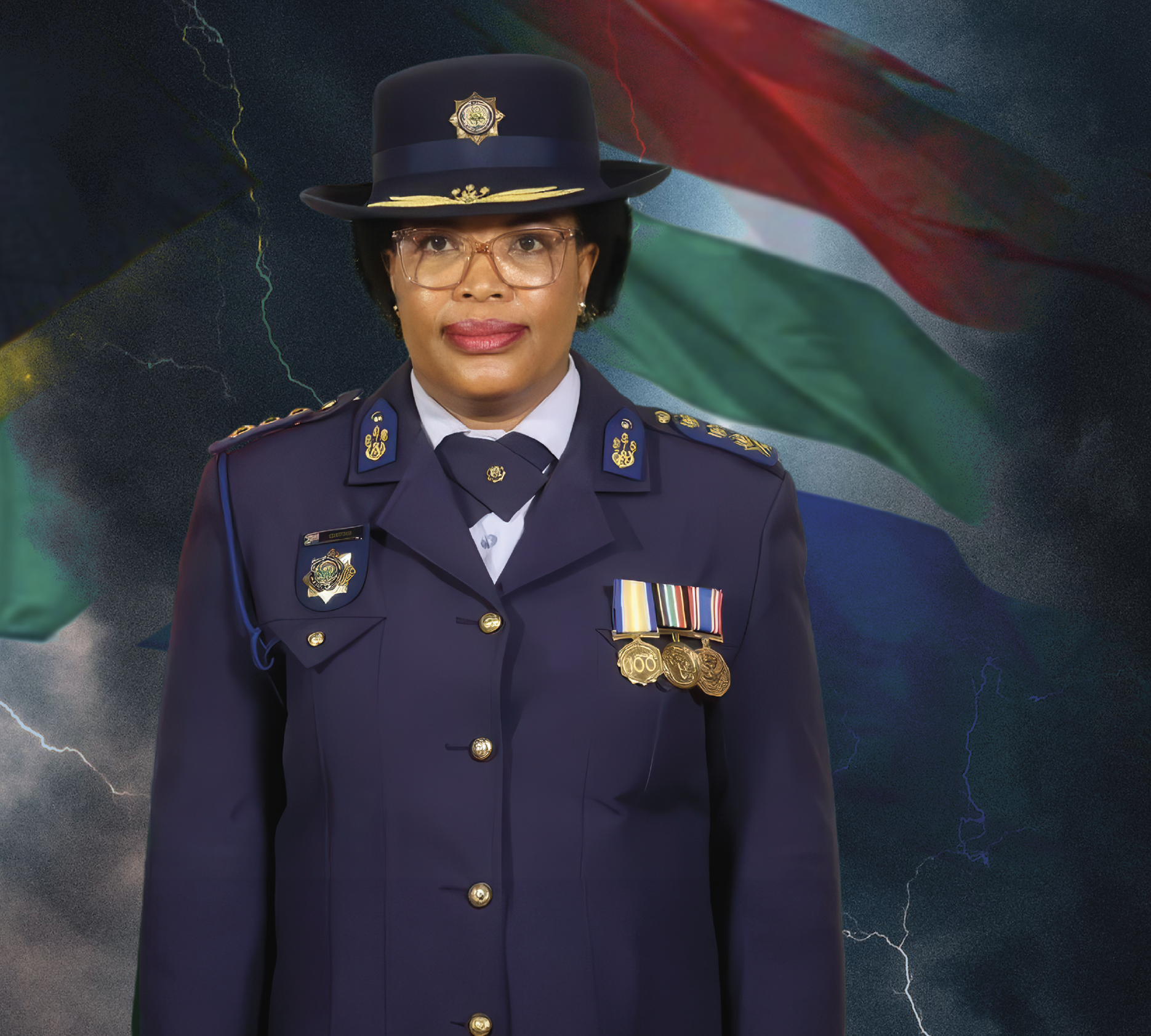
Nasiphi Ndevu explores how Lieutenant General Puleng Dimpane became the face of accountability in South African policing
South Africa’s policing system has entered one of the most closely watched periods in recent years following the appointment of Lieutenant General Puleng Dimpane as Acting National Commissioner of Police. At a time when public confidence in state institutions continues to face pressure from allegations of corruption, irregular expenditure, and governance failures, her appointment has become more than just a leadership change. For many South Africans, it represents a test of whether ethical leadership and accountability can still rise within institutions that have often struggled under the weight of controversy.
Her appointment follows the suspension of former National Commissioner General Fannie Masemola after allegations linked to irregular tender processes and procurement concerns surfaced. The controversy placed the leadership of the South African Police Service under intense scrutiny and renewed broader national conversations about accountability within public institutions. At the centre of these discussions was a tender involving police health services, which later became the subject of investigations and parliamentary oversight.
While the scandal itself drew public attention, Dimpane’s response to the situation quietly positioned her differently from many officials often associated with governance failures. During testimony before Parliament’s ad hoc committee, she stated that she had not been involved in awarding the controversial tenders. Instead, she explained that once concerns around the tender came to her attention, she acted within the responsibilities of her office. According to testimony now available in the public domain, she oversaw investigations into the matter, reported the issues to the Auditor-General of South Africa, and stopped further payments linked to the tender arrangement.
Those actions may sound administrative on the surface, but within the context of South Africa’s public sector environment, they carried significant weight. For years, South Africans have become accustomed to stories where irregular expenditure is ignored, accountability is delayed, or wrongdoing is protected through silence and political loyalty. In this case, however, Dimpane’s actions created the image of a leader willing to intervene rather than look away.
That distinction has become central to understanding why her appointment matters beyond policing alone. South Africa’s crisis of confidence in public institutions is not only about crime statistics or corruption scandals. It is also about leadership culture. Citizens increasingly question whether public officials act in the interests of the people or in protection of political and financial networks. Against this backdrop, leadership is no longer measured only through titles or authority, but through decisions made during moments of institutional pressure.
Dimpane’s rise reflects a broader shift in expectations around public leadership. Modern leadership, especially within government institutions, is increasingly judged by transparency, accountability, and ethical conduct rather than political symbolism. The acting commissioner now enters office carrying expectations not simply to manage police operations, but to help restore institutional credibility at a time when trust has become one of the country’s most valuable and fragile resources.
The South African Police Service remains one of the most important institutions in the country’s democratic system. It carries the responsibility of protecting communities, enforcing the law, and maintaining public order. Yet over the years, the organisation has repeatedly faced criticism over corruption allegations, political interference, leadership instability, and failures to address organised crime effectively. Public frustration has grown as violent crime
Policing
levels continue to affect communities across the country, while allegations involving senior officials have damaged confidence in the institution itself.
Her background in police financial management has also shaped how many observers interpret her appointment. Financial oversight within law enforcement institutions is rarely viewed as glamorous work, yet it remains one of the most important foundations of institutional integrity. Procurement systems, budget controls, and expenditure oversight determine whether public resources are used responsibly or diverted through irregular processes. In many governance scandals across South Africa, weaknesses in financial management have often been the starting point of broader institutional collapse.
South Africa’s political and governance environment has, over the past decade, increasingly highlighted the consequences of weak leadership cultures within public institutions. The period commonly referred to as state capture exposed how corruption networks could influence procurement systems, weaken oversight structures, and undermine institutional independence. While many reforms have since been introduced, the public remains deeply aware that rebuilding institutional trust requires leaders who are willing to confront misconduct directly. Dimpane’s appointment therefore arrives during a national moment where symbolic leadership alone is no longer enough. Citizens want evidence of competence, integrity, and decisive action. They want institutions that function effectively and leaders who understand the seriousness of public responsibility.
Another significant dimension of her appointment is its impact on women in leadership within South Africa’s security sector. Law enforcement leadership has historically been dominated by men, both in South Africa and globally. Female leaders in policing often face additional scrutiny, stereotypes, and pressure to prove themselves within environments traditionally shaped by masculine leadership cultures.
Dimpane’s rise challenges some of these longstanding perceptions. Her appointment signals the growing visibility of women in senior security leadership roles and reflects broader shifts within South African institutions toward gender representation at executive level. Yet her appointment is important not simply because she is a woman occupying a senior position, but because of what her leadership style may represent.
Leadership experts increasingly argue that modern institutional leadership requires emotional intelligence, accountability, collaboration, and ethical governance alongside operational authority. These qualities are becoming essential in institutions facing public trust deficits. In this context, Dimpane’s professional image has resonated with those who believe institutional reform requires leaders focused on systems, accountability, and governance rather than political performance. Her appointment also comes during a period where policing itself is evolving globally. Around the world, police institutions face pressure to improve transparency, community relationships, and internal accountability mechanisms. Public trust can no longer be maintained solely through enforcement power. Instead, legitimacy increasingly depends on whether institutions are seen as fair, ethical, and responsive to citizens.
Leadership transitions often generate hope, but sustaining trust requires visible action. Citizens increasingly judge leaders not by speeches alone, but by whether systems improve under their leadership. This reality places enormous pressure on acting leaders who step into institutions during moments of crisis. At the same time, Dimpane’s appointment highlights an important conversation about the relationship between leadership and ethics within public service. Ethical leadership is often discussed in corporate boardrooms, universities, and governance conferences, yet its real importance becomes most visible in institutions that directly affect ordinary citizens’ lives. Policing, healthcare, education, and local government are areas were leadership decisions shape public experience daily.
In this regard, Dimpane’s appointment has symbolic importance beyond the police service itself. It reflects broader questions about the kind of leadership South Africa wants within public institutions moving forward. Does the country reward silence and political convenience, or does it create space for accountability-driven leadership? Can ethical conduct still be recognised within systems often criticised for protecting power networks? These questions remain central to South Africa’s governance future. Public frustration over corruption has not disappeared, and citizens remain deeply sensitive to leadership credibility. This explains why figures associated with accountability tend to attract significant public interest, especially when institutions face crisis moments.
The acting commissioner also inherits a police service operating within a rapidly changing social environment. Technology-driven crime, cybercrime, organised syndicates, and increasingly sophisticated criminal networks require institutions capable of adapting quickly. Leadership in modern policing therefore involves balancing operational reform, technological advancement, financial governance, and community trust simultaneously.
Dimpane now faces the task of demonstrating that accountability and operational effectiveness can exist together. In many institutions, governance reforms are sometimes viewed as administrative burdens disconnected from frontline realities. Yet strong governance systems are essential for operational credibility. Procurement integrity, financial oversight, and transparent management directly affect whether institutions have the resources, equipment, and legitimacy needed to perform effectively. The attention surrounding her appointment also reflects how leadership narratives shape public expectations. South Africans are increasingly searching for examples of competent and ethical leadership within institutions that directly affect national stability. Stories of accountability resonate because they offer hope that reform remains possible even within troubled systems.
For now, Lieutenant General Puleng Dimpane stands at the centre of that challenge. Her appointment arrives during one of the most demanding periods in South African policing, where public expectations are high and institutional credibility remains fragile. Yet within that pressure also lies opportunity, the opportunity to demonstrate that accountability, ethical leadership, and professional integrity still have a place within public service.
As the country watches closely, many South Africans will hope her leadership marks more than just another transition in office. They will hope it signals the beginning of a stronger culture of responsibility within one of the nation’s most important institutions. In an era where trust has become increasingly difficult to earn, leadership grounded in accountability may prove to be exactly what South Africa’s policing system needs most.
Nasiphi Ndevu is the Head of Research at Frank Dialogue Holdings.