

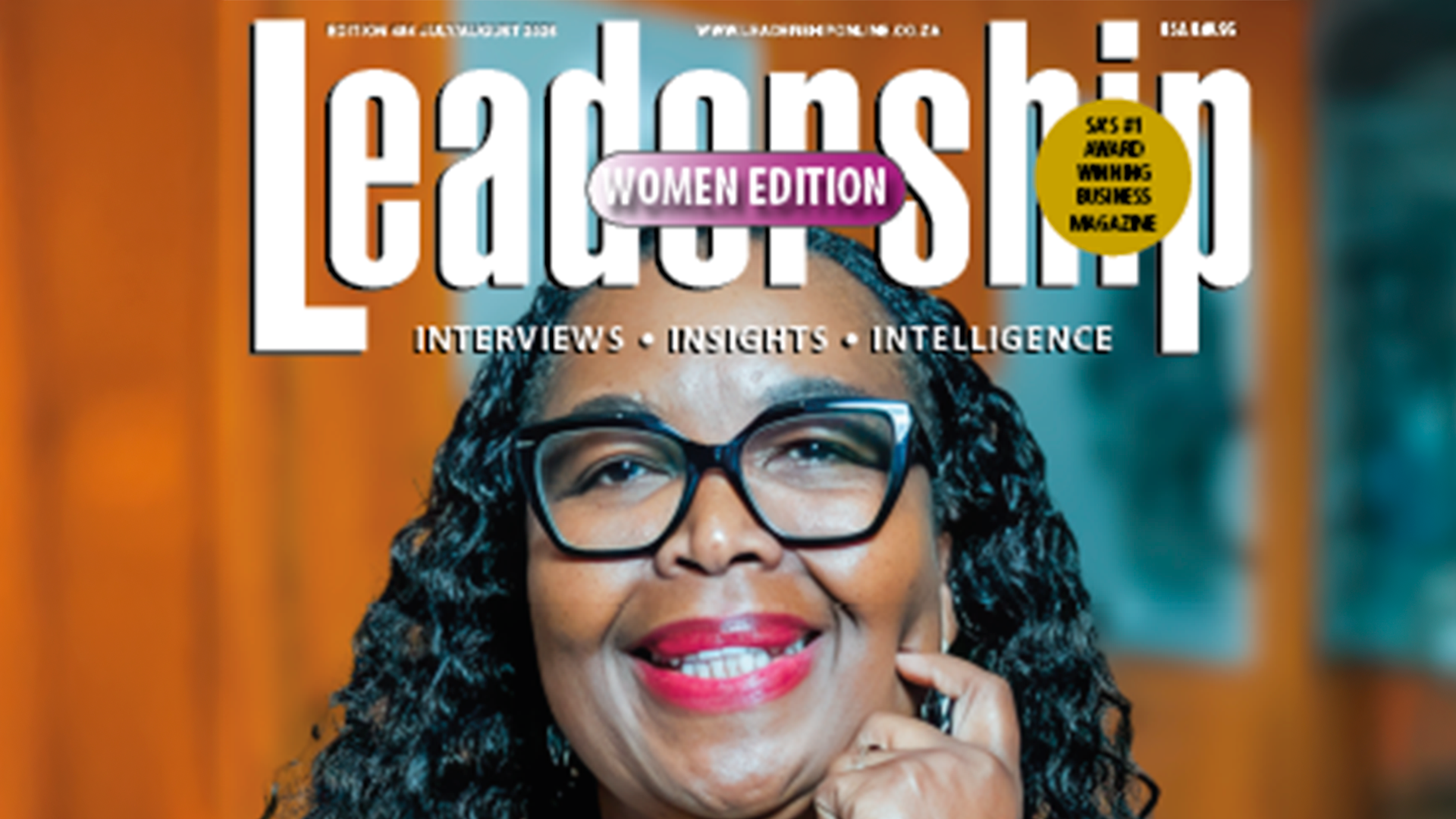
Leadership Editor, Prof. Onkgopotse JJ Tabane, sat down with Prof. Sibongile Muthwa, the Vice-Chancellor of Nelson Mandela University, for a frank discussion about her leadership, the world of education, and why the best legacy one can leave is refusing to define it
Leadership is often associated with power, authority, and certainty. The world’s most admired leaders are frequently expected to have immediate answers, bold solutions, and unwavering confidence in every decision they make. Yet Prof. Sibongile Muthwa, the Vice-Chancellor of Nelson Mandela University, offers a remarkably different understanding of leadership. For her, leadership is not about standing above others. It is about walking alongside people, listening with intention, leading with compassion, and creating an environment where everyone could flourish.
She spoke to Leadership Editor Prof Onkgopotse JJ Tabane in her office at the University’s main campus.
As the first woman to lead Nelson Mandela University, Prof. Muthwa carries one of the most significant responsibilities in South African higher education. She leads an institution that proudly bears the name of Nelson Mandela, a global symbol of justice, reconciliation, and human dignity. While many would see this as a privilege, she describes it as something much deeper. It is a responsibility that demands constant reflection, humility, and accountability.
Her story begins far from lecture halls and executive offices. It begins in the rural community of Umbumbulu in KwaZulu-Natal, where she spent her childhood on her grandfather’s subsistence farm. Those early experiences shaped not only the woman she would become but also the leader she is today.
“I have always considered leadership not as a position that places one at the top of the pyramid, but as a practice of listening, of modelling compassion, and of cultivating clarity,” she says.
Growing up in a close-knit community taught her that wisdom cannot be found only in textbooks or classrooms. It is found in everyday life, in shared experiences, in observation, and in relationships. People build with one another.
“My earliest experiences on my grandfather’s farm in Umbumbulu taught me that knowledge does not only reside in formal institutions. It resides around firesides, in communal relationships, in observation, patience, and interdependence.”
Those lessons remain at the heart of her leadership philosophy today. She believes leadership is an act of stewardship rather than status. It is about protecting what has been entrusted to you while ensuring it grows stronger for future generations.
“I internalised the notion that leadership is stewardship. It is an honour to hold and gently mould that which has been given to you with care and respect.”
Perhaps one of Prof. Muthwa’s most refreshing qualities is her willingness to admit that leadership does not require certainty. In fact, she believes that the greatest leaders are often those who are comfortable asking difficult questions instead of pretending to have every answer.
“As my responsibilities have grown, I have become less certain that leadership is primarily about having answers. It may be more about holding together different experiences, different hopes, and different fears without rushing too quickly towards certainty.”
This philosophy has become particularly important in leading a modern university. Universities are places where ideas are debated, knowledge is challenged, and different perspectives coexist. They are naturally complex institutions that require leaders who can embrace diversity of thought rather than suppress it.
“The university itself is a complex space that thrives on ideas. It is filled with competing aspirations, unequal realities, and difficult questions. Perhaps leadership’s task is not always to resolve those tensions but to create conditions in which they can be engaged honestly and constructively.”
Her approach reflects a quiet confidence that values collaboration above control. Rather than presenting herself as the person with all the solutions, she believes leadership is about creating opportunities for others to contribute their own knowledge and experiences.
”The most enduring lessons from my home are a sense of communality, discipline of clarity, patience of reflection, strategic humility, and generosity of spirit. These frame my approach to leadership.”
Those values have become even more significant because of the institution she now leads.
Nelson Mandela University is the only university in the world to carry the name of South Africa’s first democratic President. That distinction brings both honour and responsibility.
”Carrying Nelson Mandela’s name is both an honour and an unsettling responsibility. We cannot reduce Mandela to a symbol that simply reassures us.”
For Prof. Muthwa, the Mandela name should never become a comfortable label or a marketing tool. Instead, it should serve as a constant reminder that the university must continuously strive towards justice, dignity, and democratic values.
“We do not own it as a brand. Rather, we believe that the power of the name may lie precisely in the fact that it resists easy ownership.”
In a time when confidence in institutions is declining across many parts of the world, she believes universities have an important responsibility to rebuild trust by creating spaces where dialogue, critical thinking, and respectful engagement can thrive.
“The responsibility of a university bearing his name may not lie in claiming moral superiority but in continually asking whether we are creating spaces where dignity, dialogue, justice, and human flourishing remain possible.”
She believes those questions should never have permanent answers.
“They must be asked repeatedly.”
What makes Prof. Muthwa’s leadership particularly distinctive is her willingness to embrace paradox. She believes the University must honour Nelson Mandela’s legacy while also remaining committed to questioning accepted ideas. After all, universities exist to pursue truth through inquiry rather than unquestioning agreement.
“Universities are not monuments. They are places of inquiry.”
She explains that being an academic expression of Mandela means embracing curiosity, debate, and intellectual courage.
“When we talk about striving to be an academic expression of Mandela, this is what we mean. Grappling and navigating through knowledge and inquiry the endless possibilities with a critical mindset.”
That same mindset shapes how she views the future of higher education. Around the world, universities are facing unprecedented challenges. They are expected to produce world class research, prepare graduates for employment, contribute to economic growth, solve social problems, and remain financially sustainable, all while adapting to rapid technological change.
“Universities today seem pulled in many directions simultaneously.”
Rather than seeing these competing demands as obstacles, Prof. Muthwa believes they present an opportunity for universities to redefine their purpose.
“The future university needs to become more permeable, more collaborative and more self-critical.”
Central to her vision is the belief that universities cannot isolate themselves from society. Their work must extend beyond classrooms and research laboratories. They must actively contribute to solving the challenges facing their communities and the nation.
This belief is reflected in her commitment to building what she often describes as ”a university in service of society”.
She challenges the idea that academic excellence and social justice are opposing goals.
“Our experience suggests something more complicated. Academic excellence divorced from social realities risks becoming socially irrelevant. Yet social commitment without intellectual rigour can ultimately fail the very communities it seeks to serve.”
Instead of asking how universities should balance excellence with social justice, she believes institutions should continually ask a more important question: ”What does excellence mean in a profoundly unequal society?”
It is a question that sits at the centre of her leadership and one that continues to shape the direction of Nelson Mandela University.
Prof. Muthwa’s journey demonstrates that true leadership is not measured only by titles, rankings or achievements. It is measured by the ability to inspire hope, encourage dialogue, and create opportunities for others to succeed.
Her story is one of humility, resilience, and purpose. From the fields of Umbumbulu to the leadership of one of Africa’s leading universities, she has remained guided by the same values that shaped her childhood: compassion, community, integrity, and service.
In an age that often rewards certainty above wisdom and authority above empathy, Prof. Sibongile Muthwa reminds us that leadership is ultimately about people. It is about creating spaces where knowledge flourishes, where dignity is protected, and where future generations are empowered to imagine a better world. That is what it means to lead beyond certainty.
Exclusive Q&A: A Conversation on Leadership, Education, and the Future
Your leadership journey began on your grandfather’s subsistence farm in Umbumbulu and has taken you to the helm of Nelson Mandela University. How did those early experiences shape your leadership philosophy?
I have always considered leadership not as a position that places one at the top of the pyramid, but as a practice of listening, modelling compassion, and cultivating clarity. My earliest experiences on my grandfather’s farm taught me that knowledge does not only exist in formal institutions. It exists in our communities, around firesides, in observation, patience, and in the relationships we build with one another. Growing up, I came to understand leadership as stewardship. It is an honour to care for something that has been entrusted to you and to shape it with humility, respect, and generosity. As my responsibilities have grown, I have become less convinced that leadership is about always having the right answers. Instead, it is about bringing together different experiences, different hopes, and even different fears without rushing towards certainty. Universities are complex environments filled with diverse perspectives and competing aspirations. Leadership is therefore not always about resolving every tension. Sometimes it is about creating the conditions where people can engage honestly, respectfully, and constructively. The lessons I learnt growing up, including patience, reflection, humility, and a strong sense of community, continue to guide me every day.
Nelson Mandela University carries the name of one of the world’s greatest moral leaders. What responsibility does that place on the institution today?
Carrying Nelson Mandela’s name is both an honour and an enormous responsibility. It is important that we do not reduce his name to a comforting symbol or simply treat it as a brand. The Mandela name should constantly challenge us to ask whether we are living up to the values of dignity, justice, dialogue, and human flourishing.
At a time when trust in public institutions is under pressure, universities have an important role to play. We should not claim moral superiority.
Instead, we should continually ask ourselves whether we are creating spaces where difficult conversations can happen respectfully and where people from different backgrounds can learn from one another. A university worthy of Mandela’s name must also remain committed to critical inquiry. Universities are not monuments. They are places where ideas are questioned and where knowledge continues to evolve. Honouring Mandela’s legacy does not mean protecting it from criticism. It means embracing the democratic openness and intellectual courage that he represented.
Universities across the world are facing financial pressure, rapid technological change, and increasing public expectations. What should the modern university look like?
Universities today are expected to do many things at the same time. They must advance research, develop critical citizens, contribute to economic growth, address social challenges, and remain financially sustainable. Those expectations do not always sit comfortably together. The future university must become more collaborative, more open, and more willing to reflect critically on itself. Universities cannot stand on the sidelines simply analysing society. They must actively contribute to shaping better futures. Our responsibility extends beyond producing graduates. We must produce knowledge that improves society while remaining committed to our public purpose. That means remaining responsive to technological change without losing sight of the deeper values that define higher education.
You have often described Nelson Mandela University as a university in service of society. How do you connect academic excellence with social justice?
I do not believe excellence and social justice are competing ideas. In fact, I think separating them creates a false choice. Academic excellence without an understanding of society’s realities risks becoming irrelevant. At the same time, social commitment without intellectual rigour ultimately fails the very communities it seeks to support. The more important question is what excellence actually means in a deeply unequal society. Universities should constantly reflect on how knowledge can improve people’s lives while maintaining the highest academic standards. Excellence should always serve humanity.
Graduate unemployment remains a major concern in South Africa. What responsibility do universities have beyond awarding degrees?
Universities certainly have a responsibility to prepare graduates for meaningful employment, entrepreneurship, and innovation. However, education should never be reduced to employability alone. Universities also develop ethical leaders, responsible citizens, and people who contribute positively to democracy and society. We need graduates who can earn a living while also advancing the public good. Education should nurture imagination, ethical thinking, social responsibility, and democratic participation. Those qualities remain just as important as technical skills in preparing graduates for an uncertain future.
Artificial Intelligence is changing higher education rapidly. How should universities embrace AI while protecting critical thinking and academic integrity?
Artificial Intelligence presents both exciting opportunities and significant challenges. It offers remarkable possibilities for research, learning, and innovation, but it also raises important questions about judgement, creativity, authorship, and truth. Rather than responding with either fear or excitement, universities should approach AI thoughtfully and responsibly. The real challenge is not whether universities adopt Artificial Intelligence. The challenge is ensuring we continue developing qualities that technology cannot easily replace, including empathy, ethical reasoning, critical reflection, and the ability to navigate complexity. Ironically, as Artificial Intelligence becomes more capable, those uniquely human qualities become even more valuable.
Nelson Mandela University has become known for its commitment to curriculum transformation and indigenous knowledge systems. What does meaningful decolonisation mean to you?
Meaningful decolonisation does not have a single blueprint. It requires us to ask important questions about whose knowledge is recognised, whose voices are heard, and how intellectual authority is constructed. For too long, university education often suggested that some knowledge systems were more valuable than others. Meaningful transformation challenges that assumption. Decolonisation is about recognising the richness of all human experience and ensuring our teaching, research, and knowledge production reflect that diversity. It strengthens universities because it expands our understanding rather than limiting it.
As the first female Vice-Chancellor of Nelson Mandela University, what progress has South Africa made in advancing women into leadership?
South Africa has undoubtedly made important progress. More women occupy leadership positions today than ever before. However, representation alone is not enough. We must continue examining how institutions themselves are structured, whose leadership styles are recognised, and what invisible burdens women continue to carry. Leadership frameworks have traditionally been shaped around masculine ideas of power. As more women lead, leadership itself must continue evolving. Women’s experiences and contributions should not simply fit existing systems. They should help reshape them.
You often describe Nelson Mandela University as ”a university with soul”. What does that mean in practice?
A university with soul is not a sentimental idea. It is an institution that remembers its humanity. Universities can become highly efficient, highly ranked, and highly productive while slowly losing sight of the people who make those achievements possible.
The phrase reminds us to ask whether our teaching affirms dignity, whether our research serves society, whether our governance reflects care, and whether our success creates space for compassion. Ultimately, we need to see people, acknowledge their humanity, and create environments where every individual feels recognised, respected, and empowered to contribute.
As you reflect on your leadership journey, what legacy do you hope to leave behind?
Legacy is a difficult concept because history is never complete while we are still living it. If I leave anything behind, I hope it is not simply a list of achievements. I hope I will have helped create conditions where others can flourish. Institutions are always greater than individuals. My hope is that Nelson Mandela University will continue contributing knowledge while questioning power, embracing innovation while protecting humanity, and advancing excellence while deepening justice. The future cannot simply be predicted or managed. It must be imagined, challenged, and created together. Perhaps my greatest legacy will be refusing to define legacy itself and remaining committed to the belief that education remains one of the greatest forces for good. It is a force that must always be carried forward by responsible, selfless stewards.
Prof JJ Tabane is Editor of Leadership Magazine. The research for this piece was provided by Nasipi Ndevu Head of Research at Frank Dialogue Holdings.
| www.leadershiponline.co.za
COVER STORY
www.leadershiponline.co.za |
COVER STORY
COVER STORY
“I have always considered leadership not as a position that places one at the top of the pyramid, but as a practice of listening, of modelling compassion, and of cultivating clarity”
www.leadershiponline.co.za |