

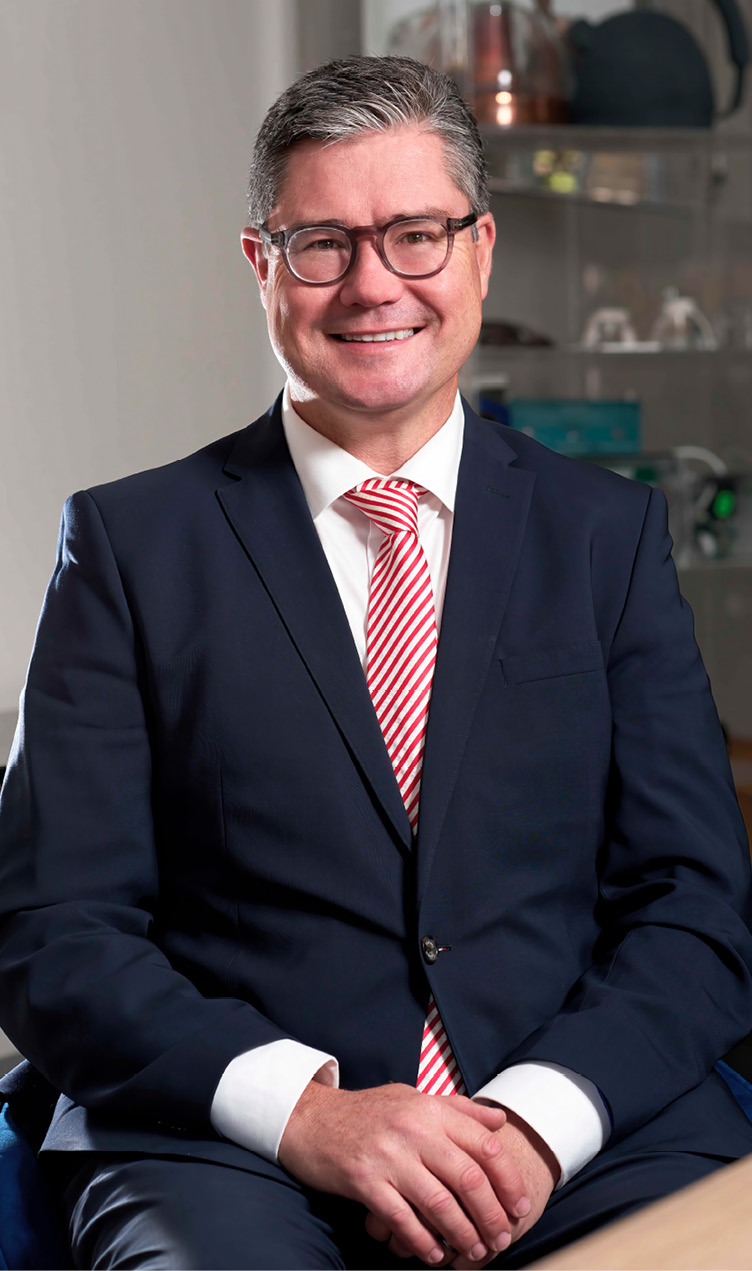
Ido Lekota met with Principal and Chief Executive Officer (CEO) of STADIO Higher Education, Dr Stan du Plessis, for a discussion about all things education
The newly appointed Principal and Chief Executive Officer (CEO) of STADIO Higher Education, Dr Stan du Plessis, brings nearly three decades of experience in academia and university leadership to the role. Du Plessis brings not only expertise but also a visionary commitment to contributing to the country’s private higher education sector and therefore to the country’s much-needed skills development.
Dr Du Plessis’s academic career is marked by significant accomplishment in some of South Africa’s most respected institutions. Before joining STADIO, he served as Chief Operating Officer (COO) and Professor of Economics at Stellenbosch University, managing complex university operations alongside his academic responsibilities. His leadership was characterised by strategic operations reforms, driving institutional growth without compromising academic integrity.
His professional footprint extends beyond Stellenbosch. As a former President of the Economic Society of South Africa, Dr Du Plessis played a leading role within the country’s economic academic community, promoting rigorous study and dialogue on critical socioeconomic challenges. Furthermore, his involvement as part of the advisory “Harvard Group” of economists to the government signifies his recognition as a trusted advisor capable of contributing to national economic policy formation through empirical research and insight.
The vision: Quality at scale
For Dr Du Plessis, the new role offers an exciting challenge that has eluded higher education for centuries: scale. “The biggest unfilled need in the South African higher education system is the ability to deliver quality at scale to a much larger section of our population,” he says. “This is what STADIO has chosen as its agenda—and it’s what I have long believed is the most important challenge in our sector.”
Traditional universities worldwide tend to remain relatively small, he explains, with even iconic names like Harvard, Oxford, and Cambridge enrolling no more than 25 000 students. “If we simply follow the traditional model, we won’t succeed in our objective. We have to do things differently.”
Rethinking the academic model
That “different” approach is already underway at STADIO. Dr Du Plessis describes the institution’s “new academic model” as a carefully designed process that applies lessons from the Industrial Revolution: specialisation, collaboration, and efficiency.
“Instead of asking one lecturer to do everything, from programme design to lecturing and assessment, we’ve built specialist teams for each part of the process, with strong coordination across them. This allows us to deliver programmes more efficiently, while safeguarding quality,” he explains.
This focus on efficiency also underpins STADIO’s pricing strategy. “We deliberately want to serve the broad market, not price for the elite. Keeping our programmes affordable is only possible if we deliver them efficiently—but that’s the only way to open access to all South Africans.”
Success measured beyond studies
Central to Dr Du Plessis’s vision is the alignment of academic programmes with the job market. He believes STADIO’s success should be measured not by the number of graduates, but by how many of those graduates find work. “We want our students to get access, to succeed in their studies, and then to get a good job. That changes the trajectory of whole families,” he says.
To achieve this, STADIO is strengthening ties with industry and committing to measure graduate employability directly—something largely absent in South African higher education. “We won’t just ask if students are employed; we’ll ask if they’re employed in the fields, we’ve prepared them for. That feedback must shape our programmes.”
Growth and recognition
Over the next five years, Dr Du Plessis expects STADIO to achieve a “step change” in size and impact. The institution is targeting 80 000 students by the end of the decade, supported by a blend of distance and contact learning. Investments in campuses—including a new comprehensive campus in Durbanville—will improve student experience for both contact and distance learners.
He also has his eye on STADIO’s next big milestone: recognition as a fully-fledged university. “That is ultimately a regulatory decision, but our responsibility is to deliver the quality, efficiency and student success that will make that recognition possible.”
Broadening and deepening access through life-long learning
Dr Du Plessis believes the role of a modern university is not just to prepare students for their first career, but to support them throughout their working lives. “We need to think horizontally—reaching more South Africans—and vertically, expanding our role in the lives of each student,” he says. “That means being there five, 10 or 15 years later, when people need reskilling or leadership preparation. Sometimes it won’t be a degree, but a shorter programme or specialist skill. Our relationship with students must be lifelong.”
Enthusiasm for education
Known for his accessible leadership style, Dr Du Plessis plans to be visible on campuses and in regular contact with staff and students. Above all, he hopes to be experienced as a true enthusiast for higher education.
“As leaders in the academic environment, we must do more than just impart knowledge—we must inspire. We have the rare opportunity to change the lives of students and their families. That’s something worth getting excited about,” he says.
By emphasising efficiency, affordability and employability, Dr Du Plessis’s leadership directly tackles key national imperatives: widening access to tertiary education, developing a skilled workforce aligned with economic needs and promoting social equity through educational opportunity.
His focus on data-driven programme improvement and strong industry partnerships addresses persistent disconnect between academic qualifications and labour market realities. This approach promises to enhance the relevance of higher education and improve graduate outcomes in a country with critical skills shortage.
Moreover under his leadership, STADIO’s vision of lifelong learner engagement prepares South Africans to adapt in an evolving economy, contributing to sustained economic growth and social advancement.
In his new position, Dr Du Plessis stands at the forefront of transforming South African higher education, bringing his profound academic expertise and visionary leadership to STADIO Higher Education. His commitment to delivering “quality at scale” through innovative teaching models, industry linkages, and enduring learner partnerships has the potential to reshape the private higher education sector—and by extension, the broader economy and society.
Ido Lekota is a media practitioner and an independent socio-political commentator.