

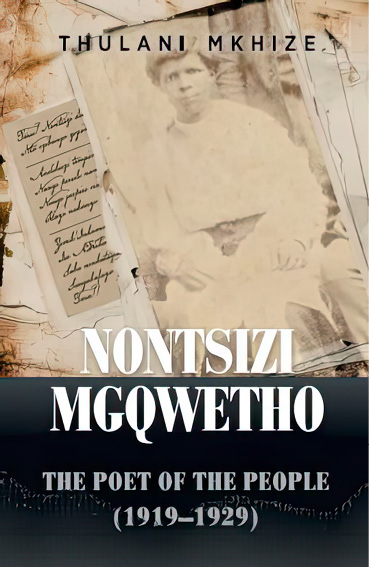
Leadership is delighted to publish an excerpt from Dr Thulani Mkhize’s new book, Nontsizi Mgqwetho: The Poet of the People
In the Xhosa political context, the imbongi is endowed with the task of mediating the behaviour of those in power and those subject to it; hence Nontsizi Mgqwetho’s preoccupation with leadership and the effects of leaders’ actions on those subject to their political power in the city space.
Throughout her poems, leaders are generally painted in negative terms; this is especially true of political leaders, who are depicted as educated and Christian opportunists who exploit the poor and the ‘Reds’ for their own personal gain. The leaders of the South African Native National Congress and their newspaper are no exception. In the poem ‘Imbongikazi No “Abantu-Batho”’ (‘The Woman Poet and Abantu-Batho’) (Opland 2007: 24–29), Mgqwetho defends Reverend Maxeke, a religious leader and editor of Umteteli wa Bantu; she takes it upon herself to assert and legitimise his authority. Mgqwetho warns L.T. Mvabaza, then the editor of Abantu-Batho, to stop accusing Reverend Maxeke and using him as a scapegoat for internal problems within Congress just because he started a rival newspaper. Indeed, this was an extremely turbulent time in black politics in South Africa, and Mgqwetho’s poetry accurately reflects this; she is right in the thick of critical political engagement. She outspokenly and unashamedly criticises the South African Native National Congress for causing division among black people and then accusing others of doing so. She clearly sees herself as the poet of Umteteli wa Bantu and not of Abantu-Batho, though her writing first appeared in the latter paper. When the editor of Umteteli wa Bantu is accused of creating a split within Congress, Mgqwetho again does not hesitate to set the record straight.
In a poem titled ‘[Uqekeko lwe Congress]’ (‘[The Split within Congress]’) (Opland 2007: 16–23), she tells Congress leaders that they are blind to their own internal politics and the discontentment that people are experiencing. She views them as essentially out of touch with the people and accuses them of seeing any dissenting voice as a threat to Congress. Thus, they are standing in the way of a solution and as a result have betrayed the nation. She argues that Maxeke had been patiently watching Congress, and was not quick to offer criticism, but after seeing that they were deceiving people he broke away from them. Through her praise of Maxeke and condemnation of Mvabaza, she paints Congress as embroiled in petty politics while there are urgent and important issues to address. She seems to strongly believe that they are misleading people and using Maxeke as a scapegoat by claiming that he is causing division among black people by starting another newspaper. Mgqwetho paints Congress leaders as untrustworthy individuals with self-serving interests, parading as heroes and saviours of the nation while remaining blind to the true state of the nation and its people, who are looking to them to provide a way forward. She writes:
Uti ke yena oka Maxeke (B.A.,)
Ungasemoyeni
Imikwa yabo kudala
Ayikangela wancama.
Uti oka Maxeke (B.A.,)
O Funz’eweni abasazi
Nalapo mabapate
Bayeke kona.
Bati oka Maxeke
Utengisa nge sizwe
Kanti kudala bona
Basitengisa kuqala.
Maxeke, B.A., speaks out.
Long he stood downwind
watching their antics,
and in the end he turned his back.
We’re urged over the edge,
says Maxeke, B.A.,
by those who run blind,
with no home to turn to.
Maxeke, they claim,
is selling the nation;
but they sold it off
a long time ago.1
Although written almost a century ago, Mgqwetho’s work resonates with contemporary significance. She raises and addresses issues that are currently plaguing the African National Congress even now. Many leaders within the African National Congress are found wanting over and over again, grasping for leadership positions without a heart for the people they are supposed to be serving. Mgqwetho exposes corruption and exploitation and fulfils the role of imbongi by offering both praise for what is good and criticism of what is deplorable. This is something that modern iimbongi have lost; they offer only praise for prominent people and those in political power. As Raphael d’ Abdon argues, Zolani Mkiva (a modern imbongi) has been able to do this so well that he is given ‘grandiloquent titles such as “Poet of the Whole Nation”, “Royal Poet of the Republic”, “Government’s Poet”, among others’ (D’Abdon 2015: 314). In d’ Abdon’s assessment, it would appear that Mkiva is given these titles precisely because he turns a blind eye to the sociopolitical crisis and corrupt leadership in South Africa. Thus, the true role of iimbongi has been usurped for political gain. Yet criticism is an integral part of the role of iimbongi; without it people would be disillusioned, and corrupt leaders would go unchecked. As Opland aptly points out, Mgqwetho is ‘painfully sensitive to the dissension amongst blacks and the failure of black leaders that constitute major obstacles to the attainment of black freedom’ (Opland 1998: 207).
It is very clear that the printing press had become a battleground for the politics of the day, and that newspapers became a powerful vehicle for black expression, creativity and advocacy. Mgqwetho joined a long history of black writers in newpapers (Tiyo Soga, William Wellington Gqoba, Jonas Ntsiko) who engaged with pertinent issues of the day. Although the newspapers they wrote in were initially run and controlled by missionaries, they ‘passed into secular (and often black) control as from 1884’ (Opland 2008: 1). Popular newspapers at the turn of the twentieth century included Imvo Zabantsundu, Izwi Labantu, Abantu-Batho and Umteteli wa Bantu, in which ‘poetry, biographies, travelogues, history, gossip and social news’ were published (Opland 2008: 1). Mgqwetho’s body of work was published in the pages of Umteteli wa Bantu from 1920 until 1929. Thereafter, her literary career spanning this decade was only available in the archives of the Chamber of Mines Library until 1984, when Opland came across her contributions in the pages of Umteteli wa Bantu while conducting research in this library. It is clear that the newspapers provided a powerful and empowering outlet for Mgqwetho’s creativity and political stance.
A significant portion of Mgqwetho’s poetry is solely dedicated to defining whom she considers as constituting ‘the people’. Not only does she define the people, but she dissects their very make-up, their vices and their strengths. She knows and understands her subject and does not hesitate to substantiate her claims using examples that clearly resonated with the people of her time and now do so with the contemporary reader. For example, in ‘Induli ka Xakeka!—Enyukwa ngu Ntu!!’ (‘The Hill Difficulty the Black Man Scales’) (Opland 2007: 94–9) Mgqwetho asks:
Ngumlungu na? Ote mansingamanyani
Sixwitane sodwa sibang’ amawonga
Ndingatini betu pikis’ezo ndawo
Ngumlunguna? Ote masitye zimali
Did the whites instruct us not to unite?
We stand on each other to reach above.
What more can I say? Have I got it wrong?
Did the whites instruct us to squander our funds?2
Mgqwetho adopts a frank tone to get to the root of the problems and hindrances confronting black people at the time.
The hill ‘Difficulty’ is a reference to The Pilgrim’s Progress by John Bunyan, which was a seminal text in the education of black people by missionaries. Mgqwetho empties the text of its spiritual significance and uses it as a metaphor for the black struggle against oppression. She is open and candid throughout the poem, and asks her readers to meet her in serious debate:
Bona ke! Namhlanje ndifun’uqondile
Mfondini wakuti nantso intlekele
Make uzibuze wozu undingqinele
Make kaloku nje sitwax’ ukuteta
Nduli ayinyukeki! Iyatshitiza
Andizikukwekwa ndirola umxelo
Yiyipi okwangoku ebhadlileyo
Into eseyimile kwezabantsundu
Nantso ke ne African National Congress
Esasiyibonga kwapuke nembambo.
Sebehamba ke beyibuza kwakuti
Besiti kanene kodwa yatshonapi
Akunakupikwa ndilusizi ukutsho
Ziko inyaniso kulo mbuzo wabo
Mna ke ngokwam andikunqweneli
’Kutyafisa imigudu eseyenziwe
Look! Today I want you to understand
the essence of our distress.
Compatriot, wrestle with what I say,
meet me in sober debate.
The hill can’t be scaled! It’s slippery.
I won’t mince words, I’ll bare my heart:
up to this point in time,
just what have blacks achieved?
Take the African National Congress:
we once burst our ribs in its praise.
Now we go round in search of it:
‘Has anyone seen where it’s gone?’
None can deny, I’m sorry to say,
these questions have some point.
But as for me, I’m not at pains
to mock their efforts to date.4
Mgqwetho cuts to the chase and asks blacks to look inward, to examine themselves and give careful thought to their ways. What legacy are they leaving behind? After thus introducing the African National Congress she goes on to point out their faults:
Kodwa eyona tyefu endiyibonayo
Ityafiswa kukutanda amawonga
Azinasidima into zomntu ontsundu
Zipetwe ngabantu abanamakwele
Lenduli—ka Xakeka ixake cwaka
Kudala mu siyinyuka siba manzi
Ayinyukeki konke kumntu ontsundu
Imbhinqisa kupela ngelitye lembola
Ngu mona uba libhaxa kulenduli
Yimali iba libhaxa kulonduli
Ngoko ke sixakiwe kukuyinyuka
Pikisa ezondawo ke ngwevu yakuti
Vying for status is lethal poison
internally sapping Congress.
Undermined by the envious,
black people strive in vain.
This hill Difficulty’s beaten us,
we’ve tried and tried to scale it:
it can’t be scaled by blacks
strapped with the millstone of custom.
Envy’s an obstacle up this hill,
money’s another obstacle:
and so we battle to scale it.
Greybeard of ours, am I wrong?5
Mgqwetho advocates unity as the only way forward, rhetorically asking: ‘what has more power than unity?’ Clearly, she insists, if black people work together there is nothing that can stand in their way. Seemingly, education alone will not do, and something greater and more powerful is needed.
Ultimately, Mgqwetho’s poetry illustrates that no one is exempt from criticism or above reproach, from the missionary to the black political leaders who profess to fight for the people. She carries out her responsibility (as imbongi cum political poet) to speak truth to power without fear. However, there is a sense that Mgqwetho feels betrayed by the scarcity of quality leaders; hence she focuses on biblical figures as examples of leaders with a heart for the nation. Throughout her poetry, a leadership void persists, and she is at pains to see it filled, so that news of Africa’s restoration can ring out to the ends of the earth.
Dr Thulani Mkhize is the author of ‘Nontsizi Mgqwetho: The Poet of the People’.