

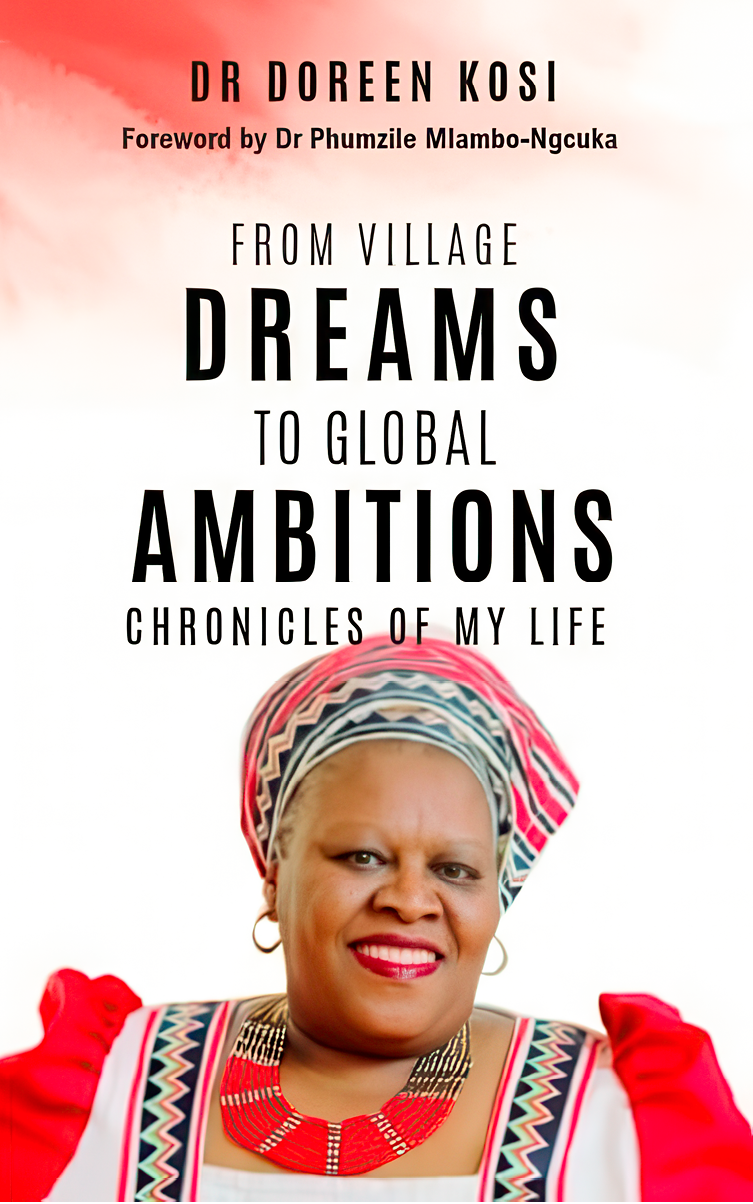
Leadership is delighted to publish an excerpt from Dr Doreen Kosi’s new book, From Village Dreams to Global Ambitions: Chronicles of My Life
Chapter 5: Embarking on the PhD Degree Path
“A PhD is a journey of discovery, where you get to explore the depths of your research question and contribute to the advancement of knowledge. The road to a PhD is paved with setbacks, rejections, and frustrations. But it’s the determination to push through that ultimately leads to success.”
My decision to pursue a PhD came after years of postponement, self-doubt, and professional distraction. Although I was scared to embark upon this journey, despite having achieved many career milestones, I knew my life story was incomplete without this chapter. As Ellen Johnson-Sirleaf once said, “If your dreams do not scare you, they are not big enough.”
With that conviction, I began my PhD with the Global Centre for Academic Research, affiliated with South Valley University in Zambia. My research, “A Qualitative Evidence Synthesis on the Inclusion of Gauteng Province Corporate South Africa Middle Managers in Strategy Development as a Contributor to Positive Organizational Performance”.
My research proposed the new U.B.U.N.T.U. African Leadership Framework for Inclusion, rooted in the philosophy of Ubuntu. This framework redefines leadership through the lens of interdependence, empathy, and shared accountability. It calls for corporate and public leaders alike to integrate African values of compassion and collectivism into modern systems of governance and management.
Completing my PhD affirmed more than academic credibility and was not the end but the beginning of a lifelong responsibility to mentor others, contribute to Africa’s intellectual renaissance, and uphold the values that had carried me thus far.
The Transformative Power of My PhD Journey
Pursuing my PhD was far more than an academic exercise. It was a deeply personal and transformative journey that reshaped how I think, perceive, and engage with the world.
Intellectually, it challenged me to interrogate assumptions I had long taken for granted, pushing me beyond the comfort zones of professional competence into the demanding realms of critical inquiry and intellectual courage. I began to see knowledge not as a static possession but as a living, evolving dialogue that requires humility, curiosity, and the willingness to unlearn.
The rigour of doctoral research demanded discipline at a level I had never known before.
Every chapter, literature review, and theoretical framework required mental endurance and precision. Through this process, I learnt to approach complexity not with fear but with fascination. I learnt to see patterns where others might see chaos and to connect dots across disciplines, cultures, and histories. This intellectual maturity strengthened my analytical and reflective capacities, allowing me to think systemically, write with clarity, and engage with policy and leadership debates from a position of grounded authority.
On a personal level, the PhD journey was an awakening and a mirror that forced me to confront my own resilience, insecurities, and sources of strength. The process reaffirmed the village girl within me who learnt to rise before dawn, to complete her duties with diligence, and to keep her eyes fixed on the horizon of possibility.
As my research deepened, I became more empathetic and self-aware. Immersing myself in human experiences, leadership dynamics, and social inequities heightened my sensitivity to the stories behind the data, to the lives shaped by systems, and the systems shaped by lives, and deepen my humanity.
In the end, this journey transformed my understanding of leadership itself. I learnt that leadership is not only about influence or power, but it is about consciousness, the ability to act with awareness, grounded in knowledge, humility, and purpose. The PhD also taught me to lead with both my mind and my heart, integrating scholarly insight with lived experience.
My PhD journey also opened doors to a broader world of academic engagement. Achieving academic success became not merely a personal triumph but a gateway to contributing meaningfully to the global body of knowledge. Immersed in this dynamic sphere, I discovered that scholarship is both a limitless and transformative ongoing dialogue that shapes and is shaped by those who dare to participate in it.
During my PhD studies, I also had the privilege of presenting academic papers at four international conferences, each marking a significant milestone in my academic trajectory.
My first presentation took place at the 3rd Multi-Disciplinary International Research Conference, hosted by the Open Learning University (OPENLU) in December 2021. As a novice in the world of international conferences, I not only gained confidence through my involvement but also had the rare opportunity to serve on the OPENLU International Conference Organizing Committee alongside distinguished scholars such as Professors King Costa, Muyisa Kazimoto, and Steven Oloo. This role offered invaluable exposure to the intricacies of academic convening.
Building on this foundation, I went on to present papers at the 6th, 7th, and 8th World Conferences for Qualitative Research in 2022, 2023, and 2024, respectively. In 2024, I had the honour of not only presenting but also moderating one of the conference sessions, an experience that affirmed my growth as an academic and a leader within scholarly spaces.
Seeing my name featured in the Abstracts Books of these prestigious conferences remains a humbling reminder of how far focus, perseverance, and dedication can carry a determined soul.
Most profoundly, completing the PhD symbolised the fulfilment of a generational dream and a testament to those who came before me and believed in the capacity to rise beyond any limitations. It closed one chapter of striving but opened another of service. I maintain that I have a responsibility to use my acquired knowledge not as a symbol of status, but as a tool for transformation, mentorship, and nation-building.
Reflecting on these experiences, I recognise them as some of the defining highlights of my academic journey and opportunities. If I could achieve this, so can others. With the right focus, determination, and support, every individual holds the potential to rise beyond their circumstances and reach their highest aspirations.
Completing my PhD was never about a title but about creating impactful new knowledge that contributes to the broader academic community, producing research that contributes towards solving problems and positively changing the world. It was also an affirmation that academic excellence is not reserved for the privileged few but for those bold enough to chase their dreams and achieve beyond their circumstances.
Dr Doreen Kosi