


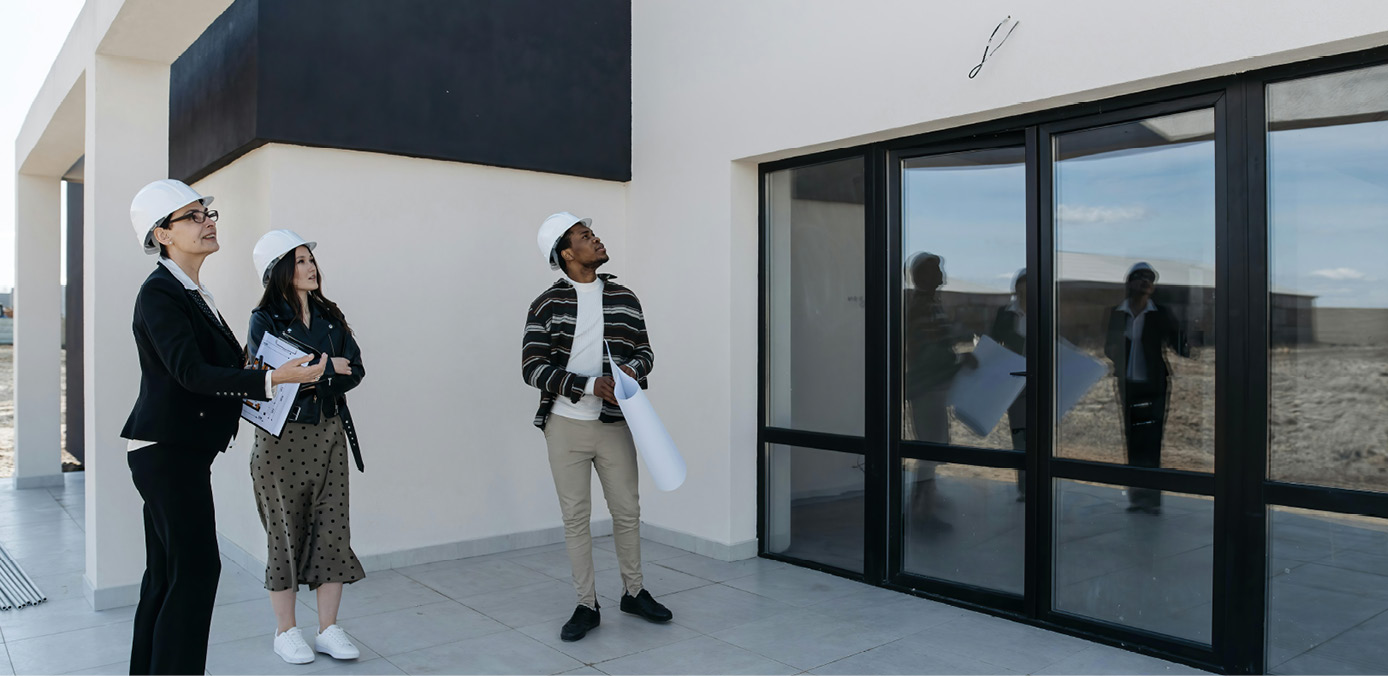
Lomile Mokoka highlights the important steps to consider when purchasing a vacant stand with the intention of building a house
Many housing consumers in South Africa are opting to build homes from scratch with all the new estates mushrooming throughout the country. It’s a tempting proposition to own a brand-new home tailored to your exact specifications. However, building can be a very daunting task for most people. It can also be unnecessarily expensive if you don’t understand the steps involved in constructing a house.
One of the more important steps is the financing of the vacant stand on which to build. This article discusses five crucial steps to consider when purchasing a vacant stand with the intention of building a house on that stand.
Get pre-approved by a bank
The first step would be to get pre-approval from your bank. This is easy to do if you’re a full-time employee, but a little bit trickier if you are self-employed. In the case of an employee, the bank would assess your affordability based on your latest three months’ cashflows. It is therefore vital to keep your financial affairs pristine in the months leading up to your bond application. Any negative balances, returned debits or expenses that clearly exceed inflows will have an adverse effect on your affordability in the bank’s eyes. The same applies for a self-employed individual but the caveat is that not only must a self-employed individual include their payslip in the application, the financial statements for their business must also be submitted for the last two financial years. The final amount calculated by the bank as the assessed affordability of the applicant is the combined amount that would be financed for both the land and the completed building. Once you have that, you can confidently go out into the market and search for vacant stands within that price range bearing in mind how much would be left over for the construction of the house and the professional fees.
Finding the land
Online property portals such as Property24, Shelter247, Private Property, MyRoof, etc are great resources for not only seeing what is on the market but a tool to compare prices, get an understanding of average selling prices in different areas and what size house you can reasonably get for your price range. An estate agent is also a very valuable resource for finding properties that have not been listed and to give you guidance on what to expect about an area.
Consult an architect
After identifying the stand, it would be best to secure the stand and find an architect who would be able to prepare for you a preliminary design that can be costed. Be sure that the land on which you want to build has the correct zoning rights for you to be able to build a residential home. It is very easy to obtain a zoning certificate from the local municipality or speak to a municipality official in their townplanning department about whether the land that you are keen to purchase does indeed allow for the construction of a house and in some cases a stand-alone cottage or outbuilding. Knowing the zoning rights of a property is important because not all stands are zoned residential, but typically in a residential estate all the stands are zoned residential. It is the responsibility of the architect to confirm the zoning rights prior to commencing with the design but if you have already purchased the land then you may have a long road and expensive ahead of you of applying for the rezoning of that land. The architect would require guidance on your budget, your needs and the details of the accommodation such as the number of bedrooms, number of living areas, number of bathrooms, etc.
Get construction quotations
After preparing the preliminary design, take the design to two or three builders to get comparative quotes. Your architect should be able to guide you through the quotations and provide you with an informed opinion of which builder to proceed with. Ensure that the builder provides you with an indicative timeline or program for the works. Depending on the bond amount, some banks require that you procure the services of a quantity surveyor. A quantity surveyor is a professional who quantifies every item or material required to construct the house to completion as well as the labour that will be employed by preparing a document called a Bill of Quantities. Builders use this document to assist them to accurately price and it provides a consistent basis for comparison of the pricing between the builders. You will need to enter into a contract with the builder because the building contract is a requirement for obtaining a building bond. Ensure that there is a suspensive condition in the contract that stipulates that the contract is only valid and binding on condition that you obtain financing for the construction and purchase of the land.
Approach bank for building bond application
When making an application for a building bond, the bank will require a signed contract with the builder as well as a signed offer to purchase for the purchase of the land. Accompanying those two contracts should be the building plans and the cost breakdown for the construction among other standard loan forms and documentation which are bank-specific. Depending on your affordability and your credit score, amongst other factors, the bank would require a deposit typically around the region of 10% of the entire construction and land purchase amounts combined. The reason for applying for a building bond as opposed to a traditional bond for the land first then later another bond for the house is simple: banks consider the purchase of an empty stand alone as a far higher risk than granting a building bond. Banks typically treat such purchases as speculative which for them poses a huge risk.
To mitigate this risk, the banks would require at least a 40% deposit of the land price from the purchaser which can be a very hefty amount especially if you still need to build the house shortly after the land purchase. It is therefore easier to combine the building and the land prices and pay a smaller percentage deposit. For low risk clients who have good credit scores and can easily afford the bond repayments, a bank can offer them a 100% building bond or even slightly more than 100% in order to cover transfer costs and bond costs.
The services of a bond originator are often very crucial in getting a competitive interest rate on the bond or even a competitive amount on the bond. Most home-buyers often rely on their banker to source a bond for them with the hope that this will be the best route to securing the maximum amount available for them at the best possible interest rate. This is seldom the best option because the bank has no incentive to give you the best offer when it doesn’t have to compete with other banks for your business.
Only after the approval of the building bond, can the architect then proceed to get the building plans approved by the Home Owners Association, in the case of an estate, thereafter approval by the municipality.
Upon approval by the municipality, the plans are handed to the builder, who then has to enrol the home with the NHBRC. It is important that your builder possess a valid NHBRC registration number in order to be able to enroll the house at the NHBRC. An enrolment fee is applicable which is directly proportional to the value of the land and building combined. As of 2024, the enrolment fee was a maximum amount of R34 000 which would apply for house with a value of more than R5 000 000. House enrolment is an important legal requirement and cannot be by-passed even in cases where there is no bank involvement. Only when the certificate is actually printed and physically issued, can construction commence. Furthermore, the contractor will not be able to claim the first draw from the bank without producing the NHBRC enrolment certificate.
In conclusion, getting a building bond is a far better way of obtaining financing for the construction of a new home as opposed to attempting to finance the land and the construction separately.
Lomile Mokoka is a professional architect and the MD of Seru.

