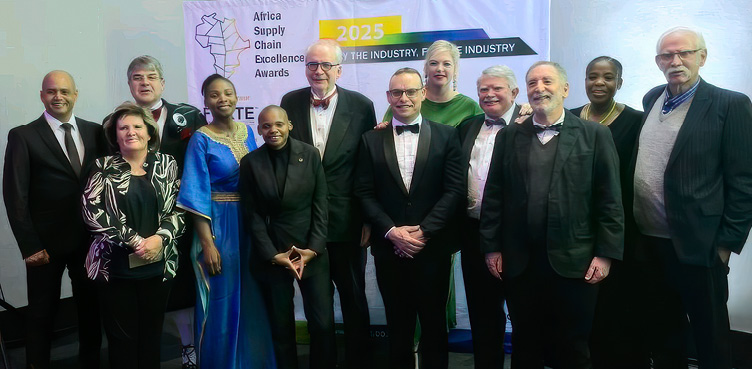
On 7 August 2025, CMCOMMS Supply Chain Quality Assurance received the Outstanding Achievement in the Humanitarian and Health Supply Chain Management Category at the Africa Supply Chain Excellence Awards (ASCEA). Presented “by the industry, for the industry”, this accolade recognises years of work transforming humanitarian and health supply chain systems into resilient, professional, and quality-assured networks that safeguard lives across Africa.
The award submission was anchored on one central idea: Good Storage and Distribution Practices (GSDP) as an affordable and accessible tool in the fight against substandard and falsified medical products (SFMPs), integrated with field-based Last Mile Assurance assessments to strengthen quality and integrity throughout the supply chain.
From Policy to Practice: Turning Standards into Action
Health supply chains across Africa are often governed by policies and regulations that look robust on paper. The real test lies in translating those documents into daily practice at warehouses, border posts, distribution hubs, and rural health facilities.
CMCOMMS has built its reputation on bridging that gap—turning policy into practice by designing, implementing, and embedding practical quality assurance systems that work in real-world African contexts. Whether it is a GSDP compliance checklist adapted for humanitarian operations or a Last Mile Assurance tool tailored for fragile health systems, CMCOMMS ensures that every measure taken is both compliant with international standards and workable for the teams on the ground.
A Pan-African Commitment Rooted in GSDP
At the heart of CMCOMMS’ work is a belief that how medicines and medical products are stored, transported, and distributed is as critical as how they are manufactured. This principle has guided a sustained advocacy and technical assistance effort to embed GSDP in humanitarian and health supply chains across Africa.
Our engagements span GSDP compliance assessments, technical audits, and training programmes for humanitarian agencies, ministries of health, regulatory authorities, and logistics service providers. The objective remains constant: protect product integrity, protect patients, and protect public trust.
GSDP: From Technical Standard to Human Safeguard
While GSDP may appear to be a technical compliance checklist, in practice it is a life-saving measure. SFMPs do not always present as obvious threats—they can be genuine medicines that have lost quality due to poor storage or distribution practices. Without proper temperature control, protective packaging, and documented chain of custody, medicines can become ineffective or dangerous.
Through its integrated Prevention, Detection, and Response approach, CMCOMMS addresses these risks:
- Prevention: Strengthening systems through compliance audits, supplier pre-qualification, and hands-on staff training.
- Detection: Implementing inspection protocols, quality control sampling, and field-level reporting channels.
- Response: Coordinating recalls, enforcing regulatory action, and tracking corrective measures to prevent recurrence.
Last Mile Assurance: Quality Where It Matters Most
In humanitarian and health supply chains, the last mile—the final stage where products reach clinics, hospitals, and communities—is often the most vulnerable. CMCOMMS’ Last Mile Assurance (LMA) work ensures that GSDP standards are upheld right to the point of care.
By assessing conditions in warehouses, vehicles, and health facilities, LMA identifies gaps that could lead to quality loss, from inadequate cold chain equipment to poorly documented product handovers. This is not just about finding problems; it is about building practical, context-specific solutions that frontline staff can sustain.
Professionalisation as a Strategic Imperative
CMCOMMS is not simply “supporting” the movement to professionalise Africa’s health supply chain workforce—we are part of the movement’s leadership.
As a Coalition Member of People that Deliver (PtD), a PtD STEP 2.0 Accredited Implementing Partner, the Southern Africa Regional Lead for the International Association of Public Health Logisticians (IAPHL), and a VCare Academy Knowledge Partner, CMCOMMS plays a direct role in shaping and delivering professionalisation strategies at national, regional, and continental levels.
The CMCOMMS Medical Logistics Practitioner Training Programme
One of our flagship contributions to professionalisation is the CMCOMMS Medical Logistics Practitioner Training Programme—a fully accredited, Africa-grown training initiative designed to strengthen the skills, confidence, and recognition of health supply chain professionals.
This programme is accredited by:
- The Pharmacists Council of Zimbabwe (PCZ)
- The International Pharmaceutical Federation (FIP)
- The CPD Group UK
It is also recognised by the Medicines Control Authority of Zimbabwe (MCAZ) for its integration of GSDP and Time and Temperature Sensitive Pharmaceutical Products (TTSPP) best practices.
Impact to date:
- Over 1 000 professionals trained in Zimbabwe and across Africa
- Courses tailored for warehouse operators, transporters, pharmacists, procurement officers, and humanitarian logisticians
- Practical modules covering cold chain management, GSDP compliance, last mile delivery, and regulatory audit readiness
This achievement represents more than numbers; it is the foundation of a competent, recognised, and sustainable workforce that can safeguard the integrity of medical products in the most challenging contexts.
Multi-Stakeholder Collaboration: A Non-Negotiable
Preventing SFMPs and ensuring GSDP compliance is not the responsibility of regulators alone. CMCOMMS works across a network of stakeholders, including humanitarian agencies, procurement entities, logistics companies, community organisations, and law enforcement.
We also engage actors often overlooked in formal strategies—such as truck drivers, bus operators, and freight forwarders—whose decisions directly influence the integrity of the supply chain. By equipping them with the awareness and tools to refuse transporting non-compliant products, the overall system is strengthened.
Recognition of an African-Led Model
Receiving the ASCEA award affirms that African-led solutions, designed and implemented by regional experts, can meet and exceed global benchmarks. It reinforces the reality that GSDP—while technical in nature—is a strategic enabler of humanitarian and public health outcomes.
CMCOMMS’ approach demonstrates that quality assurance is not a donor-imposed requirement; it is an investment in health system credibility, community safety, and sustainable access to medicines.
Sustaining Momentum Beyond the Award
This recognition is not an endpoint; it is a launchpad. CMCOMMS intends to:
- Advocate for continent-wide adoption of harmonised GSDP frameworks
- Integrate SFMP prevention into humanitarian emergency response protocols
- Scale professionalisation programmes so every supply chain role is backed by accredited training
- Expand public awareness initiatives to reduce reliance on informal markets for medicines
A Closing Reflection from a WHO-Level 3 Regulator
In summing up the significance of this recognition, it is fitting to share the words of Richard Tendayi Rukwata, Director-General of the Medicines Control Authority of Zimbabwe (MCAZ), a WHO Maturity Level 3 regulatory authority:
“Congratulations to you Mr Wil Chandomba and to CMCOMMS upon receiving this well deserved award and recognition! Your commitment to supply chain integrity of medical products on the African continent is commendable and inspiring. MCAZ is proud to be associated with you and wishes you even greater success and recognition in this critical field because your success directly and indirectly translates to better access to quality healthcare for all Africans. Keep up the good work, sir!”
This sentiment captures the essence of the award: technical excellence, human impact, and a commitment to the health and dignity of every African.
Wilson Chandomba is the Founder and Managing Consultant of CMCOMMS and IAPHL Southern Africa Regional Lead.