
















































































Adapting for impact: how technology is reshaping higher education
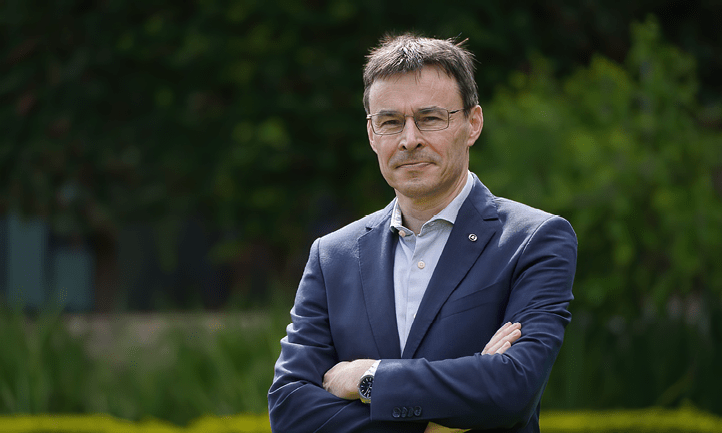
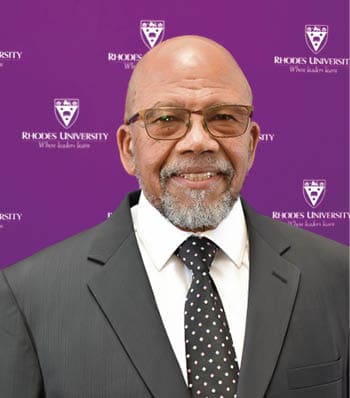
Adapt IT Education Group Managing Director Luxolo Rubushe is a visionary leader with a deep passion for advancing Higher Education. In a compelling conversation with Leadership Editor Professor JJ Tabane, he unpacks key themes poised to transform the delivery of Higher Education across the African continent.
Luxolo Rubushe is passionate about education. Between all he must do to see to the running of ADAPT IT Education, he is also in the throes of forming an Adapt IT Academy with a focus on bridging the digital divide and optimise opportunities of youth employment in Africa. He has taken on all of these responsibilities because, in his view, it is essential that we do all in our power to leave behind a strong legacy of education.
Rubushe relates how he did not set out to lead an organisation such as Adapt IT Education —rather, it stemmed from how his parents instilled a love for education in their children. Education has been central to his upbringing and members of his family now hold over thirty graduate qualifications between them.
“Our mother imparted a lot of passion for education in all of us,” he says.
His introduction into the world of education was born with his role as Chief Operations Officer (COO) of the NSFAS (National Student Financial Aid Scheme), where he developed an understanding of the post-school education sector and the importance of partnerships between institutions and tech companies. He had previously worked as Senior Manager at Accenture, implementing leading ERP solutions such as SAP and Oracle. It was his role at NSFAS, however, that created a wide network that would serve him well for the rest of his career.
“I could see disparities between historically disadvantaged institutions (HDIs) and historically white institutions (HWIs), especially in administration,” he recalls. “At some HDIs it became normal for students to physically queue on campus without having formally applied. That should not be the norm.”
Rubushe see technology as an equaliser.
Adapt IT has been a leading player in higher education in Africa and beyond for almost 40 years. It developed the ITS Integrator, now on its 16th edition, with a primary focus on addressing the challenges of institutions of higher learning across the African continent. “Technology is an equaliser across the globe and Adapt IT Education’s EdTech solutions are being used around the globe. The good news is that the IP sits with us—we are not a reseller. This gives us an edge,” he says, revealing a key component of Adapt IT Education’s strategy. “Locally, we help to bridge the gap between HDIs and HWIs. Globally, we benchmark our solutions against the best in the world.”
We pivoted and extended our offering and integrated digital teaching and learning through our partnership with Moodle, covering the entire student lifecycle, from Enquiry to Alumni.
Our acquisition by Omegro (Volaris), part of Constellation Software, provides us with a strong platform to invest in and incorporate leading technologies in our stack, benefiting from hundreds of other businesses in the group.
Rubushe notes that while there have been many efforts, there is still significant room to enhance application and consistency of processes throughout the education system.
“If all role players fulfilled their responsibilities, there would be no need for ‘favours.’ An institution stands or falls on its integrity, of assessments, examinations, and graduates.” he says, highlighting how Adapt IT solutions enhance institutional honour and reputation. “Adapt IT Education provides a platform that ‘locks’ marks, ensuring they remain secure and protected from interference during transmission between systems and before marks are released for access to the student. This approach helps track student progress, optimises academic support programmes, prevent wrongful promotion or graduation.”
Another example he cites is a lack of validation and authentication of matric results at a time of registration, risking incorrect registration, and graduation. Correct application of the academic structure in the ITS Integrator solution obviates this challenge, aids automatic promotion and automatic identification of qualifying graduates, in line with institutional guidelines. A process that historically took weeks can be done in a matter of hours.
Visions for Higher Education
Rubushe’s Vision for a Stronger Higher Education System
If anyone is truly listening
He outlines a bold vision for transforming higher education, one that tackles inefficiencies head-on and puts student success at the centre. Here are four key interventions he believes could make a lasting impact:
1. Fix NSFAS
Timely student registration hinges on the smooth functioning of NSFAS. When it falters, the entire academic calendar is thrown into disarray. According to Rubushe, “If NSFAS is in crisis, the whole system feels the ripple effects.” Getting this right is the first and most urgent step.
2. Tackle the High Attrition
Various research papers indicate high attrition rates in the PSET sector, with reports of as high ”sixty percent of those going to TVET colleges drop out in the first year.” This presents significant challenges on the national fiscus, and noting the rule of n+1, the state is compelled to fund the needy student for a subsequent year “There are limited systems to track progress, and institutions are not addressing the real challenges students face. Yet, the technology exists to do this better.”
Best case for us would be a collaboration with the sector with a target of, say, 50% decrease on the attrition rate over the next 3 to 5 years, which could have significant positive implications for broader student funding in the sector, especially when one notes that institutional funding allocation is also a function of throughput and pass rate.
3. Rethink Space and Access
Every year, thousands of willing students are left out simply because there is no space. Rubushe believes a hybrid learning model is the answer. “We need to move beyond the limitations of physical buildings. The proliferation of online teaching and learning, particularly from leading international institutions, is testament to a different approach that could accommodate thousands of additional student enrolments.”
4. Overhaul the Curriculum
To what extent are graduates academically prepared to deliver value from day one in the workplace? Rubushe raises concerns about the gap between academic learning and practical application. “Internships are too short, and many students struggle with basics like writing reports or professional communication, in addition to the core areas of study like technology and information systems. We need real curriculum reform that bridges this divide.”
5. Innovate and Commercialise
Our institutions have deep expertise in research and, as a continent, we are endowed with a myriad of challenges to solve for. The reality of Artificial Intelligence presents us with an opportunity to ‘Africanise’ the AI space. Adapt IT is working on strategic partnerships with leading institutions to co-invest in cutting edge solutions. These partnerships are complemented by niche acquisitions that complement the existing technology and solution stack.
Adapt IT Education has the capacity and expertise to assist the PSET sector in driving these essential interventions and is already demonstrating this capability in various international markets as part of its growing global footprint.
In an extensive conversation we find out more about his vision and what lays ahead in the journey that Adapt IT Education has embarked upon.
How did your background influence and inspire your passion for education?
The biggest influences were my parents and siblings, and my mother, Nosizwe Rubushe, has always been passionate about education. She narrates a story whereby missionary preachers and teachers approached her parents of the Mapuma dynasty to allow their daughter to continue with her studies, noting her brilliance in class. She proudly boasts about how she always achieved first or second place in her class. Her inability to continue with her academic programme translated into her encouraging her own children to study and close that void. My father Mabali Rubushe, realising that, as blue collar worker, his chances of making a decent living from his job were significantly constrained, partnered and supported our mother in her vision to educate their children. That man sacrificed his best years for us, working himself to the bone from Monday to Sunday without rest, just to fulfil this shared vision.
A pioneer in education was our grandfather, Manunu Rubushe, who invested in educating not only his children, but also those of the broader Rubushe family, and who went on to make a name for themselves in various fields available to them at the time.
It would be amiss of me not to pay tribute to my siblings who took responsibility for financially supporting the younger ones in the family so that we could study and finish our tertiary education, particularly MK, Ondluhlanga and Pamela Rubushe. My sister, Pamela, was one of the first graduates in the family in 1979, and she has been a major influence in my life as she sacrificed her meagre salary as a social worker to get me a good education. When it comes to education, she has led from the front by bagging four degrees—including her Masters—long before it was fashionable to do so.
This legacy has, over time, resulted in our family realising academic success at post-school level in various fields such as business administration, law, finance, chartered accounting (CA) as well as chartered financial accountancy (CFA), engineering, information systems, marketing and entrepreneurship, quantity surveying and infrastructure management, industrial psychology, political science and sociology. At last count, there were approximately 40 degrees and diplomas among us kids, including our children.
Education is therefore a defining virtue that shapes the character of the Rubushe family, the genesis of which is our parents, internalised by my siblings and celebrated through our children.
What was the highlight that shaped your vision for the difference Adapt IT can make?
I come from a background of struggle that values education and intellectuals. My world view has also been shaped by the philosophy of black consciousness which, among others, compels one to take complete responsibility of ones destiny and to espouse excellence. In every task I have undertaken, I have espoused exceptional outcomes.
My first introduction to the power and influence of education dawned when I became the Chief Operations Officer (COO) at the National Student Financial Aid Scheme (NSFAS) in 2012. I worked with a wonderful team of operational staff who achieved great feats in unlocking inherent challenges and increasing weekly fund disbursement from under R50-million to over R600-million per week, following a re-engineered manual process. That experience for me and my staff affirmed the power and benefit of LEADERSHIP. We were able to disburse R6-billion in 9 months, a feat not experienced by the sector up to that point
One morning I arrived at the office to find an elderly man waiting with his wife. Due to their commitment to educate their son, the elderly man returned from retirement to earn an income, and when this was not enough he took loans with banks. When that was not enough, he came to me at NSFAS to try and assist them. I remember his gaze when he pulled out the proof of loans from two banks. This was so painful to experience and reminded me of my own father’s struggles. Long after we had assisted him, he would just call me randomly and ask how I was doing. “Mntanam, mkhulu kakhulu umsebenzi owenzayo, uThixo akuphe amandla.” (My child, you have a massive responsibility on your shoulders, may God give you strength.)
By the time I was headhunted by Adapt IT in 2015, I had a deep understanding of the challenges of the Post School Education and Training (PSET) sector, covering both universities and colleges. Adapt IT Education was founded on a unique solution known as the ITS Integrator that was purpose-built to address administrative challenges of the PSET sector some 39 years ago. It is an integrated ERP of Student Management, Finance and HR/Payroll. I had started my career with Accenture where I spent more than nine years implementing large-scale Enterprise Resource Planning (ERP) solutions that were geared towards the total transformation of organisations. I understood their power to transform organisations. This experience was complemented by my role in defining and driving the execution of organisational and technology strategy through the Coega Industrial Development Zone (IDZ), an experience I continue to cherish to this day.
When I appreciated the history, legacy and deep functionality of the ITS Integrator system, I was convinced that, applied differently, it would be the engine of total transformation in our institutions of higher learning. That has been our mission in South Africa, and through the rest of the African continent.
What major interventions has Adapt IT introduced to enhance the education system?
The most decisive intervention we have implemented relates to an epoch we refer to as Starting the Academic Programme on Time. We coined this epoch because it addresses one of the key outcomes of a multi-pronged review and analysis of the challenges of the sector. One of our key findings was that there were significant gaps between various departments charged with the responsibility of ensuring that the academic programme starts on time. These include those charged with marks administration, examinations, promotions, graduations, academic applications and registration, residence administrations, maintenance of the academic and fee structure, space management and funds administration, particularly NSFAS in the South African context.
With COVID-19 tailwinds on our back, we championed a complete self-service capability as Adapt IT, where students are able to apply for academic and residence enrolment without the need to be physically present on campus. This includes direct interface with third-party payment providers such as banks for near real-time clearance.
This has been complemented by what we refer to as the White Space Programme, an intervention of closing the gap between Adapt IT and our clients regarding the effective use and value of our products and solutions. The results have been overwhelmingly positive.
How would you assess the state of the higher education industry, especially considering the recent deregistration of some colleges and recurring issues of poor client service and fraud?
Our PSET sector is resilient and thriving, particularly when it comes to the core business of the institutions, which is research output and the development of critical skills. The challenges I can highlight relate to three areas:
a) NSFAS Administration
The effectiveness of the PSET sector in South Africa has a significant dependency on NSFAS, noting its budget of over R40-billion per annum. Challenges with NSFAS have a knock-on effect on the administration and teaching. I would encourage more engagement and partnership with organisations such as Adapt IT, due to our reach and influence.
b) Financial Sustainability
Institutions are faced with a challenge of financial sustainability, driven largely by limited budget allocations and increasing operational costs. Consequently, there is a drive for internal efficiency as well as the pursuit of sources of third-stream income.
c) Curriculum Review
There is a growing need to align curricula to current market and job requirements, noting the impact of technology such as Artificial Intelligence (AI). This gap is evidenced through the youth graduate and learnership programmes that Adapt IT runs, especially when compared to clients from other geographies.
Adapt IT has positioned itself as a leader in education technology. What are the key pillars that set the company apart, and how do they drive its success?
Adapt IT was acquired by Omegro, which is a portfolio of Volaris, who are a part of Constellation Software. Their philosophy is that of an acquirer and retainer of vertical market businesses, for life, and never sell. Constellation Software is listed on the Toronto stock exchange with a market capitalisation of $92-billion, and ranks in the top 10 software businesses in the world.
There are a number of key elements that set Adapt IT apart. At a group level, we are market leaders in developing vertical market software and digitally-led solutions. This allows Adapt IT to focus on providing solutions that are aligned with customer needs and can scale and optimise impact across the institution.
Adapt IT Education retains its leadership position in the sector because:
- • Our ITS Integrator was developed from the ground up to address challenges of the higher education sector. It was not repurposed from another industry for the education sector;
- • We have a deep understanding of higher education, supported by a product that is backed with almost 40 years of intellectual property;
- • We are not resellers of third-party products—we research, develop, implement and support our own products and solutions;
- • We provide integration capability with a number of key role-players in the sector, viz ,the National Student Financial Aid Scheme (NSFAS), learning management systems for digital teaching and learning, banks for online payments, and telecommunication providers for improving engagement with students and staff alike;
- • Long-term financial sustainability is supported by the universal and successful experience of Omegro that focuses Research and Development (R&D) as well as effectiveness in maintenance and support;
- • Long-term partnerships with our customers and the broader education sector, including the Department of Higher Education and Training (DHET). We hold regular engagement through our annual ITS User Group, from which Special Interest Groups (SIGs) shape the future development needs of the sector.
Can you walk us through the latest developments in your flagship software solutions, particularly the ITS Integrator?
Sector needs have evolved quite significantly over the past three to five years. Central to that change has been a complete shift from a centralised back-office to student self-service processes.
This has had significant shifts in terms of product design, accessibility, security, as well as agility in the pace of product development and enhancement.
Artificial intelligence (AI) is making its mark across multiple industries, particularly in higher education.
Adapt IT has, over the past three years, invested in the next generation of its product, ITS Infinity. This product is underpinned by a philosophy of automation and simplification. We have prioritised student management with a focus on streamlining a modern application, admission and selection process. Results at our early adopters Walter Sisulu University (WSU) and the Tshwane University of Technology (TUT) have been outstanding.
Some example of benefits already identified are:
- • Empowering institutions with actionable insights! Our insights dashboard for the registration system offers real-time analytics and visualisations;
- • Providing administrators with a comprehensive view of enrolment trends, course demand, student demographics, and more;
- • Streamline decision-making, optimise resource allocation, and enhance student experiences with data-driven strategies tailored to the needs of education institutions.
We have enabled an end-to-end process of students applying and registering online without the need to set foot on campus. We are embedding AI in the applications process, noting our integration with, for instance, the Department of Home Affairs in the verification of identity documents.
Adapt IT is a certified implementer of Moodle, the most commonly used Learning Management System (LMS) in the world, driven largely by the fact that it is Open Source. We are working with the broader community to leverage the benefits of AI mark assessments, curriculum development, and so on.
Since our last conversation, what new technological innovations has Adapt IT introduced into the education space?
We went back to basics and began a process of engaging our customers on what we term the White Space Programme. We are running the programme in order to truly appreciate challenges that our customers are experiencing and how our ITS Integrator and other solutions are able to address these. We visited 31 institutions in the past academic year, where we ran the programme over three days, covering the core components of our ERP, namely Student Management, Finance and HR/Payroll. We then put together a programme for each institution in order to address any key challenges they may have.
Arising from this programme we discovered that some key functionality was not being optimised by institutions. Examples are:
- • Automated student communication with students through what we call iComms. Students require a feedback loop so that they are in touch with the institution and the status of their academic programme.
- • Accommodation management: ITS has an integrated academic and accommodation management solution that provides visibility of the number of beds, the fee per bed, in addition to seamless management of on- and off-boarding processes, with full integration coming between the number of available beds and the related billing, thereby minimising the risk of significant losses for institutions.
- • The engine of the ITS Integrator assists with identifying risks for penalties on enrolments, which is a serious challenge for the sector, as institutions are penalised significant amounts for missing enrolment targets.
- • Student Tracking is another functionality that enables institutions to minimise dropouts and thus optimise subsidy allocations from DHET.
- • Timetabling is another critical element that brings together various elements such as space management, institutional planning and academic planning together. We have CELCAT that streamlines and automates this process for institutions by automatically allocating students to available classes by lecturer, noting the carrying capacity of each venue so as to eliminate the possibility of students not having a place to sit during lectures or examinations.
- • We have also partnered to provide access to Moonflow, a supplier management tool that responds to the compliance and audit challenges of the sector. This provides validation at onboarding, assists to track procurement in line with the registered industry, and checks for staff who may be directors in companies that are procuring services in the same institution.
The TVET sector plays a critical role in skills development. How is Adapt IT supporting this sector, and what impact has your involvement had so far?
There are 23 TVET colleges that are customers of Adapt IT, particularly in South Africa. TVETs are central to the development of critical skills for industry. We are proud of our record of providing solutions for end-to-end student administration, from enrolment to graduation. Secondly, we are providing our Moodle LMS in the application of digitising teaching and learning. There has also been a request to provide our alumni management with an application to assist with tracking students once they graduate and who are in need of employment opportunities.
Noting the specific requirements of TVET colleges, we have created a separate business unit within Adapt IT Education and convened our inaugural TVET-focused summit in 2024 to consolidate an integrated TVET-specific solution.
Lastly, we are collaborating with SAPCO, a leadership structure of TVET principals, in the formation of the Adapt IT Academy so that we may provide additional upskilling opportunities to improve the chances of employment for graduates. Collaboration with SETAs as a critical partner in the provision of skills for industry is essential for the success of this initiative.
The hybrid education model is gaining traction globally. How do you see Adapt IT accelerating its adoption and addressing key challenges in blended learning?
We are proud of our successful implementation of Moodle LMS at UNISA, one of the largest distance learning institutions in the world. That experience has been vital in shaping our capability in enabling hybrid learning. We understand that the core business of institutions is not administration, but teaching and learning.
ITS Integrator already provides core information necessary for hybrid learning, including academic planning, student enrolment, marks management, examinations and graduation. We have built an integration layer between our ITS and various LMS systems in order to enable this process.
We are exploring generative AI to automate contact centre processes. Our platforms have to enable various role-players, including proctoring, content development, assessors and tutors via a digital platform. An integrated ITS and Moodle LMS provides the capability we require to facilitate blended learning in the sector.
How are your strategic partnerships evolving? Have they delivered the anticipated value since your last feature in Leadership Magazine?
Our network of strategic partnerships has had mixed results thus far. WSU and TUT are great examples of where our partnerships have succeeded. It was Infinity on both, but we succeeded in providing a cloud hosting solution for TUT as well. Moonflow, our supplier management application, was another example of a successful collaboration. We have also signed partnerships with other leading institutions and these will be announced over the next few months.
Our analysis on the challenges pointed to a need for a clear governance framework for addressing investment decisions and associated benefits. Some of the partners also raised concerns regarding IP, and these have been attended to. As part of Omegro, we have access to a framework for driving profitable partnerships and we shall be launching this programme on 30 June 2025, before the end of Quarter 2.
Adapt IT has a growing international footprint. How are your global strategic growth interventions progressing, particularly in East Africa?
East Africa is certainly our focus for growth, both in terms of organic growth as well as identifying opportunities for Mergers and Acquisition. Kenya has over 120 universities and colleges, while the number in Tanzania is around 200.
I am happy to report that we secured our first customer in Kenya, the United States International University, in January of 2025, after many years of establishing our presence in the region. We are currently busy with the implementation phase of this project.
We were honoured to have the CEO of the Higher Education Student Loans Board (HESLB), Dr Bill Kiwia, attend our ITS User Group in March 2025. We believe there are promising opportunities for us to bring our deep experience in higher education and add significant value in the region.
What is the current adoption rate of your ERP systems in the education sector? Previously, 19 out of 26 universities were enrolled—has this number grown?
We have remained fairly stable in South Africa. Our experience informs us that their gestation period is 18-24 months. Noting the current challenges of the sector we don’t anticipate any major shifts, particularly in the short- to medium-term.
East Africa, on the other hand, is showing great promise. Our success with USIU augurs well for us, and we are realistic but certainly optimistic of our prospects in this region.
As a business leader navigating an evolving digital landscape, what are the top three leadership lessons you’ve learned on your journey?
Leadership is primarily about people. This requires that we intentionally invest time in understanding our people, their aspirations, concerns and fears. Our task is, to the best of our ability, align these to opportunities within the organisation.
The first leadership lesson is VISION. In a dynamic environment such as technology, with the opportunities and risks it provides, it is critical that you have a clear vision around which you can galvanise your team.
Second, you have to create and foster a LEARNING CULTURE. True strength and sustainability comes from an organisation that is not intimidated or overwhelmed by change, as this should be a constant in a dynamic technology environment.
ADAPTABILITY: Be firm on STRATEGY, but be flexible on TACTICS. Delegation requires that we accept that our colleagues may have a different approach to executing our strategy.
Artificial Intelligence, particularly Generative AI, is transforming industries. How is Adapt IT leveraging AI to enhance its offerings in order to improve educational outcomes?
Our current focus is on leveraging extensive opportunities for training and upskilling our staff on AI, noting its impact in the sector. We have also re-aligned our teams to have a dedicated focus on piloting high-impact projects in what we refer to as Initiatives—these are funded opportunities with a clear business case and return on invested capital, over clearly defined timeframes.
Strategic partnerships will be a key source of strategic advantage on AI. We are fortunate in that we work with institutions of higher learning, with a vested interest on research in areas that are of particular interest for us, such as generative AI, virtual and augmented reality.
Prof JJ Tabane is the editor of Leadership and BBQ Magazine.
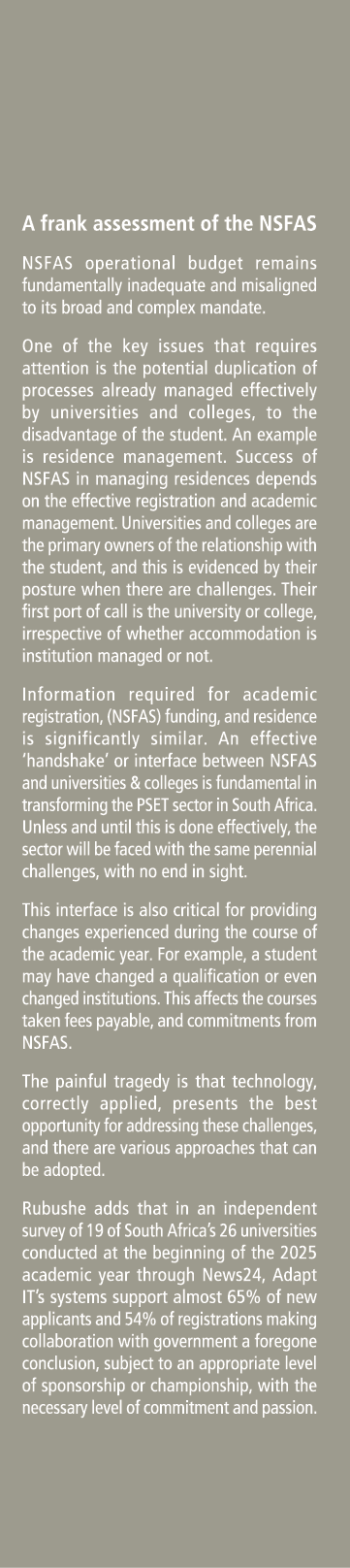
A frank assessment of the NSFAS
NSFAS operational budget remains fundamentally inadequate and misaligned to its broad and complex mandate.
One of the key issues that requires attention is the potential duplication of processes already managed effectively by universities and colleges, to the disadvantage of the student. An example is residence management. Success of NSFAS in managing residences depends on the effective registration and academic management. Universities and colleges are the primary owners of the relationship with the student, and this is evidenced by their posture when there are challenges. Their first port of call is the university or college, irrespective of whether accommodation is institution managed or not.
Information required for academic registration, (NSFAS) funding, and residence is significantly similar. An effective ‘handshake’ or interface between NSFAS and universities & colleges is fundamental in transforming the PSET sector in South Africa. Unless and until this is done effectively, the sector will be faced with the same perennial challenges, with no end in sight.
This interface is also critical for providing changes experienced during the course of the academic year. For example, a student may have changed a qualification or even changed institutions. This affects the courses taken fees payable, and commitments from NSFAS.
The painful tragedy is that technology, correctly applied, presents the best opportunity for addressing these challenges, and there are various approaches that can be adopted.
Rubushe adds that in an independent survey of 19 of South Africa’s 26 universities conducted at the beginning of the 2025 academic year through News24, Adapt IT’s systems support almost 65% of new applicants and 54% of registrations making collaboration with government a foregone conclusion, subject to an appropriate level of sponsorship or championship, with the necessary level of commitment and passion.