


Max Matavire looks at the effects mining activities have on local communities, with proposals on how mining companies can work together with local communities for mutual benefit without damaging the environment
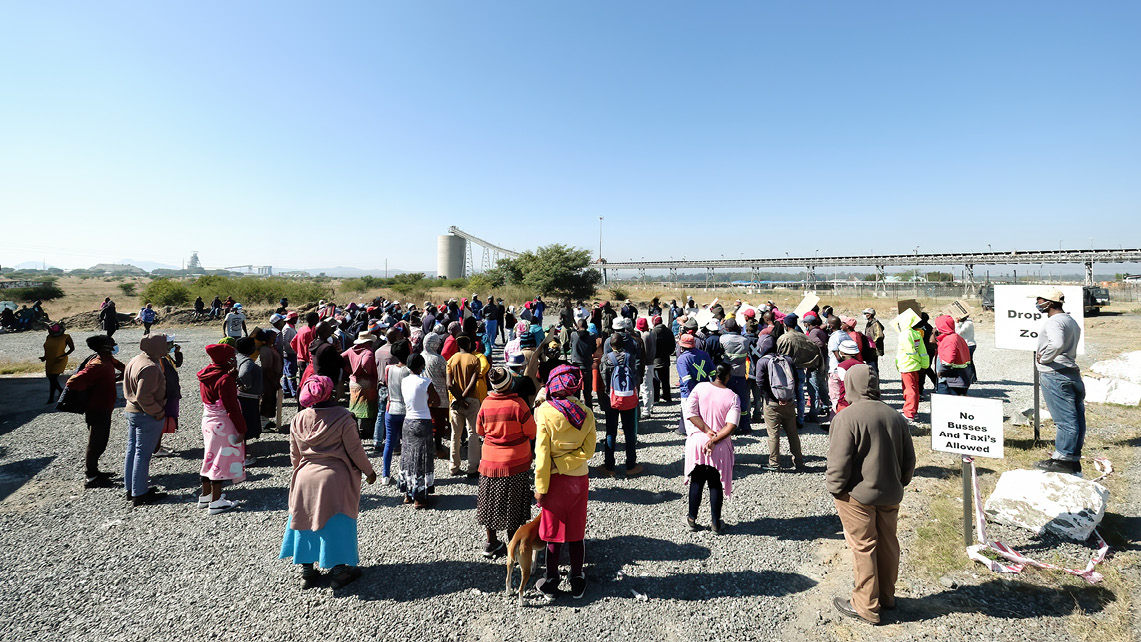
August, 14th 2023 will, for bad memories, remain etched in the minds of the Gcinasizwe Village community in the remote rural region of Pondoland in the Eastern Cape. This is because it is the day their land rights and cultural dignity were violated by an international mining company when it started titanium mining on their culturally revered land, which is home to their ancestral graves.
The 200-household close-knit community’s anger was even made worse by the fact that they knew nothing about what was about to happen on their agricultural and grazing land as they were not consulted prior. Little did they know that a deal—disguised as rural development—had been entered into on their behalf between an Australian mining company and the Department of Minerals and Petroleum Resources behind their backs.
On the fateful day, the Gcinasizwe community woke up to unfamiliar noises of blasting and rumblings of heavy earthmoving machinery clearing a 50-hectare piece of land close to their homes, preparing it for mining operations. This is the land they had for generations revered as sacred and as their cultural heritage, as each time the community faced natural disasters such as floods, diseases, and other unexplained natural causes, they would go there and perform their traditional rituals to appease their ancestral spirits. All this was to end abruptly.
Community elders decided to approach the mining company only to be told consent had been given by the government, and that the community was sitting on huge deposits of precious minerals. The community mobilised and protested against the continued mining operations.
Several meetings between the government, the mining company, and the community were held but with no solution. Finally, with the support of human rights lawyers, environmentalists, and other sympathisers, the matter was resolved in the court of law, with the Gcinasizwe community emerging victorious and the mining company packed its bags and left.
This is but one of the numerous incidents which happen to most rural communities in South Africa where economic development projects are imposed on them without first being consulted. Other provinces whose rural communities have also fallen victim to the exploits of international mining companies are KwaZulu-Natal and the North West, since they are also endowed with mineral wealth. In July, the Mkhwanazi family in Dannhauser, a small coal mining town in KwaZulu-Natal, had to fend off Ikhwezi Mining Company which started mining on the family farm without their consent. The company produced a mining consent document which it said was issued to it by the government 10 years ago. The matter is currently in court.
The South African government just grants mining permits to international mining conglomerates behind the backs of communities on the pretext of development, which is supposed to benefit the communities. In real practice, this does not happen—after digging for the minerals and in the process causing irreparable damage to the environment, destroying the communities houses due to blasting vibrations and causing illnesses because of the mining dust, the mining companies leave for their shores together with the mining loot, leaving communities with massive gaping holes on their once pristine land and polluted drinking water sources.
This is a common occurrence in South Africa’s exploitative mining industry riddled with corruption as deals are cut between mining companies, the government, and middlemen without the involvement or benefit to the communities who are in some instances forcibly relocated elsewhere, paving the way for mining to take place. Sadly, communities are accused of being anti development when they stand their ground and oppose the mining operations.
Examples of this happening are in the Pondoland in Transkei, Eastern Cape at a village called Xolobeni and in Marikana in the North West province, where over 34 Lonmin mine workers demanding a living wage of R12 000 were moored down by South African police. Current South African President Cyril Ramaphosa, who at that time had shares in the company which owned the mine, is to date accused of having sent email messages to mine management instructing them to take stronger action against the protesting miners.
In the case of Marikana, the killing of the 34 miners is commemorated annually as a massacre. Anglo Ashanti Gold, who were the owners of Lonmin Mine, sold their operations and left the community in a deplorable state—communities live in corrugated tin sheet dwellings without water, no electricity, no recreational facilities, and unpassable dirt roads.
In Xolobeni, also in Pondoland and about 50 kilometers from Gcinasizwe Village, the community fought against this exploitation and took both the then Department of Minerals Resources and the Australian uranium mining company to court and won. In fact, the strong 250-household community which had organised itself under the name Amadiba Crisis Committee (ACC) won two court cases after Mineral Resources Minister Gwede Mantashe had appealed the first ACC court victory.
Mantashe, who had sought to divide this community by managing to isolate one traditional leader and influencing him to allow the mining to take place by offering him incentives, did not succeed, but still this resulted in killings as the communities became divided and turned on each other.
The ACC, under strong leadership of a gallant social justice activist Nonhle Mbuthuma, and galvanised by the mantra, “nothing for us without us”, rejected the mining development. “It must not be viewed as if we are anti development. No. The type of development they want to bring here is mining, and as you might be aware this activity is destructive by its nature. It damages the environment and worse still this area the environment is pristine and very sensitive. We also have our ancestors graves here and so it would be insensitive and unAfrican for someone, a foreigner for that matter, to come and dig up and in the process expose our ancestors remains,” Mbuthuma says in an interview with Leadership magazine.
“This land is our heritage and should be respected. Why doesn’t their so-called ‘development’ come in the form of eco-tourism and agriculture? The damage to the environment left by mining is permanent, irreversible, and we can’t afford that to happen here. Also mining is short term—when the deposits are depleted, they leave, whereas eco tourism or agriculture are sustainable for generations to come. We don’t want mining here,” says Mbuthuma emphatically.
The ACC is a social justice movement formed in 2007 whose focus is human rights, community land rights, resisting mining and infrastructure development whose sole aim is to maximise profits at the expense of the environment, human rights, and social justice. In a telephone interview, Xolobeni elders Mongameli Jacobs says: “During blasting, stones fly into households forcing families to flee with their children. This is not development, it’s destruction.” He added that even those jobs local communities are promised during these so-called development projects do not materialise as they are sold. “There’s lots of corruption,” he states, citing the example of the South African National Roads Agency Limited (Sanral) where jobs were being sold for as much as R20 000 during the construction of the N2 Wild Coast project which burrows through the Xolobeni community.
In her 2019 landmark judgement in favour of the ACC against the then Department of Minerals Resources, Gauteng High Court Judge Annali Basson said governance must first get consent from the affected communities when it wants to grant mining licences. Dismissing the department’s appeal, Judge Basson said: “Not only would it (mining) bring about a physical displacement from their homes, but it would lead to an economic displacement and engender a complete destruction of their (communities) cultural way of life.”
The department had argued that “mining was capable of co-existing with agriculture and tourism”. It had also lied that the community would get 25 percent of the mining deal for free.
Studies and practical examples have shown that mining companies throughout the African continent are known to be super exploitative. They take advantage of most African countries’ weak institutions, poor governing systems, and rampant corruption to buy their way through. The companies don’t exercise their corporate social responsibilities by ploughing back to the communities they operate in. Instead, they plunder the resources and as soon as there’s nothing more to extract, they leave poor, diseased communities and a damaged environment.
Bench Marks Foundation lead researcher David can Wyk says he has “very little time and respect for international mining companies. They are plundering the economies of African countries”.
Bench Marks Foundation is a South African non profit organisation promoting ethical investments and monitors multi-national corporations in Southern Africa and Africa as a whole to ensure that they meet minimum social environmental and economic standards, and it promotes an ethical and critical voice on what constitutes corporate social responsibility.
“South Africa must take full control of it’s mining industry. These mining companies are here to exploit. They are retrenching workers everyday and pay workers paltry wages. They don’t have interest in Africa except exploitation—extracting minerals and leaving local communities more poorer and a damaged environment,” said Van Wyk in an interview.
In one of his research papers published in 2018, titled ‘Global mining companies exploit African countries like South Africa by manipulating the tax regime’, Van Wyk says despite South Africa being richly endowed with numerous mineral resources which should fuel economic growth and development, the country still struggles with high poverty rates, underfunded public services and limited infrastructure. “One of the critical reasons for this paradox lies in the way mining companies—often multi-national giants—engage in tax evasion and avoidance, siphoning off revenues that should support national development.”
He says the South African government faces challenges in regulating the sector and the broader socio-economic impacts. Van Wyk accuses the mining companies of concealing their true financial situation to reduce their tax liability. This includes under reporting income, inflating deductions or hiding money and assets. Tax avoidance, says Van Wyk, on the other hand involves exploiting loopholes in the law to minimise tax payments, typically through aggressive but legal means. “These practices deny African governments vital revenues but they differ in legality and the mechanisms involved.”
Estimates suggest that Africa loses billions in US$ (dollars) every year due to corporate tax abuses in the extractive sector. This loss limits governments’ ability to invest in social services like health, education, and infrastructure. Another socio-economic impact resulting from the irresponsible and exploitative behaviour of the extractive sector is the increase in inequality. “When companies do not pay their fair share, the tax burden shifts to ordinary citizens often through regressive consumption taxes thereby worsening social inequality,” says Van Wyk.
Among some recommended reforms and solutions to improve this situation, Van Wyk suggests:
- Strengthening of the legal frameworks: This entails modernising mining laws, closing loopholes, and enacting robust transfer pricing regulations.
- Building of institutional capacity: invest in training, technology, and resources for tax authorities and regulatory agencies so as to monitor the extractives sector.
- Engaging in civil society: Supporting the watchdog role of civil society organisations and investigative journalism can expose abuses and hold both government and mining companies accountable.
Kgothatso Ndengethwa, a researcher, geologist, and founder of Imbokodo Mining Services, which specialises in artisanal and small scale mining, says the government should differentiate between informal community mining and invasive illegal mining if it is to succeed in formalising the sector.
In her research published in 2015 and supported by the Canon Collins Foundation and the National Research Foundation of South Africa, Ndengethwa argues that not all informal mining is illegal and that it is not all the same.
“In South Africa illegal mining as it currently stands covers all aspects of unpermitted mining. But this definition does not allow for differentiation between invasive illegal mining and informal community mining.
“Invasive mining occurs when miners illegally enter the old mine workings of decommissioned mines. Informal mining is community-based mining that typically follows customary law. The two are very different types of mining but have the same illegal status under the law. This gives rise to a fundamental question: is all informal mining illegal and is it all the same? The answer is NO.”
Ndengethwa says throughout the African continent artisanal and small scale mining, whether legal or illegal, has been associated with social problems such as crime, conflict, environmental damage, health risks, and child labour.
She says for the scourge of illegal mining to be curbed, there must be a distinction between illegal mining and informal mining. Ndengethwa says activities of illegal miners, commonly referred to as zama zamas in South Africa is considered illegal because they operate without a permit and also because they trespass on the land of large scale miners and are in possession of unwrought gold which is illegal under the Precious Metals Act of 2005.
“Because the zama zamas activities are very different from those of informal community miners who exercise customary mining practices which are infact recognised by the Department of Minerals Resources, the informal community miners should be formalised and recognized under South African law,” argues Ndengethwa, adding that this has not happened yet due to lack of capacity in the small scale mining sector.
Max Matavire is a freelance Journalist who writes for City Press, the Mail & Guardian, and Sunday Times.
