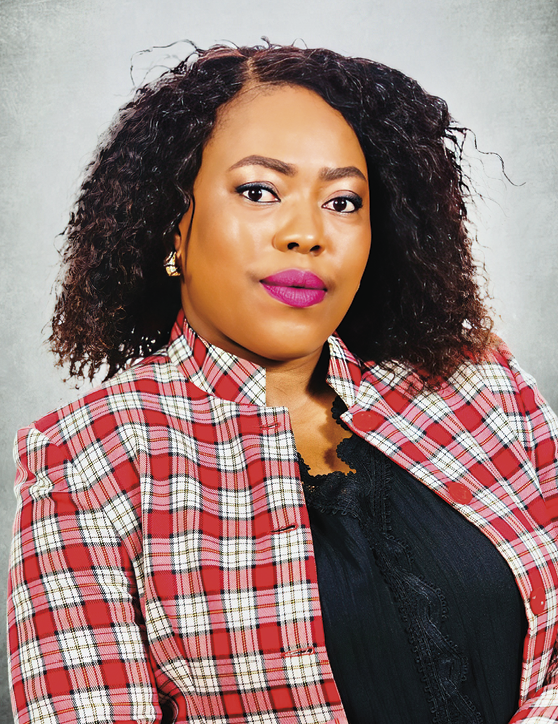
The Council for Geoscience’s Dr Thuli Khumalo simply wants what’s best for women, and she is playing her part in pushing for true equality
Dr Thuli Khumalo’s journey to the position of Executive Manager: Office of the CEO at the Council for Geoscience (CGS) is as inspirational as it is impressive.
While right now she may be the glue that holds a lot of the operational aspects of the Council together, it was her stints as the Chief Operations Officer in the Presidential Climate Commission, Deputy Director-General (Climate Change and Air Quality) and National Air Quality Officer in the Department of Forestry, Fisheries, and the Environment that truly put her on the map.
But as much as she has played a major role within the South African scientific community, at her core, Dr Khumalo is a powerful woman who has obliterated the barriers which have held back so many women in what is a male-dominated sphere.
“For me, it has always been very clear how important the roles of hard work and being focused in life are. In a lot of my professional work and also at a personal level, I think there is no substitute for hard work and being focused on what you want to achieve. That has been critical for me,” she states.
“But I have also had support at different times in my life. I feel that when you grow in your career as a woman and move up the ranks, support is so important. I think as women we have to be intentional about setting up those support structures for ourselves so that we can focus on the things that we need to focus on.”
The challenges facing women
Dr Khumalo believes that there are too many competing priorities for women in the world of science and work in general, which make if difficult for women to grow quickly in their careers.
She used an apt example of a young woman who is a talented scientist. She is progressing in her career, but she reaches the point in her life when she wants to settle down and start a family.
However, as she does not have sufficient support, she feels she is being pulled in all directions.
This scenario is more common than many think and means that difficult decisions need to be made.
Dr Khumalo explains: “In my experience as far as competing priorities for women are concerned, I’ve had to work two or three times more than my male counterparts to receive the same type of recognition.” It has just felt like as a woman one has to prove themselves over and over in the workplace to attract the right type of attention and recognition. Even now, it’s a struggle for women to be recognized for the work that they do. I think that’s part of the reason why many women find it a bit of a struggle to advance in their careers.”
And if that is not enough of a challenge, sometimes you have to contend with the struggles of not receiving the required support from your colleagues on a day-to-day basis.
This is something which Dr Khumalo has experienced in the past, but the reality is that it only motivated her to come out stronger.
“There were times in my career when I did not get support from colleagues, people that I was working with, at least at times when I thought I needed the support. So I would have to work it out and fight it out on my own,” she continues.
“I have had times where even my supervisor did not support me at all and it was very hard working under them. The working experience should not be like that for anybody. It was also sad at the time, but when I look back now, I realize that that was the time I grew the most and learnt to be deliberate and meticulous in my work.”
Then there is the reality of the field in which Dr Khumalo operates.
The world of science is not for the faint-hearted. It’s a fast-paced world where people like Dr Khumalo need to keep abreast of the latest advancements, conversations, and happenings, all while juggling your normal responsibilities.
“Science can be tough. You really have to keep moving and stay ahead of the game. You can’t just say, ‘Oh, now I have a PhD I am cool’. No, you always have to keep up with what the developments are and keep growing,” she adds.
Empowering women in science
Dr Khumalo has been fortunate during her career to receive opportunities to upskill herself; opportunities which have aided in her journey to the top. She has also had guidance from her superiors (both male and female) who are great leaders, she said.
As a result, she believes that there is no substitute for the coaching and training of people in organizations, as it ultimately enables them to uncover their own strengths and understand their weaknesses. It’s beneficial for everyone involved.
This is something which Dr Khumalo believes we need to see more of if we are to grow and empower women to be their best selves. We should move beyond the era of “first woman to be that, first woman to do that and so on to an era where women are not first, where it has become normal for women to take up those leadership roles. Thankfully, the CGS is intentional about empowering women.
“We have to be intentional about growing women. It will not happen as a spin-off of something else. In the CGS, we have a performance target which ensures that we have at least 50% women in the executive management team. That’s being intentional. We want to see women in the decision-making structures of this organization,” she explains.
“We also have specific targets for how many women are in management in general and how many women are senior scientists.” We work intentionally towards achieving these targets.
To be able to hit those targets, the CGS provides all staff with platforms to upskill themselves, such as bursaries to further their studies and personal development plans which chart a course towards stronger personnel.
But while these opportunities are great, Dr Khumalo says the onus lies with the individual to want to grow and ultimately succeed in their career.
“These kinds of initiatives are fantastic, but the women must take advantage of them,” she insists.
“For instance, we had an executive coaching programme in the Department of Environmental Affairs, many people did not take advantage of that. They never thought they needed a coach because they, I don’t know, thought they were already good at what they do or they did not know the value of what an executive coach could bring to the table. So there’s providing growth opportunities as an organization but there’s also willingness on the part of the women to take on those initiatives that have been made available to them.”
The here, now, and future for Dr Khumalo
Since joining the CGS, Dr Khumalo says that she has seen an improvement in the performance plan of the organization, which she believes will be evident when the latest annual report is released.
In terms of strategic projects, she says: “I have been involved with many projects that I feel I have made a positive contribution to. For example, South Africa is in this conundrum of the Just Energy Transition while addressing our challenges of poverty, inequality and unemployment, and the CGS is doing a carbon capture utilization and storage project that promises to solve a lot of the climate mitigation problems that we are faced with.
“I led the delegation of the CGS that attended the UNFCCC COP 28 in Dubai last year where we presented this work and made it known broadly to the country and the world that South Africa is looking at this kind of technology to solve some of our climate issues.”
This world was well received and there has been positive spin offs in the form of partnerships established to continue with the project and upscale it.
On the people front, Dr Khumalo says she has met young women at the organization who are “worth it”; that want the best for themselves and for others, just like herself, who want “to change the world, one person at a time”.
“I like working with people like that, those that say, ‘Let’s push, let’s do and achieve together’.”
Looking to the future, Dr Khumalo believes there is still a lot to do.
There is a lot to look forward. Focusing on our mapping programme and all the thematic areas towards fulfilling the mandate of the CGS. The CGS has also signed memorandums of understanding with other organizations for various big projects, and she admits that it would be great to “see those move beyond the pilot phase to actual implementation of projects and programmes”.
“It would be great to keep the CGS performance up there and the systems in the organization functional and working efficiently. We are already implementing a world-class ERP system (called Project GEOSYNC) to support automation of our business processes. Further, one of the things that I am pushing for now in the ICT front is having an electronic document management system so that there is efficiency and continuity in the organization as well as accurate record keeping,” she concludes.
And we wish you all the best in your future endeavors.