

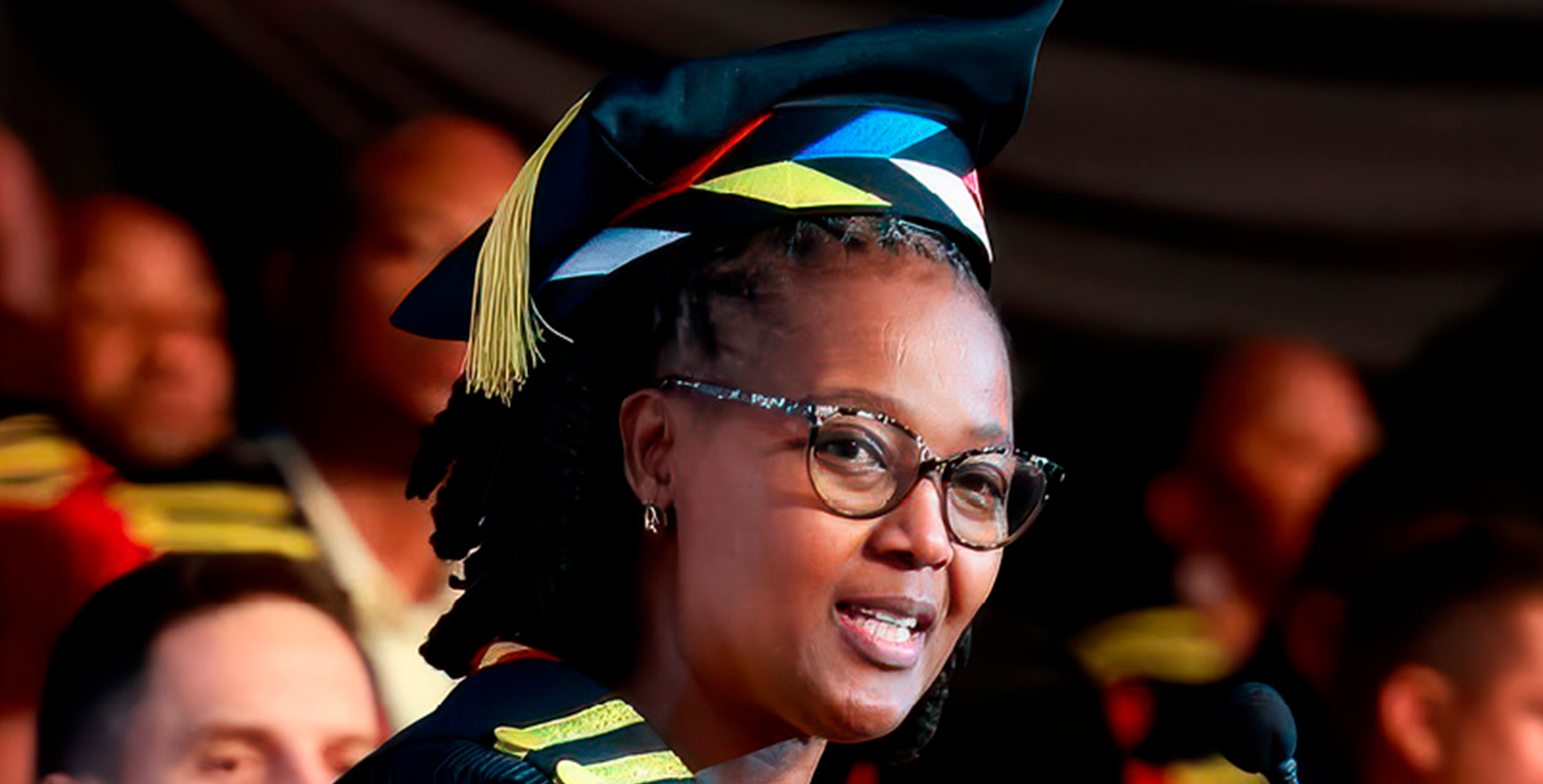
Led by Vice-Chancellor and Principal, Prof. Pamela Dube, the women in leadership positions at the Central University of Technology, Free State are shining examples of how dedication, selflessness and strong values can help shape a brighter future.
Prof. Pamela Dube: Vice-Chancellor and Principal
On 17 February 2023, the Central University of Technology, Free State (CUT) entered a defining new chapter with the inauguration of Prof. Pamela Dube as its first woman Vice-Chancellor and Principal – and the first woman to hold the position at a university in the Free State.
Her appointment represented more than an historic first. It marked the beginning of a period of institutional renewal built around transformation, strategic clarity and inclusive leadership.
Guided by Vision 2030, Prof. Dube set about strengthening relationships across the university community, confronting organisational culture and cultivating a leadership environment rooted in collaboration, empathy and shared responsibility.
As CUT’s 2023–2026 strategic cycle, Charting the New Path for CUT, drew to a close, the university had undergone significant change. Academic offerings expanded, research and innovation increased their societal impact, infrastructure was modernised and partnerships were strengthened.
That momentum now continues through CUT’s 2026–2030 strategy, which places Prof. Dube’s Champions – student success, work-ready graduates, entrepreneurial capability and the university’s national and global relevance at the heart of its next chapter.
Academic renewal has been a significant part of this transformation. CUT has refined its academic portfolio to respond to changing industry and societal needs, while blended learning and flexible learning pathways have expanded its approach to higher education. Through its partnership with Higher Education Partners Africa, the university has also introduced fully online qualifications, including programmes in Human Resources Management, Health Management and Information Technology.
Research and innovation have similarly advanced, with new research centres and innovation hubs strengthening CUT’s focus on solutions-driven knowledge. A landmark achievement was the awarding of a National Research Foundation Research Chair under the South African Research Chairs Initiative in Medical Product Development through Additive Manufacturing, which was later elevated to Tier 1 status.
Yet Prof. Dube’s leadership is not defined solely by institutional strategy or academic achievement. Central to her approach is the belief that transformation must create opportunities for others – and particularly for women.
Her tenure has advanced women’s leadership at CUT by creating opportunities for women to influence institutional direction and development. A notable example is the forthcoming partnership with the Female Academic Leadership Fellowship (FALF), undertaken in collaboration with the University’s four female Deans. Her commitment to inclusion and opportunity is also reflected in her mentorship of female PhD candidates from CUT and beyond.
That philosophy is particularly evident in her commitment to student success.
Initiatives such as Siyaphumelela and CUT’s partnerships with the World Access to Higher Education Network (WAHEN) have strengthened student support and institutional learning. Under Prof. Dube’s stewardship, more than R4.3 million in funding was also secured from The Kresge Foundation to support interventions focused on student retention, academic success and holistic development.
Support from organisations including the Saville Foundation, Old Mutual, government, SETAs, the Industrial Development Corporation and Tshikululu Social Investments has further broadened access to educational opportunities, while a scholarship initiative has sought to support financially vulnerable students and address historical student debt.
Prof. Dube has also demonstrated that leadership can extend beyond institutional decision-making. She personally contributed R182 725.57 towards the launch of the CUT Student Food Bank, established to address food insecurity among disadvantaged students.
For Prof. Dube, leadership is measured not simply by title or position, but by impact – creating pathways for mobility, opening doors for others and ensuring that transformation remains meaningful and sustainable.
That commitment is also reflected in the Student Women Economic Empowerment Programme (SWEEP), an initiative designed to equip young women with entrepreneurial skills, strengthen economic participation and confront systemic gender inequality. Through the programme, CUT is helping young women to develop not only academically, but economically and socially, while encouraging a new generation of confident and self-sufficient women leaders.
Prof. Dube’s influence extends beyond CUT. She was appointed Chairperson of the Board of Directors of the Technological Higher Education Network South Africa (THENSA) for the 2026–2028 term and Vice-Chairperson of the Board of Directors of Universities South Africa (USAf) for the 2026–2027 term.
Her contribution to higher education has also been recognised through the 2023 SAASSAP Presidency Lifetime Award for her contribution to student affairs and services in South Africa and internationally. Under her leadership, CUT also became the first African university to receive recognition from the Accreditation Council for Entrepreneurial and Engaged Universities (ACCEU), strengthening its position as an institution committed to innovation, entrepreneurship and socially responsive higher education.
Alongside these achievements, investment in CUT’s physical and digital future has continued. More than R1.2 billion has been invested in modern facilities across its campuses, including upgraded laboratories, student residences and specialised academic buildings. High-speed connectivity has expanded across teaching and residence spaces, while energy-efficient systems and solar installations have reduced energy consumption per student by 30%.
Since 2023, Prof. Dube has conferred qualifications on more than 15 000 graduates, including master’s and doctoral candidates – each representing not simply an institutional statistic, but an individual life changed through education.
Her own journey to the Vice-Chancellorship was built over a distinguished national and international academic career. Before joining CUT, Prof. Dube served as Deputy Vice-Chancellor for Student Development and Support at the University of the Western Cape and held academic roles at institutions including the University of Siegen in Germany, the University of KwaZulu-Natal and Kathmandu University in Nepal.
She has also held senior leadership and management positions at the Nuclear Energy Corporation of South Africa, the former National Department of Education, Wits University and the University of Johannesburg.
Prof. Dube holds a PhD in interdisciplinary studies in Humanities from the University of Siegen, specialising in postcolonial literature, gender studies and media studies, alongside professional management qualifications from the UCT Graduate School of Business, Bryn Mawr and Oxford University’s Saïd Business School.
Her career has taken her across institutions, disciplines and continents, but at CUT, her legacy is increasingly one of transformation through people.
As the university enters its next strategic chapter, Prof. Dube continues to advocate a future built around innovation, global relevance and human-centred technological advancement. Central to that ambition is the development of a research centre focused on the human-technology interface, an idea she first introduced during her inaugural address in 2023.
Four years after becoming CUT’s first woman Vice-Chancellor and Principal, Prof. Dube’s leadership demonstrates that breaking a barrier is only the beginning.
The greater legacy lies in creating opportunities for others to follow – strengthening institutions, empowering future leaders and ensuring that transformation reaches far beyond the person who first opened the door.
Prof. Muthoni Masinde: Faculty of Engineering, Built Environment and Information Technology
Prof. Muthoni Masinde’s journey began in a small village in Kenya, where she attended primary and secondary school before enrolling for a Bachelor of Computer Science at the University of Nairobi.
That journey would eventually take her to universities across Africa and Europe, including the University of Cape Town, University of the Free State and Belgium’s Vrije Universiteit Brussel, before ultimately leading to her role as Dean at CUT.
”I have never defined my career by the positions I have held. I have always seen myself first as a teacher, a researcher, and someone who enjoys solving problems that make a meaningful difference in people’s lives,” she says.
While she never planned on becoming a Dean, each role and challenge prepared her for an opportunity she ultimately saw as one to serve.
That philosophy continues to shape her leadership. Rather than trying to do everything herself, Prof. Masinde focuses on providing strategic direction, creating opportunities and removing obstacles so that others can thrive.
”My responsibility is to enable, encourage, and cheer people on, while ensuring that the Faculty remains focused on a shared vision,” she explains.
This approach has also seen her become a mentor to many, particularly women. Her advice to those seeking to fulfil their own potential is simple: ”Do not wait until you feel ready. Work hard. Know your field. Continue learning. Be authentic. Treat everyone with dignity and respect, regardless of their position or title.”
Humility, integrity and excellence remain central to her leadership, while her long-term goal is to leave behind a Faculty strengthened by systems rather than dependent on individuals.
”Titles are temporary. The systems we strengthen, the people we mentor, and the lives we influence are the legacies that endure,” she concludes.
Prof. Ntsoaki Malebo: Faculty of Health and Environmental Sciences
Prof. Ntsoaki Malebo’s career at CUT began as a postdoctoral fellow after completing her PhD at the University of the Free State. Since then, she has progressed through academic, management and senior management positions.
Despite the administrative nature of many of those roles, she continues to regard herself as an academic, with leadership providing an opportunity to create an environment in which others can succeed.
”I have always been driven by the need to support others, especially sharing information and creating opportunities that enable them to succeed. I have never imagined myself at the helm, but I always wanted to lead behind the scenes,” she says.
That commitment is reflected in her contribution to the growth of CUT’s disability unit, securing a Kresge Foundation grant supporting student success initiatives and helping to develop and implement the university’s postgraduate diploma in Higher Education.
One of the greatest challenges she continues to encounter is student funding.
”There are students who drop out due to lack of funding and that is one of the most difficult experiences,” she says. ”When students come to higher education for a university degree, their success has a positive impact on their families, communities, and the nation.”
The challenge has motivated her to collaborate with other units in seeking alternative funding sources, while CUT’s broader purpose provides motivation during difficult periods.
For Prof. Malebo, Ubuntu remains a particularly important CUT value and a constant reminder that leadership is ultimately about serving others.
”It is through an enabling environment that CUT can achieve its vision,” she concludes.
Prof. Wendy Setlalentoa: Faculty of Humanities
Prof. Wendy Setlalentoa’s career in education spans more than four decades, beginning as a Lecturer at Taung College of Education in the Northern Cape before she moved to Strydom College of Education in Thaba Nchu.
She joined CUT in 2004 and has since served as Lecturer, Senior Lecturer, Programme Head, Head of Department, Associate Professor, Full Professor: Science Education and Dean of the Faculty of Humanities, as well as Acting Deputy Vice-Chancellor.
Looking back, she believes every role helped prepare her for the next.
”My journey has always been driven by a desire and passion to make a meaningful contribution to education, through teaching, leadership, research, and developing others,” she says.
Her achievements include helping to initiate B Ed Honours programmes currently undergoing accreditation and leading the Faculty in successfully hosting the 13th International Conference on Mathematical Creativity and Giftedness in 2024.
Yet developing people remains at the heart of her leadership, including supporting other women as they pursue their own ambitions.
”My message is simple: believe in yourself and never stop learning. Don’t wait until you feel completely ready because leadership is a journey of growth,” she says.
Her advice extends beyond individual advancement.
”Lead with integrity, humility, and compassion. Success is not measured only by the position you hold, but by the lives you influence and the opportunities you create for others. Most importantly, support other women. When we lift one another up, we strengthen our institutions and our communities.”
Prof. Setlalentoa hopes ultimately to leave a legacy of developing people, strengthening institutions and contributing meaningfully to education.
”I hope people will remember me as a leader who served with integrity, inspired others to achieve their potential, and always believed that education has the power to transform lives,” she concludes.
Prof. Freda Van Der Walt: Faculty of Management Sciences
Prof. Freda Van Der Walt began her academic career after completing her internship to register as an Industrial and Organisational Psychologist, joining Vista University, which later became part of CUT.
After progressing from Lecturer to Senior Lecturer and spending a period away from education, she realised that her passion remained higher education and working with students.
Although she never envisaged herself becoming a Dean, she deliberately prepared for leadership by pursuing development opportunities and gaining experience.
”As a person of faith, I believe this journey was guided by God’s timing. I always sensed that I had a calling to lead, although I did not know exactly where that calling would take me,” she says.
Today, Prof. Van Der Walt strives to build a culture founded on integrity, authenticity, fairness and excellence, while creating an environment in which people feel respected and able to succeed.
”Women often bring different perspectives to leadership, and I believe that diverse leadership strengthens both our institution and the communities we serve,” she explains.
An important lesson along the way has been recognising that mistakes are part of leadership and that taking responsibility for them can strengthen trust.
”Being open about my own mistakes has strengthened relationships with my colleagues because people appreciate authenticity. They are far more willing to trust a leader who is honest enough to admit that they do not always have all the answers.”
Above all, integrity and excellence remain the values against which she measures her leadership.
”If I can make decisions with integrity, pursue excellence, and treat people fairly, then I believe I have fulfilled my responsibility as a leader,” Prof. Van Der Walt concludes.