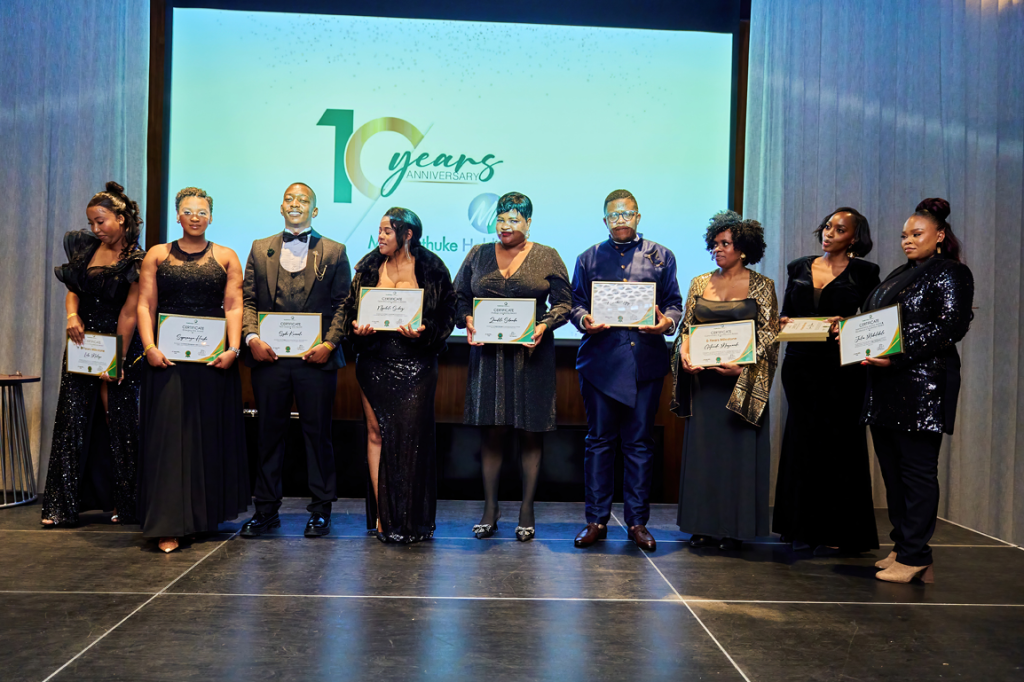
Liyanda Handula built a skills development empire that has transformed thousands of lives over the past decade, writes Busi Radebe. This is Handula’s story.
In a world where corporate success is often measured by quarterly profits and shareholder returns, Masithuthuke Holdings stands as a testament to the power of purpose-driven entrepreneurship. As the company celebrates its 10th anniversary, CEO Liyanda Handula reflects on a journey that began with personal dissatisfaction in corporate life and evolved into a multifaceted enterprise that has invested over R10-million in skills development, training more than 2,500 ICT graduates and 277 Finance and Accounting Services graduates.
The story of Masithuthuke Holdings is one of business growth and transformation. It incorporates both personal and societal growth and demonstrates how one leader’s courage to abandon the comfortable predictability of corporate employment can ripple outward to create opportunities for thousands of others. The courage is more impactful considering how it has benefited those from townships and underserved communities which were historically excluded from meaningful economic participation in the past. Masithuthuke Holdings has been intentional since its establishment and will continue to open doors for those who come from neglected communities.
The Genesis of Purpose
Liyanda Handula’s entrepreneurial journey began from a position that many would not give up, especially in an unpredictable economic climate. He had a stable corporate job with regular income and clear advancement prospects, but even with that stability—and the accompanying corporate perks—beneath the surface of this conventional success lay a growing sense of dissatisfaction that would ultimately reshape not only his trajectory but the lives of countless others.
”I used to live a life many would consider the ideal blueprint for success,” Handula explains. ”But somewhere along the way I realised I was not fulfilled. That realisation set me on a journey to redefine my purpose and, ultimately, it led me to become an entrepreneur with a primary focus on human capital development.”
This catalytic personal awakening coincided with a significant shift in South Africa’s educational landscape. The establishment of Sector Education and Training Authorities (SETAs) in 2000 under the Skills Development Act created new opportunities for skills development initiatives. Handula recognised that his purpose aligned with the national need and that is when he founded Masithuthuke Learning. The company initially focused on Adult Education and Training (AET), previously known as Adult Basic Education and Training (ABET).
This was only the beginning as the company’s evolution from its initial focus on foundational learning to its current status as a diversified holdings company reflects both strategic vision and adaptive leadership. By 2015, the organisations had expanded beyond their original mandate, establishing Masithuthuke Holdings to encompass learning and development projects as well as consultancy services. The addition of Masithuthuke Foundation in 2020 as a Corporate Social Investment entity further demonstrated the company’s commitment to education and community development.
Navigating the Entrepreneurial Landscape
The transition from corporate employee to entrepreneur presented challenges that are particularly unique to black business leaders in South Africa. Handula identified several systemic barriers that shaped his early journey. There was limited access to funding opportunities, there were network gaps, gaining access to the market was particularly challenging, and he had to deal with complex regulatory requirements. These obstacles are a reflection of historical inequalities and structural discrimination and overcoming them required innovative solutions in addition to an unwavering determination from a determined Handula.
”Entrepreneurs, especially black ones, often face unique challenges that stem from historical inequalities, systemic barriers and structural discrimination that still exists in South Africa today,” Handula acknowledges. His approach to overcoming these challenges involved exploring alternative financing through government funding initiatives, building financial strength through project acquisition, and developing robust business plans to attract investors.
Handula stresses the importance of mentorship and partnerships on the path to success and navigating entrepreneurial challenges. Rather than attempting to deal with the complex business environment alone, he actively pursued industry mentors and forged strategic collaborations that would prove crucial to the company’s growth. This approach underscores a fundamental principle of his leadership philosophy which is the recognition that sustainable success requires collective effort and shared expertise.
The lesson that emerged from these early challenges extends beyond mere survival tactics. ”Entrepreneurship is not about having all the answers,” Handula reflects. ”It is about having the courage to ask the right questions, planning and making the right decisions. Most importantly, it is about resilience, because every day is a mixture of breakthroughs and setbacks.”
Adapting to Industry Evolution
The skills development industry has undergone a dramatic transformation in response to technological advancement, economic shifts and changing labour market demands. Masithuthuke Holdings’ ability to adapt to these changes has been crucial to its sustained growth and relevance.
The company’s evolution reflects broader trends in the industry. The shift toward digital transformation and e-learning, the emphasis on industry-relevant, future-fit skills and the importance of public-private collaborations. It is this adaptability that was tested most severely during the COVID-19 pandemic, when the company’s traditional model of in-person training in community venues suddenly became untenable.
When the COVID-19 lockdowns were imposed in South Africa it halted operations for many businesses that relied on in-contact services such as Masithuthuke, which faced zero new income for over six months. In addition, they were hit with cancelled contracts and the stark realisation that their lack of digital infrastructure had made them vulnerable. However, in true progressive fashion, this crisis became a catalyst for innovation, leading to the development of a blended learning strategy and hybrid training methodology that has since strengthened the company’s resilience and expanded its reach.
The Power of Principled Leadership
Handula’s leadership philosophy centres on open communication, transparency and the cultivation of an ownership mindset among employees. This approach extends beyond internal operations to encompass relationships with clients and stakeholders, ultimately creating an ecosystem of trust that supports sustainable business growth. The company’s adoption of an ”owner-manager culture” empowers staff members to operate with the mindset and responsibility of running their business units, fostering innovation, confidence and deep personal investment in outcomes.
The emphasis on team-building and staff morale reflects Handula’s understanding that human capital is the true engine of organisational success. ”The Masithuthuke Holdings staff are the engine and drivers of the organisation,” he notes, highlighting the direct connection between employee engagement and business performance.
Measuring Impact Beyond Profit
While financial metrics provide one measure of success, Masithuthuke Holdings’ true impact lies in its contribution to community transformation and economic inclusion. The company’s investment of over R10-million in digital skills training has resulted in more than 60% of graduates finding employment. This is a tangible demonstration of how skills development can create pathways out of unemployment and economic marginalisation.
The organisation’s role as Strategic Implementing Partner for the 2024/25 IDC Township Energy Fund Project exemplifies its commitment to addressing real-world challenges facing communities. By channeling grant funding to businesses affected by the energy crisis, the initiative has helped revitalise local economies and protect livelihoods.
This focus on measurable community impact reflects a broader understanding of business success that extends beyond traditional financial metrics. Through skills development programs, enterprise and supplier development support, youth empowerment projects and strategic partnerships, Masithuthuke Holdings has positioned itself as a stimulus for transformation and inclusive growth.
Vision for the Future
As Masithuthuke Holdings celebrates its 10th anniversary, Handula’s vision for the next decade is characterised by strategic growth, diversification, and expanded impact. The company aims to strengthen its national footprint, forge new strategic partnerships, invest in technology and innovation, and create sustainable employment opportunities in marginalised communities.
”Our long-term vision is to become a leading diversified investment and development company that drives economic inclusion and transformation across South Africa and beyond,” Handula states. This ambitious goal reflects both the company’s growth trajectory and its commitment to addressing systemic inequality through sustainable economic empowerment.
The planned expansion into new industries and investment in unrelated but high-potential sectors demonstrates strategic thinking that balances risk management with growth opportunities. This diversification strategy positions the company to build resilience while unlocking new revenue streams that can support its core mission of skills development and community empowerment.
Lessons for Aspiring Leaders
Handula’s advice to aspiring entrepreneurs in the skills development sector emphasises the importance of approaching the journey with purpose, patience and a deep commitment to impact. ”This sector is not just about training. It is about transforming lives, unlocking potential and building a better future for individuals and communities,” he emphasises.
His insights underscore several key principles for sustainable entrepreneurship which include understanding the landscape, building strategic partnerships, maintaining resilience and adaptability, and prioritising quality over quantity. These lessons have been forged through a decade of challenges and successes. They also offer valuable guidance for future leaders seeking to create meaningful impact through business.
A Legacy of Transformation
As Masithuthuke Holdings marks its first decade, the company’s story serves as a powerful reminder of entrepreneurship’s potential to drive social change. From Handula’s initial decision to leave corporate comfort to the company’s current status as a significant player in skills development, the journey illustrates how purpose-driven leadership can create ripple effects that extend far beyond individual success.
The company’s investment in over 2,777 graduates represents more than just training statistics. It represents families lifted out of poverty, communities strengthened through skills development, and a nation better equipped to compete in the global economy. This human impact, combined with the company’s continued growth and diversification, positions Masithuthuke Holdings as a model for how businesses can pursue profit while creating meaningful social value.
The next decade promises new challenges and opportunities as the company expands its reach and deepens its impact. With a foundation built on principled leadership, strategic thinking and unwavering commitment to community transformation, Masithuthuke Holdings is well-positioned to continue its journey of creating opportunity and driving change across South Africa and beyond.
In an era where businesses are increasingly called upon to demonstrate their social value, Masithuthuke Holdings offers a compelling example of how entrepreneurial vision—combined with persistent execution and genuine commitment to community development—can create lasting positive change. As the company celebrates this milestone, its story serves as both an inspiration and a roadmap for leaders seeking to build enterprises that matter.


IN HIS OWN WORDS
Looking back over the past decade, what moment or decision do you believe most significantly defined the direction of Masithuthuke Holdings?
One of the most defining decisions was choosing to transition from a focus purely on Adult Education and Training to building a broader, more diversified organisation that included consultancy, development projects and, later, our CSI arm, which is the Masithuthuke Foundation. That decision allowed us to scale up our impact and our business model. It required me to shift my thinking from specialist service delivery to strategic leadership and growth management.
You often speak about ”resilience” as a core trait for entrepreneurs. Can you share a moment when your resilience was most tested?
The early months of the COVID-19 pandemic were undoubtedly one of the greatest tests of my resilience. We were delivering in-person training sessions within communities, and the lockdown completely halted these sessions overnight. With no digital infrastructure ready and no income for months, we had to choose between waiting and radically reinventing our model. That pressure tested every part of my leadership, but it also taught me the value of failing forward. Resilience isn’t just about endurance. It’s about responding with intention and agility. COVID-19 taught us the importance of seeking alternative methods in order to continue to deliver services in communities that needed us.
In terms of company culture, what have you done differently that you believe sets Masithuthuke Holdings apart from similar organisations?
We’ve cultivated what I call an “owner-manager” culture. This means every team member is encouraged to think and act like the leader of their own unit. It’s about responsibility but also about empowering people to find solutions and innovate independently without being constantly micromanaged. We don’t just delegate tasks: we entrust purpose. This has created a culture of accountability and innovation, and it’s one of our most powerful internal drivers of success. Our staff thrives as they feel they are part owners of the business.
How do you personally stay grounded as a leader, especially as the organisation grows and your responsibilities multiply?
Remaining grounded begins with staying connected to our core mission, which is uplifting underserved communities. I make time to visit project sites, talk directly to beneficiaries and hear from our teams on the ground. Leaders should never become detached from the people they seek to serve. I also have a strong support network—including mentors and peers—who help keep me focused, honest and humble.
Beyond numbers and placements, how do you measure the success of a training programme?
For us, success is about transformation, not just completion. Yes, we track placements and performance metrics, but the deeper indicators are less tangible. They are confidence, hope and the ability for someone to envision a better life for themselves. We look at whether learners are applying their skills in real-world contexts, whether they are entering sustainable employment or starting businesses and, most importantly, if they are becoming role models in their communities. We measure success by the number of doors we are able to open for people who remain marginalised and shut out from meaningful economic participation. The impact this has on families is a big component of how we measure success at Masithuthuke Holdings.
The concept of “future-fit skills” comes up often in your strategy. How do you ensure your training offerings remain relevant in such a fast-changing world?
We stay aligned with industry trends and future forecasts. This means regularly engaging with industry partners, reviewing global reports and listening closely to the employers who absorb and hire our graduates. Relevance is not a once-off achievement—it’s a continuous process. We also adjust our programmes to reflect technological shifts and sector needs. That’s why, for example, our ICT programmes are constantly updated, and why we’re investing heavily in innovation and blended learning platforms.
What role do partnerships play in your growth strategy, and how do you decide who to collaborate with?
Partnerships have been central to our growth. From mentorships in the early days to large-scale public-private projects now. We seek partners who are mission-aligned and who bring either reach, technical expertise or shared values to the table. It’s about synergy not just scale. We’re strategic in who we work with because the wrong partnership can dilute your impact or shift your focus. With the right ones, the effect is exponential.
You’ve referenced the importance of mindset often. What mindset shifts were essential for you as you evolved from founder to CEO of a growing organisation?
The biggest shift was moving from operational thinking to strategic thinking. In the beginning I was involved in every detail, but as we grew, I had to trust others, delegate and focus on vision, growth and sustainability. I had to evolve from being the technician to becoming a leader of leaders. To achieve that requires letting go of control, embracing systems and investing in people who can deliver at a high standard without constant oversight.
The Masithuthuke Foundation plays a key role in your community development work. How do you ensure that CSI isn’t treated as an afterthought but, rather, as a strategic driver of impact?
We designed the Foundation to be more than just a compliance box. It is deeply embedded in our identity because every programme we run under the Foundation is aligned to our core belief in economic inclusion. We treat CSI as a strategic asset as it enables us to pilot new ideas, support early-stage entrepreneurs and test community-based solutions that can later be scaled. To us, CSI complements and enhances our existing commercial operations.
Finally, what do you hope your legacy will be, not just for Masithuthuke Holdings, but for South Africa’s broader development landscape?
I hope to be remembered as someone who didn’t just build a successful business but, rather, as someone who used that success to shift lives, mindsets and futures. My goal is not to be the only one who succeeds but to create a system where more people from underserved backgrounds can access opportunities and realise their full potential. If Masithuthuke becomes a model for others to replicate—one where organisations are blending purpose with profit, and growth with inclusion—that would definitely be a legacy I would be proud of.
Please comment on the SETA landscape in South Africa. What can be done to improve them?
The Sector Education and Training Authority (SETA) system has historically played a crucial role in linking education, training, and industry. While it has provided meaningful opportunities over the years, it continues to face ongoing challenges related to efficiency, quality assurance, and alignment with the evolving needs of the labour market.
The establishment of the Quality Council for Trades and Occupations (QCTO) represents a significant evolution in the post-school education and training environment. Tasked with standardising and enhancing the quality of occupational qualifications and skills programmes, the QCTO aims to streamline processes, reduce duplication, and strengthen accountability across the system. However, its current capacity to fully meet this mandate remains uncertain.
To unlock the full potential of this transition, strong leadership, inclusive planning, and enhanced coordination between SETAs and the QCTO are essential. Equally important is the provision of practical, on-the-ground support to training providers and other stakeholders navigating the shift.
If effectively implemented, this new model could give rise to a more responsive, efficient, and impactful skills development system—one that is truly aligned with South Africa’s broader transformation and economic development goals.
TEN YEARS OF MASITHUTHUKE HOLDINGS
10-Point Fact Sheet
1. Company Profile & Ownership
Masithuthuke Holdings is a proudly South African, 100% Black-owned, Level 1 B-BBEE (Broad-Based Black Economic Empowerment) enterprise focused on sustainable development and transformation.
2. Vision & Mission
The company aims “to promote access and develop capacity for broad-based empowerment of Black enterprises, especially SMMEs.” Its mission emphasises quality, competitive, and reliable services that help reduce poverty and support rural/urban communities.
3. Core Business Divisions
- Masithuthuke Services: Project management, multi-disciplinary consulting.
- Masithuthuke Learning: Accredited adult education, AET, FLC, NSC programs.
- Masithuthuke Foundation: Grant-making and community development via PBO 18A funding model.
4. Training & Skills Provision
Offers a range of SETA-aligned programmes, including learnerships, short skills training, facilitator and assessor training, and work-readiness courses tailored for sectors such as agriculture, logistics, mining, government and SMMEs.
5. Strategic Partnerships
Masithuthuke is an authorised IBM education reseller in partnership with Cyber Retaliator Solutions (CRS) and Arrow ECS, delivering certified technical training in IBM technologies and infrastructure.
6. Geographic Footprint
Headquartered in Bryanston, Sandton (Johannesburg), the firm operates nationally with additional presence through branches or facilitators in Gauteng, KwaZulu-Natal, Cape Town and East London.
7. Leadership & Governance
- Liyanda Handula is CEO and founder with experience in SETAs, UK Trade & Investment, and sector development.
- Lebo Molapo has been Project Coordinator since 2014, with a finance and training background.
8. Corporate Social Investment (CSI)
Through the Foundation, Masithuthuke sponsors youth development programmes—e.g. sports tournaments in Gugulethu, school bursaries, providing shoes and stationery to rural and disabled learners—and promotes access to education in historically disadvantaged areas.
9. Enterprise Development & Recruitment
Supports SMMEs via equity investments, corporate social investment, recruitment services nationwide, and operational shared services (HR, payroll, finance, marketing, IT) for affiliates and clients.
10. Core Values & Ethos
Masithuthuke emphasises integrity, reliability, excellence and community respect, delivering proactive, ethical services that align with B-BBEE principles and equal employment equity.
Busi Radebe is the General Manager of Frank Dialogue Holdings and a freelance writer for Leadership Magazine