


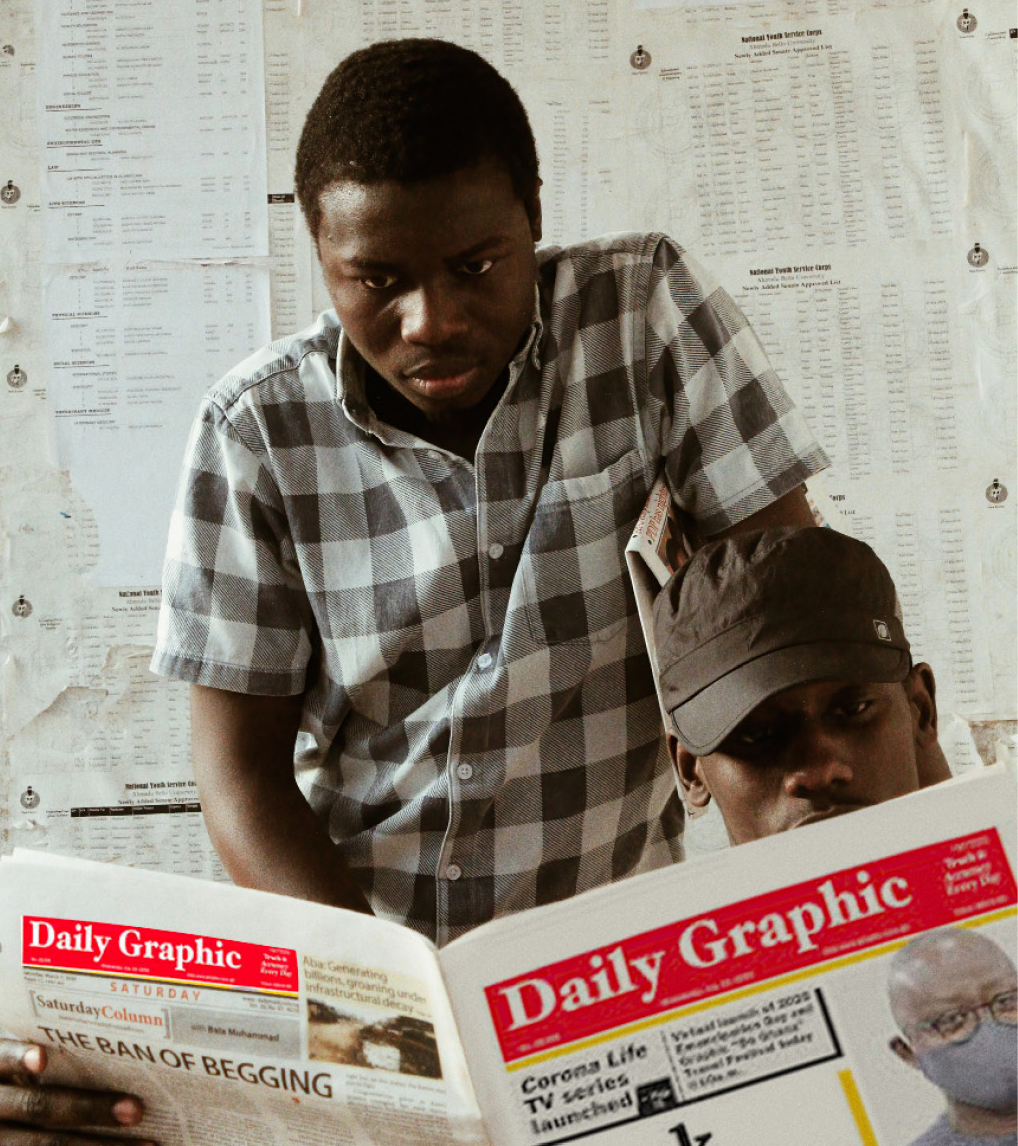
Amanda Hope Nkwana looks at media representation
and the colonial legacy in Ghana’s Daily Graphic Newspaper
The Daily Graphic, founded in 1950, is more than just Ghana’s prominent newspaper, it is a historical landmark of the country’s transition and evolution from colonial rule to decolonisation and independence.
Owned by Graphic Communications Group Limited, which is a state-run company, the Daily Graphic functions within a nuanced framework—it is not only a government-owned newspaper publication but also serves as a reliable source and a key platform for the restoration and reclamation of postcolonial identity.
This piece analyses how the Daily Graphic reflects and resists colonial legacies and explores the possibility for a decolonial and independent media approach.
Historical Background: Colonised Beginnings, An Independent Future
The genesis of the Daily Graphic is fundamentally linked to colonial administration and colonial power dynamics, founded under British rule to inform the public and influence public perception (Anokwa, 1997).
After Ghana gained its independence in 1957, ownership was automatically assigned and delegated to the new government, furthermore appropriating and repurposing colonial instruments and technologies for postcolonial futures.
The Daily Graphic’s navigation under military leadership called for strategic maneuvering of power to reconcile and juggle state priorities with public needs, which serves as an ongoing challenge in the navigation of postcolonial frameworks.
The Colonial Gaze: Reflection and Replication
The Daily Graphic, through its core principles, perpetuates and mirrors colonial perspectives at times—perspectives that prioritise Western approaches, as well as the elite systems and government influence.
- The Language of Power: The Daily Graphic newspaper is published and available solely in English, which is the language of the former coloniser. This perpetuates colonialism through unequal and restricted access, furthermore, privileging the educated elite and marginalising the broader population who utilise languages like Akan (including Twi and Fante), as well as Ewe and Dagbani as forms of communication (Ansah, 2014).
- Elite-Centered Discourse: Daily Graphic’s coverage often privileges government officials and business leaders, furthermore, echoing the hierarchical approach of colonialism. This perpetuates the marginalisation of ordinary perspectives whose experiences and knowledge are often dismissed and undervalued (Wasserman, 2011).
- The “Newspaper of Record” Framework: Daily Graphic’s approach as the definitive and state-authorized paper can reinforce colonial journalistic legacies and prioritise formal and official discourses over Ghana’s indigenous and community driven narratives.
Challenging the Colonial Narrative: The Daily Graphic Shaping National Identity
Despite these colonial influences, the Daily Graphic newspaper subverts and challenges the colonial gaze by focusing on Ghana’s stories and affairs as well as by amplifying the voices of the public.
- Shaping the National Identity: True resistance lies in prioritising Ghana’s own experiences and perspectives. By prioritising local stories, sports, arts, and culture as the focus, the newspaper helps to shape a national identity that is different from Ghana’s colonial past (Ayee, 2013).
- Holding (Some) Power to Account: The Daily Graphic’s watchdog role, though limited, inherently challenges colonial legacies. Exposing corruption in local governments, the Daily Graphic newspaper affirms and emphasises that the Ghanaian citizens have the right to hold those in power accountable. This promotes a sense of civic awareness and responsibility for a self-governing nation.
- Advocacy for the Public Benefit: Ghana initiatives such as #KeepGhanaClean, COVID-19 campaigns to stop the spread of the virus and guidelines to decrease high blood pressure and avoid diseases such as Malaria as well as HIV/AIDS address the priorities of the Ghanaian citizens. This form of journalism prioritises the well-being of the Ghanian citizens, both young and old, and overlooks the colonial legacy media.
Decolonisation: A Work in Progress
Decolonising the Daily Graphic newspaper requires a thorough and deliberate effort to disrupt its colonial roots.
- Language Decolonisation: Launching regular or weekly supplements and sections as well as YouTube segments in local languages, for example, “Graphic Akan”, serves as an approach that would make information easily and equally accessible for all Ghanaian citizens and recognise the value of indigenous languages in news coverage and current affairs discourses (Ansah, 2014).
- Decolonising Knowledge: Amplifying the voices of local citizens such as those of the youth, market women and men, farmers and community elders is also an actionable step to centering African perspectives and knowledge systems as well as challenging dominant Western narratives (Ndlovu & Ndlovu-Gatsheni, 2024).
- A Fresh Look at Sourcing News Coverage: Diversifying voices ensures that “expert and educated” voices include Ghana’s traditional leaders, local historians, and community organisers, not just scholars, university professors or official representatives.
- Ownership and Governance Framework: Reimagining and transforming the Daily Graphic newspaper’s ownership structure, maybe through citizen ownership, could reduce government influence and safeguard press freedom.
Comparative Analysis: The Daily Graphic in a Decolonizing Media Environment
Unlike private media, the Daily Graphic newspaper takes a cautious stance and is more reserved in terms of its news coverage. News organisations like The Chronicle newspaper and Joy FM radio station which are both privately owned, exemplify media resistance to colonial influence by challenging state authority and bold reporting, which serves as a crucial step towards decolonisation. However, the Daily Graphic’s approach offers a stable and distinctive form of resistance, one that maintains a unified and cohesive national identity even though a completely decolonised media landscape would blend the best of both worlds.
The Daily Graphic newspaper navigates a complex legacy of a constant negotiation between past influences and shaping Ghana’s national identity. It is a newspaper that is born of colonialism and a product of the past actively trying to serve postcolonial needs of Ghana’s citizens. While the newspaper does resist the colonial gaze by prioritising Ghanaian perspectives and amplifying the voices of the citizens, its conformity to colonial influences serves as a reminder that the decolonization process remains a work in progress. The future of the Daily Graphic newspaper depends on its commitment to embracing a more fundamental and deeper decolonisation in the form of language, knowledge and structure, one that truly represents the nation in all aspects.
Amanda Hope Nkwana is a Wits University Honours student in Media and Politics
