

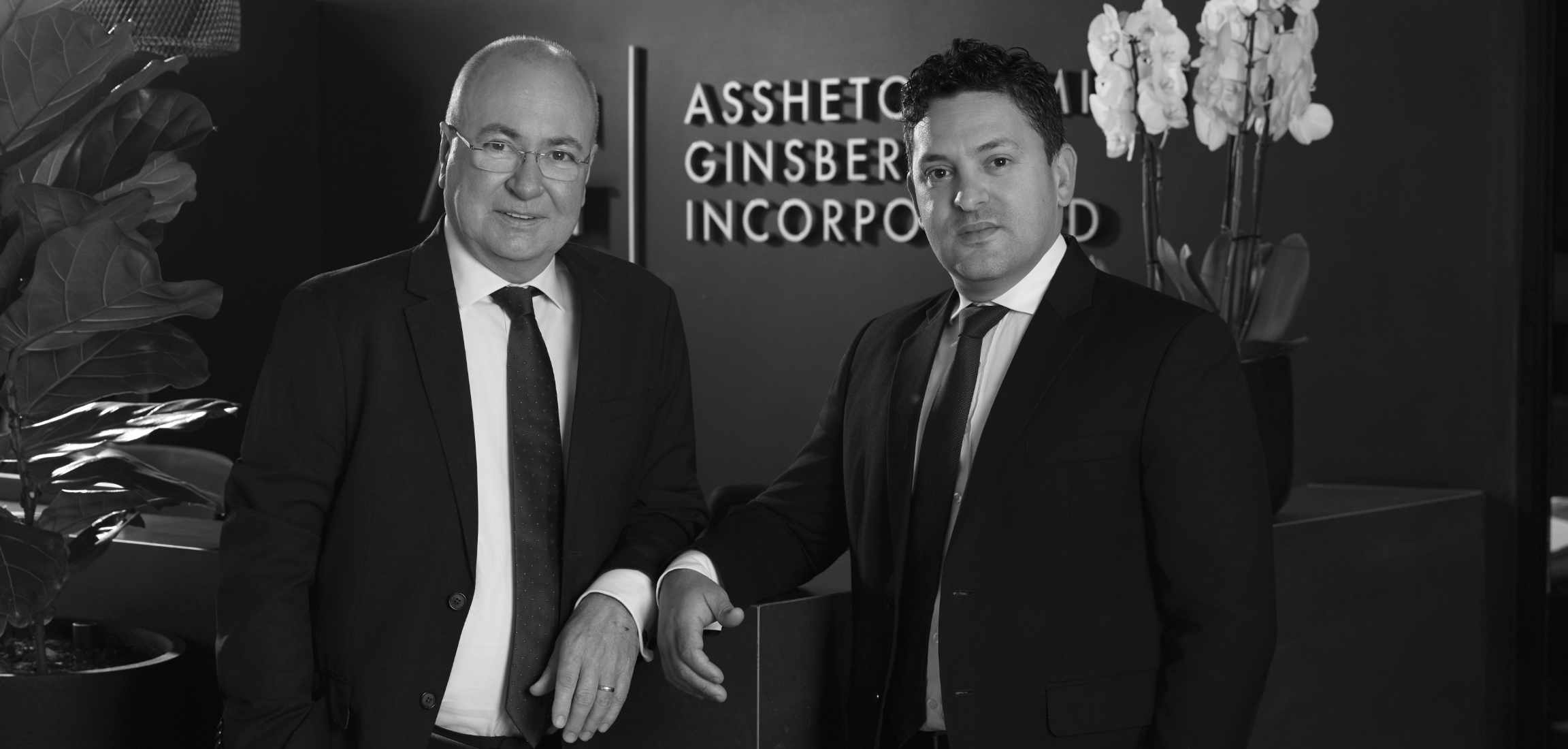
For the directors of Assheton-Smith Ginsberg, commercial law demands more than legal expertise. It requires strategic foresight, ability and the agility to make the decisive move.
Anyone who has watched Suits or Boston Legal might imagine that complex commercial disputes are resolved through dramatic courtroom exchanges, with a handful of documents waved in the air and a devastating argument dramatically delivered.
Andrew Ginsberg, director of boutique commercial law firm Assheton-Smith Ginsberg (ASG), finds this particularly amusing.
“We’ve got rooms full of documents. No case that’s even remotely complicated is summarised in a four-page document,” he laughs, pointing to the thousands of pages and months of preparation that television audiences rarely see.
Behind those mountains of paperwork lies something far more compelling: the strategic contest that can determine the outcome of a commercial dispute. It is an environment in which experience, anticipation and the ability to change direction can prove decisive.
Fellow director Craig Assheton-Smith adds that the practice of commercial law is as much about strategic manoeuvring as it is about legal procedure. Their firm’s approach reflects a conviction that agility, independent thinking and comprehensive commercial understanding can provide advantages that sheer organisational scale cannot guarantee.
Strategy over process
“We don’t look at a case from a mechanical, process-based workflow. We look for the strategy. What does the client want to achieve and how do we best serve that?” says Ginsberg.
They approach each case by assessing the client’s broader commercial objectives and the most effective route to achieving them.
“Is issuing a summons strategically the best strategy in this matter? Or should we take another approach, knowing that issuing a summons could kick-start a five-year process?”
Assheton-Smith offers a practical illustration from a matter before the Pretoria High Court. Having secured a hearing in the commercial court, both parties arrived ready to argue, only to discover that the judge had not read the papers. Rather than accept another potentially lengthy delay, he proposed arbitration.
“We have the ability to pivot. It’s strategy, the ability to manoeuvre, and we’re very fortunate to have the experience to re-direct,” he explains.
That willingness to reconsider the route, rather than become imprisoned by it, is central to the firm’s identity.
Capability without the constraints
ASG offers a “big firm capability without the big firm mentality”, but Ginsberg takes pains to emphasise that large firms fulfil important functions, particularly where specialist expertise and significant resources are required. The distinction, he believes, is that capability and scale are not necessarily interchangeable.
“Often the legal market tends to equate scale with capability but we differentiate between the two. Scale and capability are not the same thing,” adds Ginsberg.
Assheton-Smith began his career in insolvency law before moving to Cape Town in 1999 to join an international diamond mining company. Working as a legal adviser and company secretary across a group comprising 32 companies worldwide exposed him to complex commercial transactions, restructuring and international litigation.
Returning to private practice he encountered departmental boundaries that restricted his ability to serve longstanding clients across different legal disciplines. A client who trusted him with litigation might require assistance with a commercial transaction, yet internal structures could prevent him from handling the work. Ginsberg, who had previously worked alongside Assheton-Smith, shared that frustration.
“We wanted to be able to offer services beyond our niche. We didn’t want to be hamstrung into doing only one type of work,” explains Ginsberg.
Their response was to establish a boutique practice bringing together commercial litigation, agreements, insolvency, restructuring, insurance disputes and other related expertise without rigid departmental silos. That flexibility does not imply attempting to practise every branch of law. The firm consciously excludes areas outside its competence, preferring depth and breadth within its chosen commercial disciplines.
Seeing the whole board
The advantages for clients extend beyond convenience. A lawyer who understands a company’s history, commercial relationships, previous transactions and wider challenges can approach a new dispute with considerably more context than someone examining an isolated legal question.
“When you have an attorney that has done substantial work in insurance, company law, labour, different complicated commercial transactions, mergers, management buyouts then, when a client comes to you for advice, you’re not giving advice on a narrow issue. You’re pulling on multiple experiences and across a broad spectrum of subject matter,” says Ginsberg.
That broader perspective can expose risks and opportunities that might otherwise remain hidden. Assheton-Smith believes the relationship between attorney and client must extend beyond executing instructions. Repeat clients increasingly regard the firm’s directors as trusted advisers, seeking experienced judgement rather than simply the implementation of legal procedures.
Making an impact on the law
The firm’s commitment to substantive legal work is reflected in several reported judgments that have contributed to the interpretation of South African commercial law. Visser Sitrus is a case that provided an important examination of oppressive and prejudicial conduct under Section 163 of the Companies Act. Although Assheton-Smith’s client was unsuccessful the judgment established principles that continue to be referenced in subsequent decisions.
Another significant matter – Tuning Fork – concerned the liability of a surety following business rescue proceedings. Assheton-Smith successfully argued that the bank had failed to preserve its rights against his client. The implications extended beyond the individual dispute.
“The bank involved in the matter actually changed all their suretyship documents after that,” he recalls.
Ginsberg points to Watson v Renasa, a complex insurance dispute arising from an intentionally started fire that destroyed expensive printing equipment.
After the insured had successfully defended accusations of involvement in the arson, a further dispute emerged over whether compensation should reflect the machinery’s value at the time of the fire or the cost of replacing it.
The insurer argued that the policyholder had not satisfied the expenditure requirements of the reinstatement clause.
The court accepted the argument that an insurer could not wrongfully repudiate a claim and then rely on that repudiation to justify paying a lesser amount. The resulting judgment became an important authority on the application of reinstatement value conditions.
The experience also demonstrated the intellectual rewards of a varied commercial practice where understanding unfamiliar industries and their technical complexities is often essential to constructing a persuasive case.
Growing without losing agility
Preserving an intellectual curiosity and strategic independence will remain essential as ASG develops, but neither director regards headcount as the defining measure of success.
“We are boutique by design and it’s how we feel we can best service our clients,” adds Ginsberg. Their preferred approach is organic growth through carefully selected work and the development of younger attorneys who understand the firm’s philosophy and who are encouraged to challenge assumptions and contribute to strategic discussions.
Assheton-Smith feels that young candidate attorneys or attorneys have just as much to contribute and should be given the chance to voice their views as well
“If we can look back in 10 years and see law reports listing cases we’ve been involved in then that would be the sign of a successful 10 or 15 years, regardless of the size of the firm or the amount of money we’ve made,” adds Ginsberg.
Assheton-Smith envisages an equally important legacy: producing capable, agile and independently minded lawyers who will carry those principles forward.
Ultimately, the ASG philosophy is built on an understanding that commercial law is not simply a sequence of procedural moves. It is a strategic discipline requiring foresight, experience, flexibility and the confidence to recognise when the conventional route is no longer the right one.
In a profession where complex matters can stretch across years, knowing when to change direction may be every bit as important as knowing the law itself.