

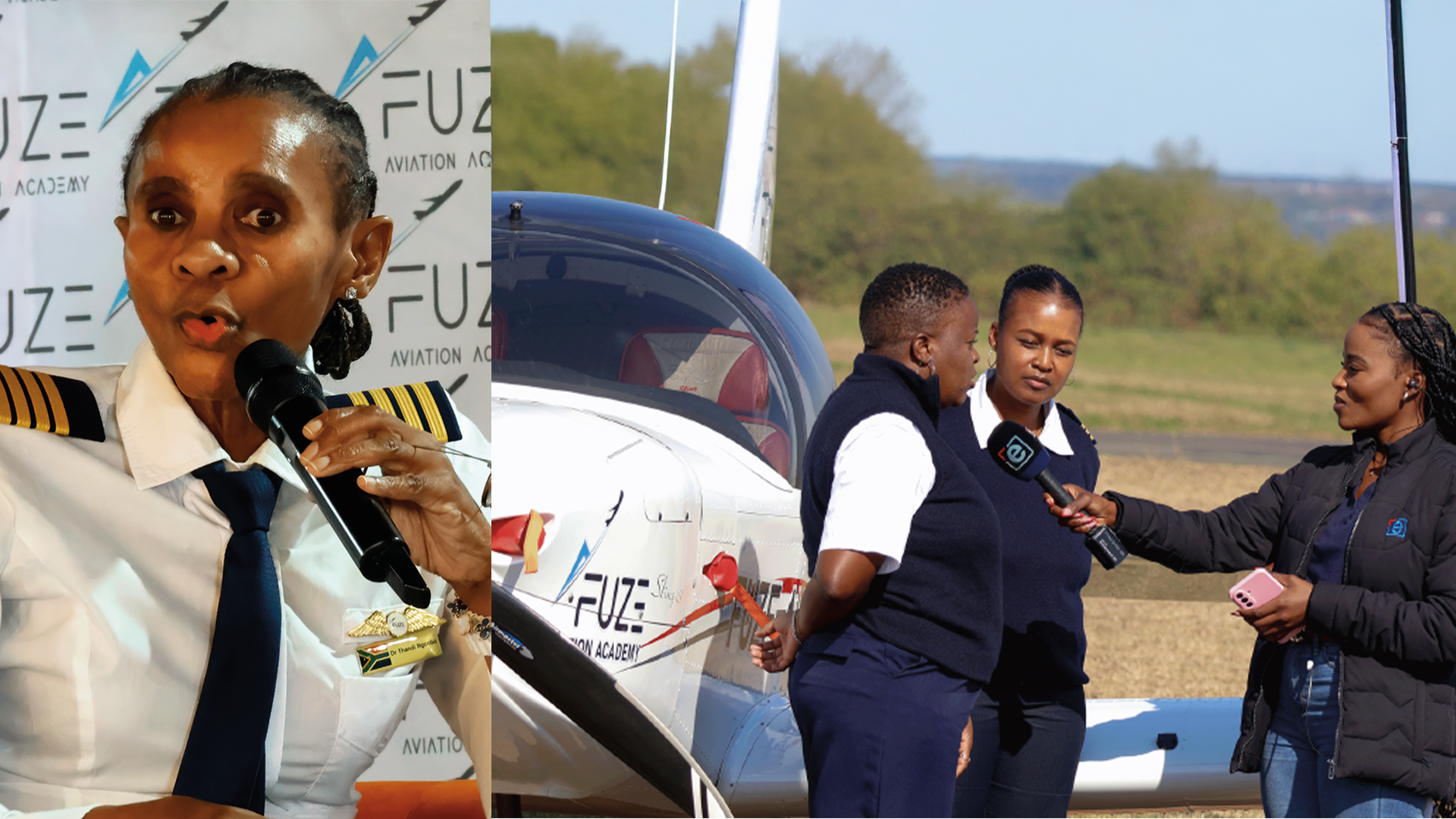
Dr Thandi Ngcobo is changing the face of aviation in Africa for the better with her brand of selfless leadership. But the achievement is structural rather than sentimental: she is building the skills pipeline that a continental aviation boom cannot grow without.
Dr Ngcobo’s professional journey is rooted in family experience and personal tragedy. From a young age, Dr Ngcobo saw her early influence and entrepreneurial roots up close. It was her grandparents that introduced her to the culture of business, giving her an early understanding of initiative, pursuit, discipline and opportunity.
“The aviation bug caught me when I lost a very good friend who loved flying. We had travelled all over the world together, with me in the jump seat”. This personal loss later deepened that sense of purpose. She became increasingly determined to create work that could inspire others, open pathways and make a practical difference in society.
Those experiences shaped the qualities that would define her career. A desire to create, an instinct for uplifting others, and an ability to see value where others often do not.
It was therefore only a matter of time before that her vision found a home in the aviation space. Dr Ngcobo now owns Fuze Aviation Academy (FAA), which she founded in 2020 at Oribi Airport in Pietermaritzburg. The academy specialises in cadet pilot training and aircraft maintenance, serving clients in both the public and private sectors.
The positioning is deliberate. Fuze sits at the supply end of the aviation value chain, on ground that African operators have historically outsourced to Europe, North America and the Gulf at considerable expense and with no guarantee that the graduates ever come home. Building that capability domestically is not simply a training business. It is import substitution in one of the few sectors where South Africa still holds a genuine technical advantage on the continent.
On her journey, Dr Ngcobo tells Leadership Magazine: “I come from a family of entrepreneurs. My grandparents introduced us to business life when I was young, and that is where it all started.
“Later in my life, while doing academic research, I asked myself a simple question: why are there so many unemployed and unskilled youth? Are we doing enough? Or are we aiming at the wrong target?
”I then started designing a model that responds to critical and scarce skills, and aviation is one of them. That is when the journey started, and I never looked back.
“The vision is to cultivate a new generation of globally competitive aviation professionals by expanding equitable access to world-class aviation education across Africa and beyond.”
While she may now be hugely successful in the aviation field, the reality is that her journey has been turbulent at times, with unique hurdles testing both her personal and business capabilities.
Africa is about to need more aviation professionals than it currently knows how to produce. The International Air Transport Association (IATA) projects that the continent will carry 345 million passengers a year by 2043, more than double the 2023 figure, while Boeing puts the regional staffing requirement at 74,000 new pilots, technicians and cabin crew over roughly the same period. The aircraft will arrive; the financing will follow. The question the sector has not adequately answered is who will fly and maintain them. It is precisely the question Dr Thandi Ngcobo set out to solve, and she began working on it well before the market conceded it had a problem.
“Building an aviation business in a highly specialised and globally competitive industry has indeed been an incredible journey. It is a challenging sector to penetrate, and one of the most highly regulated in the world, which has historically made it harder for Black African entrepreneurs to break in,” she reveals.
The importance of transformation, diversity, and the development of the next generation of aviation professionals is also high on the agenda at FAA.
While interest in aviation careers remains high, sadly, South African youth encounter barriers brought on by their foundational readiness.
One of those unique hurdles has been the compliance elements of aviation, which can be a painfully slow process to navigate. Waiting for certifications, parts approvals or international trade permits have the ability to stall a business for months.
This has taught Dr Ngcobo the power of patience and how to turn a seemingly negative situation into a positive.
“The way through it is to treat compliance as a competitive advantage rather than an obstacle. We built strong relationships with the South African Civil Aviation Authority (SACAA) and aligned our local standards directly with international best practice,” Dr Ngcobo adds.
It is a shrewder position than it first appears. In aviation, regulatory approval functions less as a licence to trade than as a barrier to entry, and an academy already benchmarked to international standards can sell into markets its domestic competitors cannot reach. Dr Ngcobo built the moat several years before she needed it.
Aviation innovation and transformation
Innovation, operational excellence, and sustainable growth are key components of every successful venture. From day one, Dr Ngcobo has been intentional about those elements to ensure success with FAA–and she has excelled as a result.
“At FAA, driving innovation, maintaining operational excellence, and pursuing sustainable growth are the core pillars of our mission. We have intentionally tailored these elements to transform South Africa’s aviation landscape and open the skies to the next generation,” she explains.
“For example, FAA has trained 18 pilots, a group consisting of Private Pilot Licence (PPL) and Commercial Pilot Licence (CPL) students. In 2022, we recruited youth from across South Africa to be trained as Aircraft Maintenance Mechanics over 36 months. Of the 80 recruited, 78 qualified and are now permanently employed with major airlines–Airlink, CemAir, and FlySafair . This is a significant achievement, especially for an academy established in 2020.”
Stated plainly, that is a completion rate of 97.5 per cent, with placement into commercial carriers rather than into a holding pattern of unemployed graduates. It is the metric that matters to airlines, which buy demonstrated competence rather than enrolment numbers, and it is the reason Fuze is now treated as a partner by operators rather than as a supplicant.
Weak preparation in core STEM disciplines, particularly mathematics and physical science, limits access to critical certifications such as the Private Pilot Licence (PPL) and Commercial Pilot Licence (CPL), or results in underprepared candidates entering advanced training environments.
This produces a recurring pattern of delayed competence, increased training costs, and, in some cases, attrition.
To fix this, Dr Ngcobo has moved the intervention point roughly a decade earlier.
”Fuze intervenes at this foundational stage, introducing learners from Grade 8 to the intellectual, technical, and behavioural demands of aviation.
“This approach shifts training from late-stage specialisation to early-stage developmental alignment, ensuring that learners progress with the discipline, competence, and confidence required for success in a high-performance global industry. Once we master this, we will see not only growth, but excellence in what we do. The future is in our youth,” Dr Ngcobo insists.
The strategic logic is worth spelling out. Aviation training providers have traditionally competed for the same narrow pool of matriculants who happened to take mathematics and physical science, bidding against one another for a supply neither of them controls. Fuze has chosen instead to manufacture that pool. Doing so changes the economics of the entire model: lower attrition, shorter time to competence, and a recruitment base that is no longer rationed by the failures of a schooling system the academy cannot fix. Competitors are still fishing in the pond. Dr Ngcobo is stocking it.
The future of African aviation
“The future of African aviation is incredibly bright,” Dr Ngcobo insists.
The projections bear her out. It is one of the fastest growing air travel markets in the world, with traffic across the continent expected to double over the next two decades — IATA puts the continent on 345 million passengers a year by 2043, growing at an average of 3.7 per cent annually.
Her vision is shaped by analysing the major goals, investments, and policies driving the continent forward, and the core of that future rests on connectivity, modernisation, and inclusivity.
None of it is guaranteed, and Dr Ngcobo is unusually clear-eyed about what stands in the way. IATA has repeatedly flagged the cost of operating in Africa, where jet fuel runs around 17 per cent above the global average and consumes some 40 per cent of airline operating costs against 25 per cent globally, alongside the slow implementation of the Single African Air Transport Market. Fewer than a fifth of intra-African routes currently offer a direct flight.
Every one of those constraints eases if the continent can crew, maintain and certify its own fleets locally, which is the precise gap Fuze was built to close. Read that way, an academy at Oribi Airport is not a peripheral concern of African aviation policy. It is one of its preconditions.
She is also particularly passionate about lifting other women up to the heights they deserve.
”For women and young professionals, this boom represents a shift from simply breaking into the industry to actively leading it,” Dr Ngcobo shares.
It is a distinction she embodies rather than merely advocates. Very few women anywhere in African aviation own the infrastructure, hold the accreditation and set the curriculum. Dr Ngcobo does all three, which is why her counsel to younger professionals carries the weight it does.
On the lessons she has learned as a woman in the aviation sector, Dr Ngcobo continues: “Competence is your loudest voice. Excellence speaks for itself, and knowing your craft inside and out builds undeniable credibility.”
With the evidence plain for all to see as to Dr Ngcobo’s impact on and vision for the aviation sector in South Africa and beyond, when it comes to her legacy, she is once again selfless, pushing the agenda of others rather than her own.
“I would like the legacy to be institutional rather than personal. The measure I care about is whether Fuze Aviation Academy is still training young people well in twenty years, under leadership that has nothing to do with me,” she says.
“Beyond that, I hope the legacy shows up in people rather than buildings. A learner from Pietermaritzburg or Newcastle who is now a licensed engineer, a first officer, a captain, and whose own children will grow up thinking of aviation as an ordinary career choice rather than an impossible one. That is the change that compounds.
“If people remember anything of mine, I would want it to be that the pathway was built properly, and that nobody had to lower a standard for it to be built.”
On the evidence, the pathway is being built precisely as she describes it — and the continent will need every metre of it.