

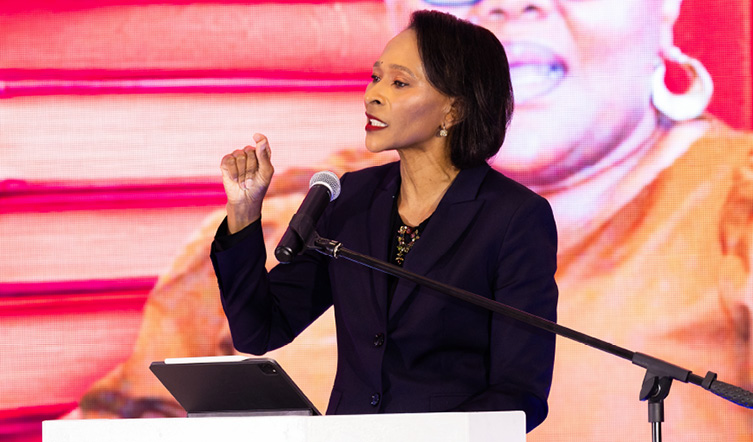
As artificial intelligence reshapes work, the defining leadership challenge is no longer simply how to equip people with new skills. It is how to develop the adaptability, judgement and human agency required to thrive when the nature of work itself keeps changing, writes Unathi Mtya.
A recent keynote I delivered at a summit on the future of education and skills development prompted me to reflect on a question that reaches well beyond schools, universities and training institutions. It is a question for every leader responsible for people, performance and organisational resilience:
If artificial intelligence can increasingly access knowledge, generate content, analyse information and perform sophisticated cognitive tasks, what should education ultimately prepare human beings to do?
The immediate response is often to focus on the skills required for an AI-enabled economy: digital fluency, data literacy, technological competence and the ability to work effectively with AI tools.
These capabilities matter. They are increasingly essential. But they address only part of the challenge facing education systems, employers and leaders.
For leaders, this distinction matters because the temptation is often to respond to technological disruption with a training catalogue. Yet the deeper requirement is cultural and strategic: to build organisations and learning systems that help people keep developing as the environment around them shifts. AI is not simply changing the skills we need. It is changing the context in which those skills will have value.
For generations, education operated around a relatively predictable relationship between learning and work. People acquired knowledge and qualifications, entered a profession, accumulated experience and developed a career. The assumption was that what we learned would retain value for a reasonable period. That assumption is now under sustained pressure.
From preparing for work to preparing for change
Technology is accelerating the pace at which work evolves. Skills have shorter lifespans; careers are becoming less linear and generative AI is beginning to reshape not only routine activities but increasingly sophisticated cognitive work. We therefore need to rethink education as preparation not simply for work, but for change.
This is where the principle of learn, unlearn and relearn becomes important. Learning is acquiring new knowledge and capability. Unlearning is recognising when established assumptions, methods or expertise are no longer sufficient. Relearning is building new capability for a changed context.
Unlearning may be the most difficult of the three. It requires humility from individuals and courage from institutions. It asks people to release ways of working that once made them successful, and it asks leaders to signal that changing one’s mind is not weakness but evidence of growth.
This is no longer lifelong learning as a worthy aspiration. It is becoming a core leadership and workforce capability. The question is no longer simply whether people have the right skills today. It is whether they have the capacity to continue developing the right capabilities as circumstances change.
The World Economic Forum’s Future of Jobs Report 2025 reinforces this shift, with employers expecting a significant share of workers’ core skills to change by 2030 and ranking analytical thinking, resilience, flexibility, agility and leadership among the capabilities needed for future work.
The future may belong less to those who know the most and more to those who can adapt intelligently when what they know is no longer enough. When knowledge becomes abundant, human judgement matters more. If machines can increasingly generate and synthesize information instantly, possessing information is no longer a differentiator. This does not make knowledge irrelevant; it simply makes judgement more important.
Human skills that AI cannot easily replace—often described as ‘soft skills’—include critical thinking, creativity, systems thinking, emotional intelligence, curiosity, collaboration and ethical judgement. Referring to these as soft skills underplays their importance.
They are capabilities for navigating complexity, and complexity is precisely what AI is likely to intensify.
A machine may generate an answer, but human beings remain responsible for determining whether the answer is appropriate, ethical and consequential. This is why education must move beyond transferring knowledge towards developing the capacity to interpret, question, create, judge and act.
In practical terms, this means classrooms, universities and workplace learning programmes should place greater emphasis on problem framing, collaborative inquiry, ethical reasoning and the confidence to work with incomplete information. These are the conditions in which judgement is formed.
UNESCO’s recent work on AI and education similarly emphasises human-centred, ethical and equitable approaches, with particular attention to human agency, critical thinking, governance and the role of educators in shaping meaningful learning.
The leadership challenge is human
The implications extend directly into leadership and, ultimately, into the future of work.
Much of the AI conversation remains focused on technology: platforms, data, algorithms, infrastructure, cybersecurity and investment. These foundations are necessary, but they do not determine whether transformation succeeds. People do.
AI can create excitement and possibility, but it can also create uncertainty around competence, relevance, identity, authority and control. An experienced professional may question the value of expertise accumulated over decades. A leader may be expected to make decisions about technologies whose implications are still evolving. An organisation may have an ambitious AI strategy while its people remain uncertain about what that strategy means for them.
My Master’s research at INSEAD, which examined the leadership practice of financial services executives in the era of AI through a systems psychodynamics lens, reinforced this dimension of the challenge. It highlighted the psychological dynamics accompanying AI adoption—including anxiety, resistance, uncertainty and changing perceptions of human agency–and identified leadership hesitation as one potential barrier to scaling AI responsibly. AI transformation is therefore not simply a technology challenge; it is a leadership challenge.
Microsoft’s 2025 Work Trend Index points in a similar direction, describing the emergence of organisations built around human-AI collaboration and arguing that leaders need new operating models as intelligence becomes more available on demand.
Leaders need to create clarity without pretending to have certainty. They need to enable experimentation while maintaining discipline. And they need to create environments in which people can adapt without feeling that adaptation means losing their relevance, identity or dignity.
This requires communication that is honest about disruption while also credible about opportunity. Employees are unlikely to engage meaningfully with AI if they experience it only as a threat or a mandate. They need to understand where the organisation is going, how work may change, what support will be provided and where human contribution will continue to matter.
It also means that leadership must increasingly encompass governance. As AI becomes embedded in decisions about people, performance, learning and work, questions of accountability and human agency cannot be delegated to the technology.
Who remains accountable for a decision influenced by AI? What boundaries should govern its use? Where should human judgement remain decisive? How do we ensure that efficiency does not come at the expense of fairness, inclusion or trust?These are not questions that technology can answer. They are leadership questions.
The future of work is a human capability question
The debate about AI and employment often focuses on whether machines will replace jobs. A more useful leadership question is how the composition of work will change as machines perform more of the tasks within jobs.
Some activities will be automated and others will be augmented. New roles will emerge and existing roles will be redesigned. This means employability cannot depend solely on mastering a fixed set of technical competencies. It increasingly depends on the ability to adapt as the nature of work changes.
Education and business therefore need to stop operating as though they are separate parts of the talent system. Education cannot simply prepare people and hand them over to employers. Businesses cannot simply consume skills produced elsewhere and expect those skills to remain relevant indefinitely. This relationship needs to become more dynamic.
This also means that senior leaders should treat learning as part of organisational design rather than as a remedial intervention. Capability-building needs to be connected to strategy, workforce planning, technology adoption and performance management. Otherwise, reskilling risks becoming reactive, fragmented and too slow for the pace of change.
Organisations will increasingly need to become places where learning is embedded in work, reskilling is continuous and technological transformation is accompanied by capability transformation.
This is where the education conversation meets the future of work. How we educate people will increasingly influence how organisations design work, and how organisations redesign work will increasingly influence what people need to learn. For leaders, this is not a side issue. It is central to strategy, productivity and organisational sustainability.
Human potential is the point
What should humans do differently because AI can do these things?That question takes us beyond technology and into the purpose of education, the nature of leadership and the future of work. The purpose of education in the age of AI should not be to make humans more machine-like or to reduce learning to a race against automation. It should be to make human beings more capable of adapting, questioning, creating, judging and leading in a world of accelerating change.
We should educate for adaptability, not simply employability. We should develop judgement alongside knowledge, and human agency alongside technological capability.
This is especially important in societies where access to quality education and digital opportunity remains uneven. If AI is deployed without deliberate attention to inclusion, it may widen existing divides. If it is accompanied by intentional investment in human capability, it can help broaden participation in new forms of work and learning.
AI should amplify human potential. Education should cultivate it. Leadership should protect it.
The challenge before education leaders, business leaders and policymakers is therefore not simply to predict which jobs AI will create or replace. It is to develop the human capability, leadership and governance necessary for people to remain adaptable, purposeful and accountable as work changes.
If we get that right, AI becomes more than a productivity technology. It becomes an instrument for expanding human potential. That, ultimately, is what educating for an uncertain future should mean.
Unathi Mtya is a Technology & Digital Transformation Executive, Chairperson: UNISA SBL Advisory Board, Board Member @ Penplusbytes & Leadership Magazine Editorial Board Member. She writes in her personal capacity.
Selected sources
UNESCO. AI and education: guidance for policy-makers. https://www.unesco.org/en/articles/ai-and-education-guidance-policy-makers
Microsoft. 2025 Work Trend Index: The Year the Frontier Firm Is Born. https://www.microsoft.com/en-us/worklab/work-trend-index/2025-the-year-the-frontier-firm-is-born
World Economic Forum. The Future of Jobs Report 2025: Skills Outlook. https://www.weforum.org/publications/the-future-of-jobs-report-2025/in-full/3-skills-outlook/