

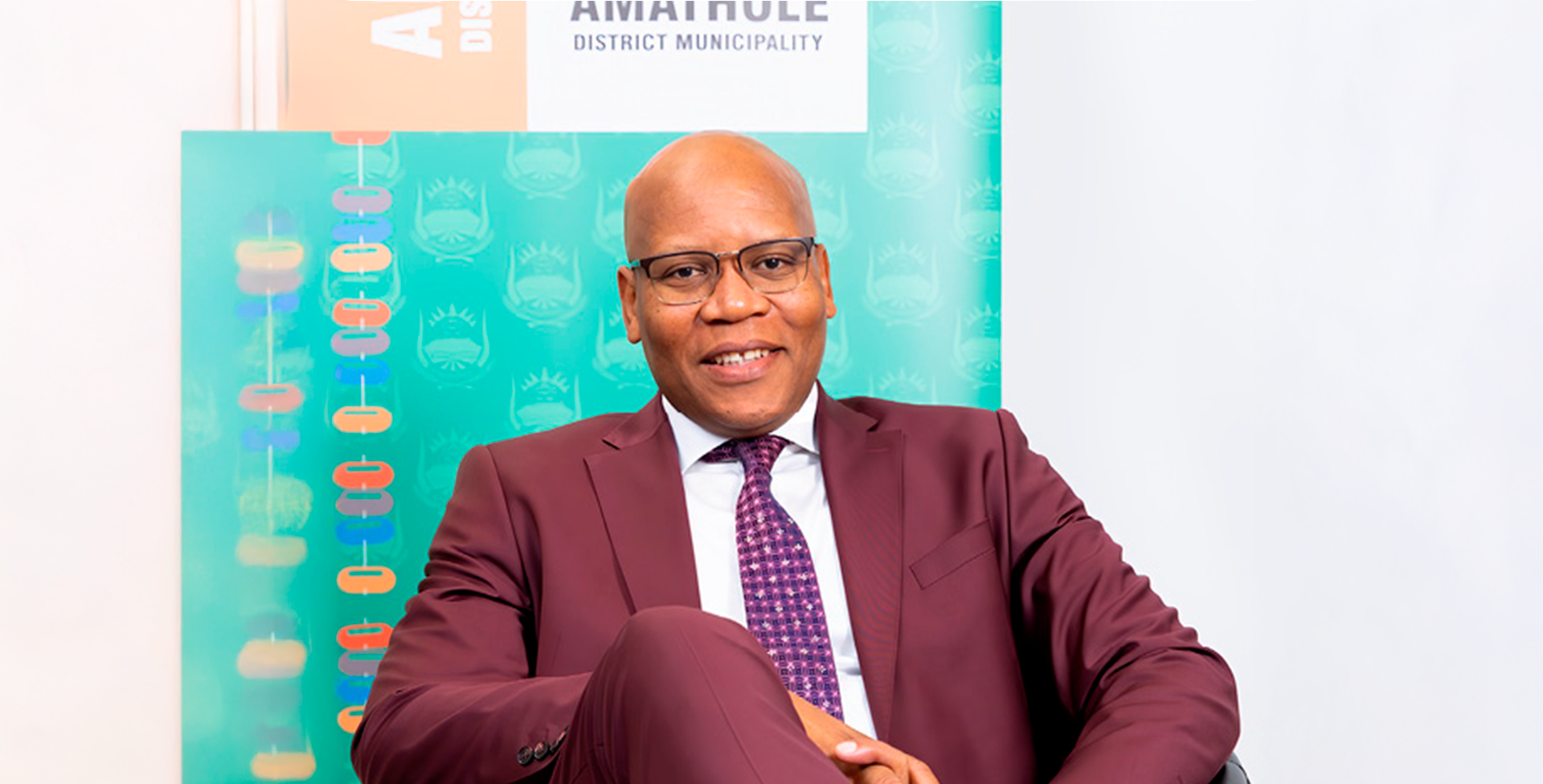
After years of financial instability and service delivery challenges, Amathole District Municipality Municipal Manager Dr Bhekisisa Mthembu believes the institution is entering a new chapter defined by accountability, infrastructure investment and renewed public confidence.
Speaking to Leadership, Dr Mthembu reflects on the municipality’s financial turnaround, the drive to strengthen water security, and the long-term vision for building a more capable and resilient district.
For the Amathole District Municipality, the journey from repeated audit disclaimers to consecutive qualified audit opinions represents more than improved financial reporting. It reflects a broader transformation in governance, institutional culture and service delivery, with disciplined financial management now underpinning every aspect of the municipality’s recovery.
The municipality recently secured its second consecutive qualified audit opinion after six years of disclaimers, a milestone Dr Mthembu describes as evidence of significant operational and cultural change.
”This milestone is far more than a technical accounting achievement. It represents a profound turnaround in institutional culture and discipline,” says Dr Mthembu.
According to Dr Mthembu, the progress has been driven by the consistent implementation of the municipality’s Amended Mandatory Financial Recovery Plan, strengthened internal controls and a renewed focus on accountability.
The municipality has stabilised employee costs at approximately 37% of operating expenditure, maintained full expenditure on conditional grants, built financial reserves exceeding R100 million and reduced fleet-related expenditure. At the same time, improved record-keeping and consequence management have strengthened governance while restoring confidence in the municipality’s financial systems.
”The Auditor-General’s confidence in our Audit Recovery Roadmap signals restored credibility. Disciplined financial management is the bedrock of sustainable service delivery, restoring public trust and enabling us to invest meaningfully in water infrastructure that restores dignity to our communities.”
While celebrating the progress, Dr Mthembu acknowledges that important work remains. Legacy irregular expenditure, historical debt and revenue collection continue to require focused attention as the municipality prepares a fully funded R2.809 billion Medium-Term Revenue and Expenditure Framework budget for the 2026/27 financial year.
Water security remains the priority
For a largely rural district such as Amathole, access to reliable water infrastructure remains one of the municipality’s most important responsibilities.
”Water is the lifeblood of our district,” says Dr Mthembu.
During the 2025/26 financial year, several major infrastructure projects either reached completion or recorded significant progress. Among the highlights was the official handover of the R27 million Ngqamakhwe Regional Water Supply Scheme Phase 3, which now delivers clean water to seven villages through new reservoirs, upgraded boreholes, break-pressure tanks and expanded reticulation networks.
Progress also continued on a number of strategic projects, including the Ngqamakwe Bulk Phase 5A scheme, the Bende Water Supply Project, Dontsa, Dwesa, Kei Bridge Water Treatment Works, the Idutywa bulk sewer upgrades and the Xhora Water Supply Project. Emergency refurbishment work was also completed using internally generated funding where required.
Recognising the need to preserve existing infrastructure, the municipality approved more than 20% of its Municipal Infrastructure Grant allocation for maintenance while reallocating funding to support recovery efforts following the severe floods experienced during June 2025.
Infrastructure alone, however, cannot guarantee long-term water security.
To combat vandalism and theft, the municipality introduced its ”ZINGCE – Take Pride” campaign, encouraging communities to play an active role in protecting public assets.
”Infrastructure only delivers lasting value when communities protect it,” Dr Mthembu says.
Alongside infrastructure investment, the municipality has continued promoting water conservation while strengthening Blue Drop and Green Drop compliance, expanding VIP sanitation programmes and ensuring water use licence compliance.
”Sustainable water security requires both engineering solutions and a shift in collective responsibility.”
Strengthening governance beyond the balance sheet
While financial recovery and infrastructure development remain central priorities, the municipality has also focused on strengthening governance and institutional capacity.
According to Dr Mthembu, long-term resilience depends on building an organisation that is both accountable and capable of delivering consistently for its communities.
Quarterly performance monitoring, policy reviews, disaster management planning, spatial planning and economic development initiatives have all formed part of this broader institutional strengthening programme.
Among the key achievements has been the approval of the municipality’s Reviewed Employment Equity Plan for 2025 – 2030, continued progress towards permanent office accommodation in Qumrha, updates to service level agreements and participation in the United Nations Making Cities Resilient 2030 initiative.
Municipal Health Services has maintained compliance monitoring across the district, while employee wellness initiatives have continued to record strong participation. Partnerships established following severe hailstorms and flooding have also strengthened the municipality’s disaster response capability.
Economic development remains another important pillar of the municipality’s long-term strategy.
The municipality has advanced five economic development programmes, implemented the Cathcart Small Town Revitalisation Strategy, strengthened its partnership with the Construction Education and Training Authority through the ADM – CETA skills initiative, and continued supporting its development agency, ASPIRE, which recently achieved an unqualified audit opinion.
Work has also continued across spatial planning, land reform, human settlements and environmental sustainability, including the submission of the Amathole Biosphere Reserve dossier.
Dr Mthembu says constructive oversight has played an important role throughout the municipality’s recovery.
Bodies including the Municipal Public Accounts Committee, the Audit Committee, COGTA, SCOPA, SCOAG and the Provincial Legislature have continued providing oversight while encouraging faster implementation of consequence management and reduced dependence on consultants.
”These efforts build a more capable, responsive institution that serves communities with integrity.”
Preparing for the next chapter
Although significant progress has been made, Dr Mthembu is realistic about the challenges that remain as Amathole prepares for a new Council term.
Revenue collection, legacy irregular expenditure and historical debt continue to place pressure on municipal finances, while vandalism, drought and increasingly severe weather events require ongoing investment and resilience planning.
The municipality’s priorities over the coming years are therefore focused on consolidating the gains already achieved while accelerating service delivery.
”We want to consolidate our financial progress towards an unqualified, and ultimately a clean, audit opinion,” says Dr Mthembu. ”At the same time, we will accelerate water and sanitation delivery, strengthen institutional capacity in ICT and performance management, and build even stronger partnerships across government and with our communities.”
The municipality also plans to intensify credit control measures, continue cleansing its indigent register and strengthen consequence management, while expanding the ”ZINGCE – Take Pride” campaign and public awareness initiatives around responsible water use.
Turning recovery into resilience
Reflecting on the municipality’s progress, Dr Mthembu believes the past few years demonstrate what can be achieved through disciplined leadership and collective commitment.
”The path from disclaimer to qualified opinion, and the progressive delivery of water infrastructure that restores dignity, proves that disciplined, collective effort yields results.”
Dr Mthembu credits municipal employees, communities, local municipalities and provincial and national government partners for helping drive the turnaround.
Looking ahead, the vision is clear.
”The people of Amathole can expect a municipality that is increasingly responsive, accountable and focused on efficient, excellent and sustainable service delivery. Together, we are turning the corner – moving from recovery to resilience and from challenges to shared prosperity.”
For Dr Mthembu, the municipality’s transformation is not yet complete, but the foundations have been laid. With improved financial governance, continued investment in critical infrastructure and a renewed commitment to accountability, Amathole District Municipality is positioning itself to deliver more effectively for its communities while building confidence in local government.
”The best chapters of Amathole’s story are still being written,” concludes Dr Mthembu.