

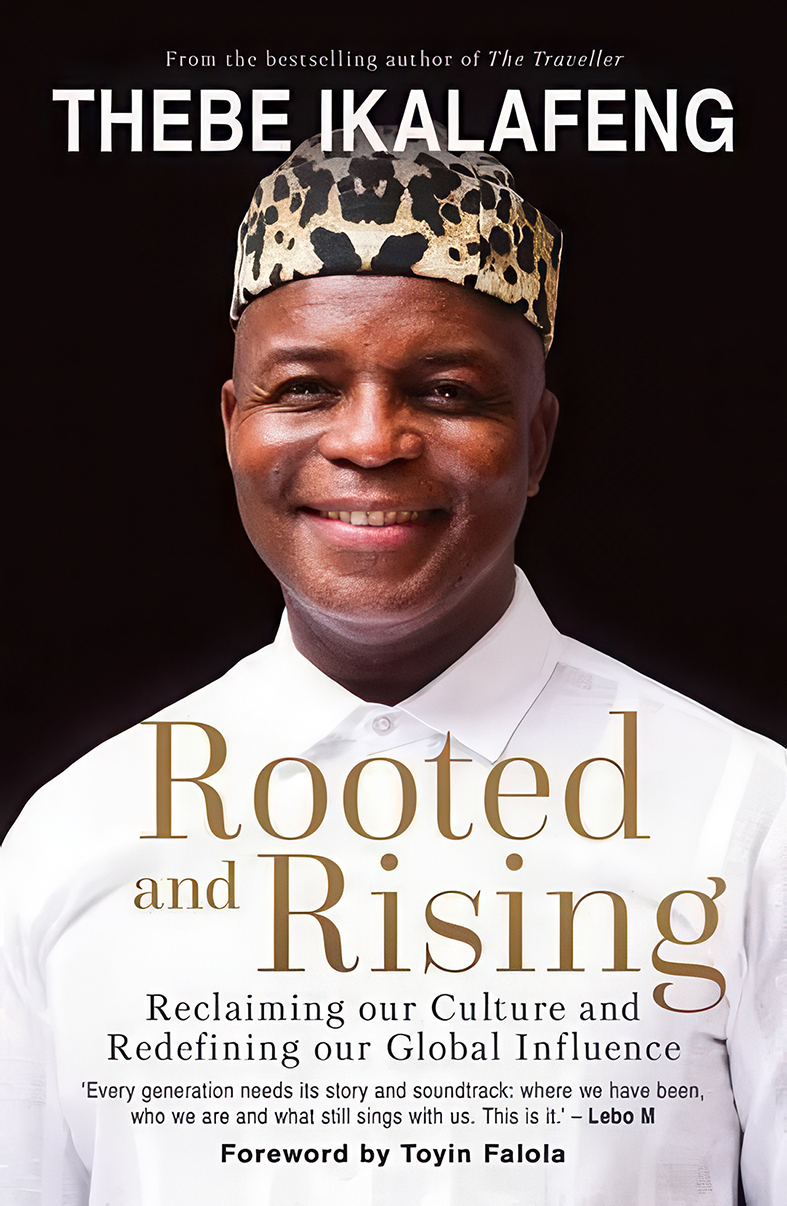
Leadership is delighted to publish an excerpt from Thebe Ikalafeng’s book, Rooted and Rising: Reclaiming Our Culture and Redefining Our Global Influence
I never thought of myself as a villager. I had never even thought of my home city, Kimberley, in those terms. It was, after all, a city of many firsts: the first city in the Southern Hemisphere to have electric street lighting in 1882—before London; the first stock exchange in South Africa; the first to adopt an automatic telephone exchange; the country’s first flying school in 1913; and the epicentre of the diamond rush that produced the Cullinan I, the 530.2-carat Star of Africa that still sits in the British royal family’s sceptre.
The only time I ever saw a cow or sheep roaming the streets was when it was on a leash, each leg held by a local man as the animal was rushed to meet its Maker, while pots were readied for mosebetsi—the Setswana word we use for any major communal gathering, whether a funeral or a wedding.
How could that be a village?
And yet, after reading Nigerian writer Feyi Olubodun’s book, ‘The Villager: How Africans Consume Brands’, I realised that I am, without question, a villager.
All Africans are villagers.
Feyi’s argument is simple but profound: at our core, Africans—even those who are urbanised, educated and globally exposed—remain deeply shaped by community, tradition, and collective identity. Decisions are rarely made in isolation. They are influenced by family, faith, memory and shared experience. That insight explains far more than how we consume brands. It helps explain our unease with ideas that place the individual too squarely at the centre —including the notion of “personal branding”.
That discomfort is not accidental. It is cultural.
In a special issue on personal branding, the editors of Harvard Business Review observed that the concept is often viewed as “smacking of superficial appearances and tasteless self-promotion”. In an African context, that resistance runs even deeper. We were taught to be humble, to let our work speak, to respect elders and hierarchy, and to remember that we exist because others do.
Anything but African.
More than a decade ago, after writing my first book on personal branding, I asked a respected older head-hunter friend to endorse it. He declined. He told me he did not believe in personal branding because it amounted to self-promotion. I was disappointed, but I understood. He came from a generation that believed you worked hard, kept your head down, and waited your turn—if recognition came at all.
His response affirmed my own earlier hesitation. Years before, when I wrote ‘Conquer the Job Market’ in 1996, I deliberately avoided the term “personal branding”, even though the book was essentially about standing out in a crowded marketplace. At the time, I framed it as personal marketing. I knew then—as I know now—that language matters, especially when culture is involved.
But the world has changed.
The American management thinker Tom Peters captured this shift when he wrote that in the age of the individual, “you have to be your own brand—distinct or extinct”. His point was not about ego, but agency. In a hyper-competitive world, professional success often depends on whether others understand the value you bring.
That reality sits uneasily with African sensibilities. But it cannot be ignored.
This tension—between who we are and what the modern world demands of us—sits at the heart of African leadership today.
The scholar W.E.B. Du Bois described it as “double consciousness”: the experience of living with two identities, two value systems, two ways of seeing oneself. While Du Bois was writing about African Americans navigating a racially stratified society, the idea resonates powerfully with Africans operating in Western-designed institutions.
To compete and lead globally, many Africans find themselves constantly negotiating between inherited cultures and imposed systems. As Ngugi wa Thiong’o once observed, we often end up seeing ourselves through European eyes, relinquishing the responsibility to define ourselves on our own terms.
Yet African thinkers have long insisted that this need not be a zero-sum choice. The Malian historian and ethnologist Amadou Hampâté Bâ devoted his life’s work to showing that Africa’s oral wisdom and traditional values could coexist with modernity—and enrich it.
This negotiation becomes visible in the everyday rituals of leadership: how we dress, how we speak, how we introduce ourselves. Dress codes that read “black tie or traditional” are not trivial; they are entry points into identity. A South African friend once joked to me, “Traditional just means I must wear my Nelson Mandela shirt.”
My own journeys across Africa and beyond have given me the confidence to move comfortably between these worlds—to wear a tailored Western suit one day and traditional imvunulo at the Umhlanga Reed Dance the next, without feeling any conflict in who I am.
One person who embodies this ease is Dr Sipho Sithole—a scholar, executive, cultural entrepreneur, and custodian of tradition, now based in the United States. Whether moving through boardrooms, launching Afro-soul artists, teaching African languages abroad or wearing his signature umqhele, Sipho shows that leadership does not require cultural erasure. It requires cultural fluency.
Ours is an era that increasingly centres the individual.
When Time magazine named “You” as its Person of the Year in 2006, it captured a defining shift. Ordinary people were no longer just participants in institutions; they were becoming creators, curators and narrators of their own stories. That shift has only accelerated. Today, whether you aspire to lead a village, a corporation or a country, visibility is no longer optional.
Gone are the days when one could wear a uniform for decades, retire quietly with a watch and a bicycle, and disappear into the background. Leadership today requires standing out—not for spectacle, but for substance.
Across Africa and its diaspora, those who have left lasting impressions are remembered not for conformity, but for clarity. From Mansa Musa to Nelson Mandela, from Fela Kuti to Wangari Maathai, from Chimamanda Ngozi Adichie to Trevor Noah, they are known because they stood for something—often against prevailing norms.
But standing out does not have to mean standing alone. In Africa, it often means lifting your village with you.
In our cultures, the most enduring symbol of leadership is not the spotlight, but the tree.
A tree represents life, continuity and growth. Elders gather beneath it to deliberate. Communities find shade under it. In many African languages, the word for shade—serithi, isithunzi, umthunzi—also means dignity. When a great person dies, we say a big tree has fallen.
In Galeshewe, the township where I grew up, a large lemon tree in my grandparents’ yard played that role. It was where my grandmother washed clothes, cooled watermelons in the heat, and told stories that quietly shaped our sense of the world. That tree offered more than fruit. It offered presence.
Leadership, in this sense, is not about casting a shadow over others, but offering shade. It is about roots that run deep enough to withstand the wind.
Rooted and Rising reframes reputation, influence, and leadership through this African lens. It moves beyond Western ideas of personal branding as self-promotion and centres instead on self-affirmation, cultural alignment, and communal responsibility.
At a time when Africa’s population is young, growing, and searching for opportunity, the competition for visibility and voice is intense. The question is not whether Africans should stand out, but how—without losing ourselves in the process.
This is an invitation to lead from who we are, not who we are told to be. To acknowledge the double consciousness we navigate, while grounding ourselves in the wisdom that has sustained us for generations.
There has never been a more urgent time to reclaim our stories, our symbols and our sense of self. There has never been a better moment to return home—to Africa—rooted, rising, and unapologetically ourselves.
Shall we?
Thebe Ikalafeng is the author of ‘Rooted and Rising: Reclaiming Our Culture and Redefining Our Global Influence’.